Dunsyre: Wild Hawthorn Press, 1978
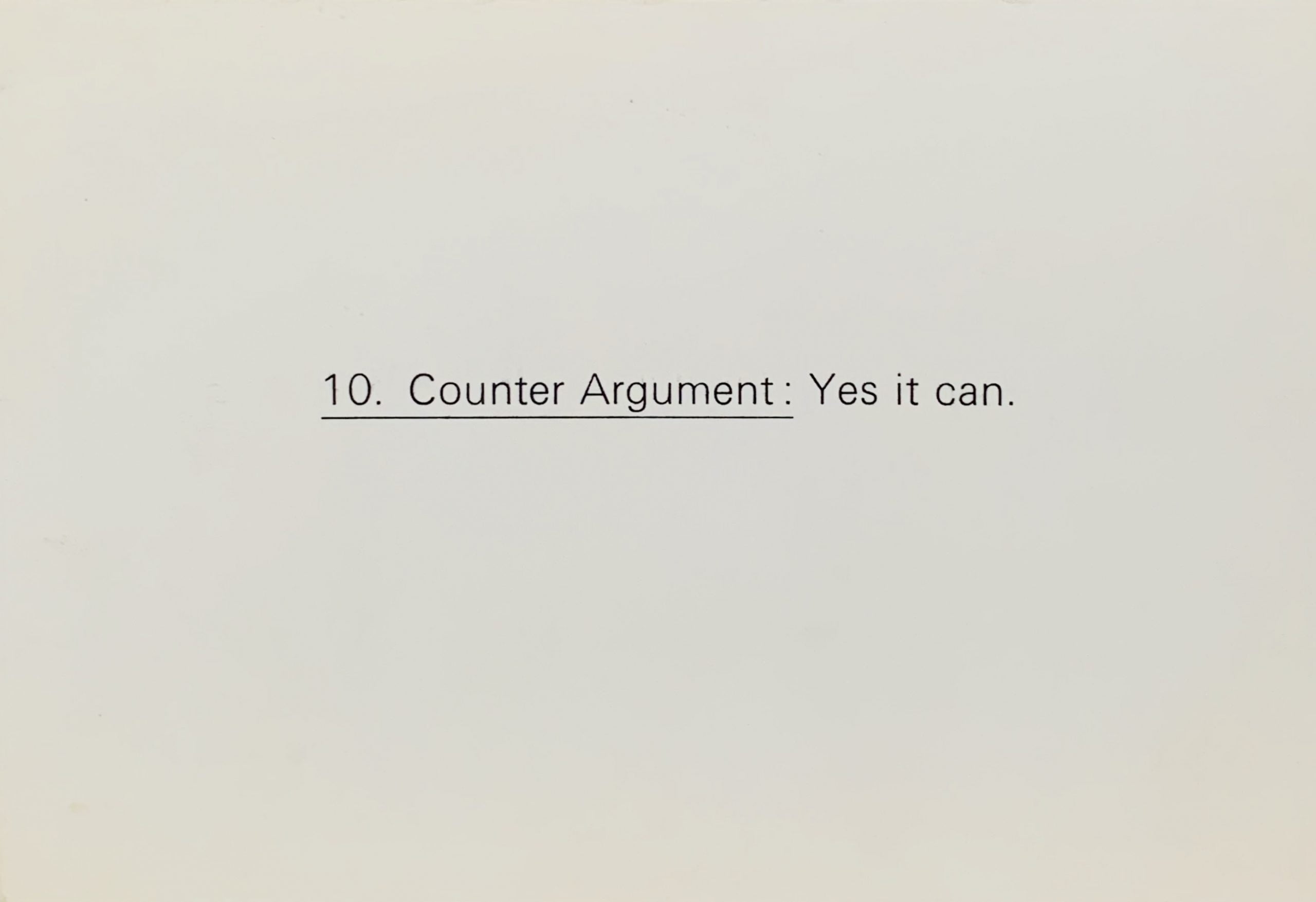
9.6 x 13.8cm, 2pp. Black on white card with an entirely typographic design on the front -
10. Counter Argument: yes it can.
On the reverse Finlay notes a report: "A project for the Expansion of the Administrative Centre of Lower Austria in Vienna." by Hans Buchwald, Wolfgang Felix Knoll and Jurgen Brenner. Stuttgart 1977." Obviously the text on the front comes from or relates to that report but we cannot find any reference to the contents or context. For now this car will remain a mystery other than being somewhat a dogmatic way of winning an argument..

...

Dunsyre: Wild Hawthorn Press, 1978
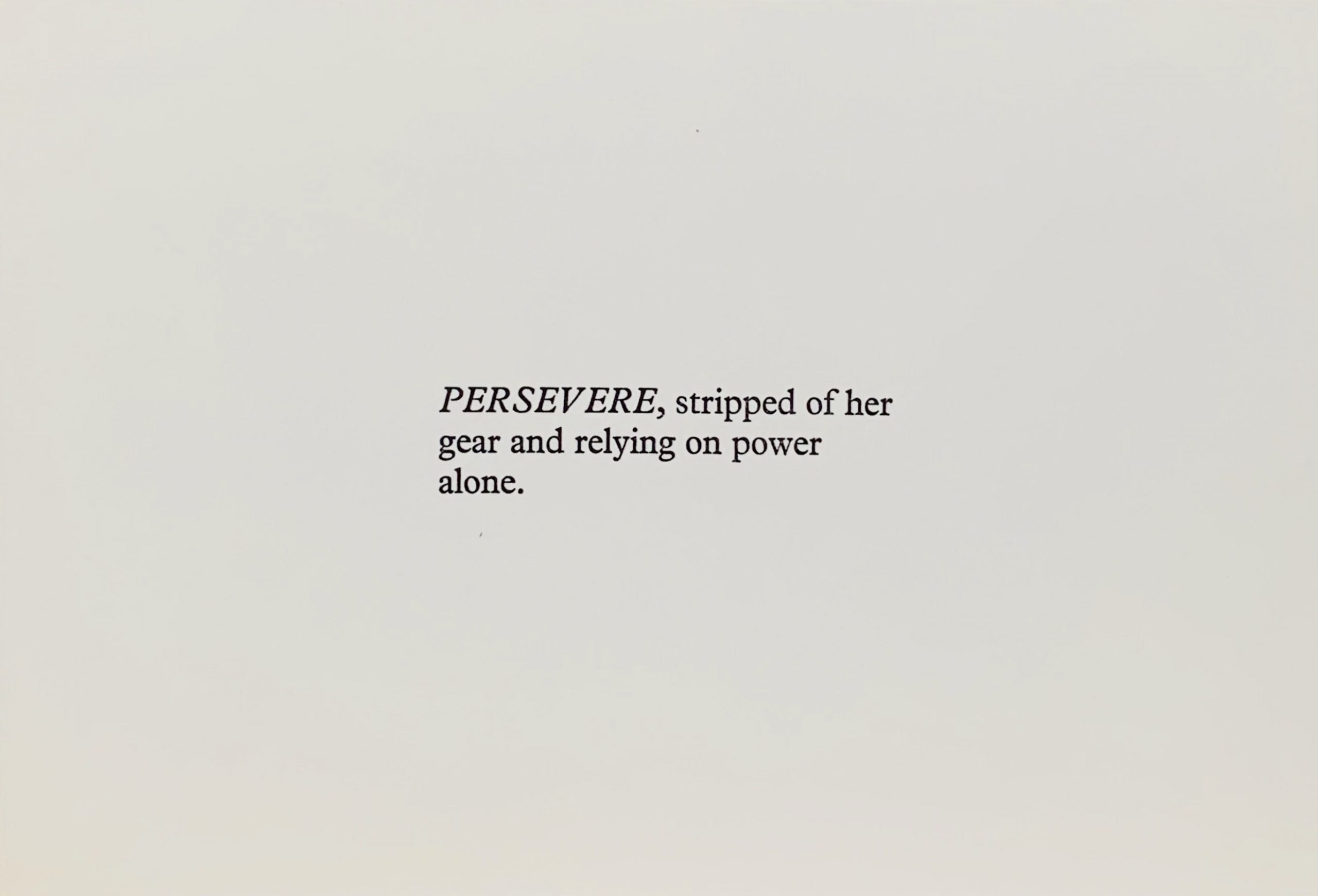
9.6 x 13.8cm, 2pp. Black on white card with a quotation from "A Handbook of Sailing Barges" which states that:
PERSEVERE, stripped of her gear and relying on power alone."
The sentence refers to a boat being unable to move mechanically - but also the alternative meaning that perseverance is relying on oneself.

...

Little Sparta: Wild Hawthorn Press, 1978
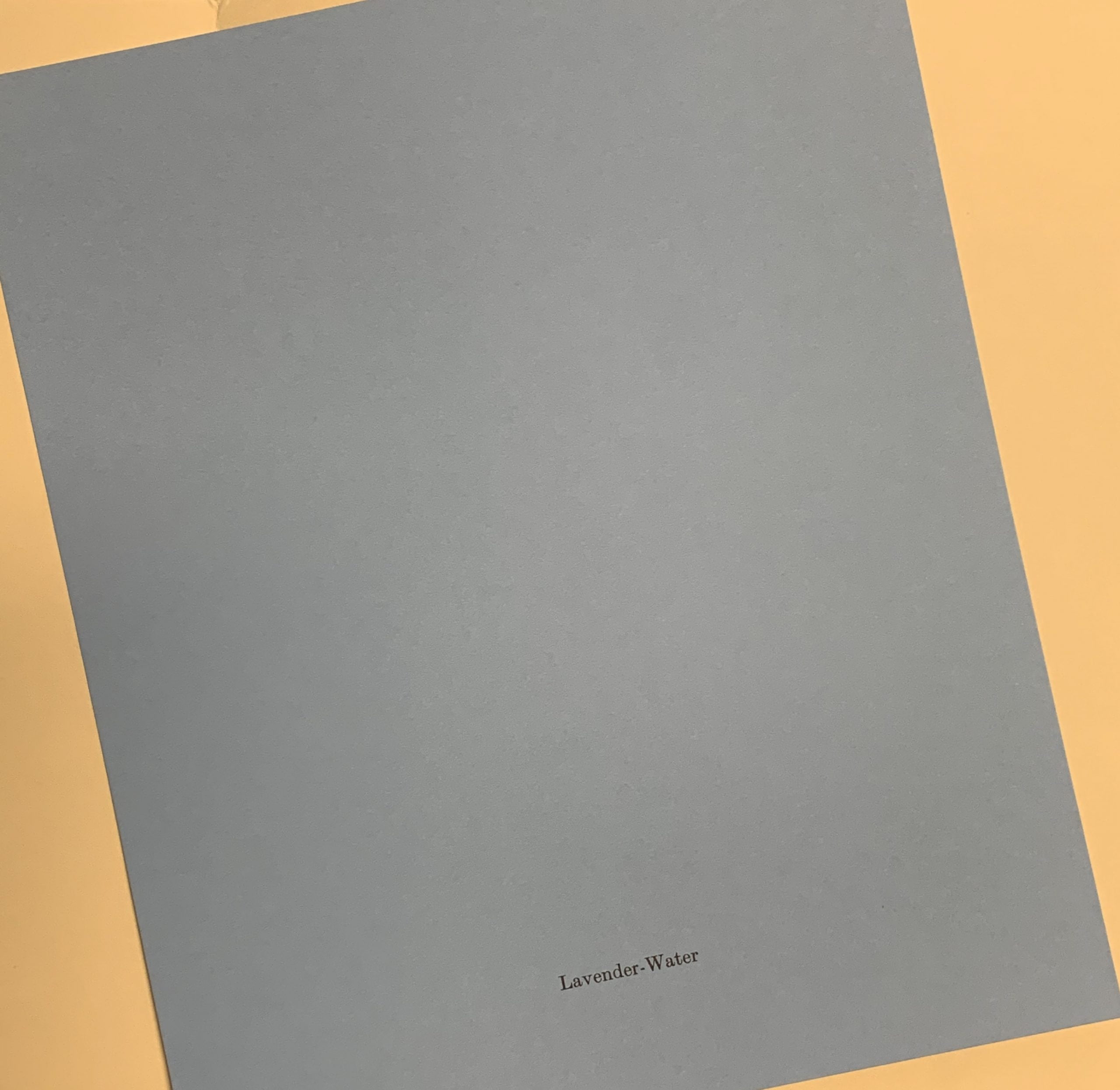
20 x 16.4cm, printed black on cream outer folder content of a single 20 x 16.4cm offset lithograph on light blue paper.
The folder has "BOIS D'AMOUR. ('LE TALISMAN')" printed at the top and the inner sheet has "Lavender Water" printed at the bottom. On the back of the folder there is also the mention that the work is "An "Homage to Sérusier."
Paul Sérusier was an abstract French painter (who was a pioneer of abstract art and an inspiration for the avant-garde Nabis movement who Finlay honours elsewhere in his works) painted a major work known as "Le Talisman" in 1888 that showed a bridge crossing into a wood. That painting is usually regarded as the first of the Nabis works. The French title of the work is "Paysage au Bois d'Amour" - hence the title of Finlay's work here.
The words Lavender Water found on the second sheet are not only associated with an over-sweet smelling perfume much beloved of old ladies but is also the colour of the water under the bridge in the Serusier painting.
This was the second of Finlay's "colour paper" works (a term we have coined to categorise these innovative works) after his earlier L'embarquement pour l'Ile de Cychere of 1975. VG+>

...

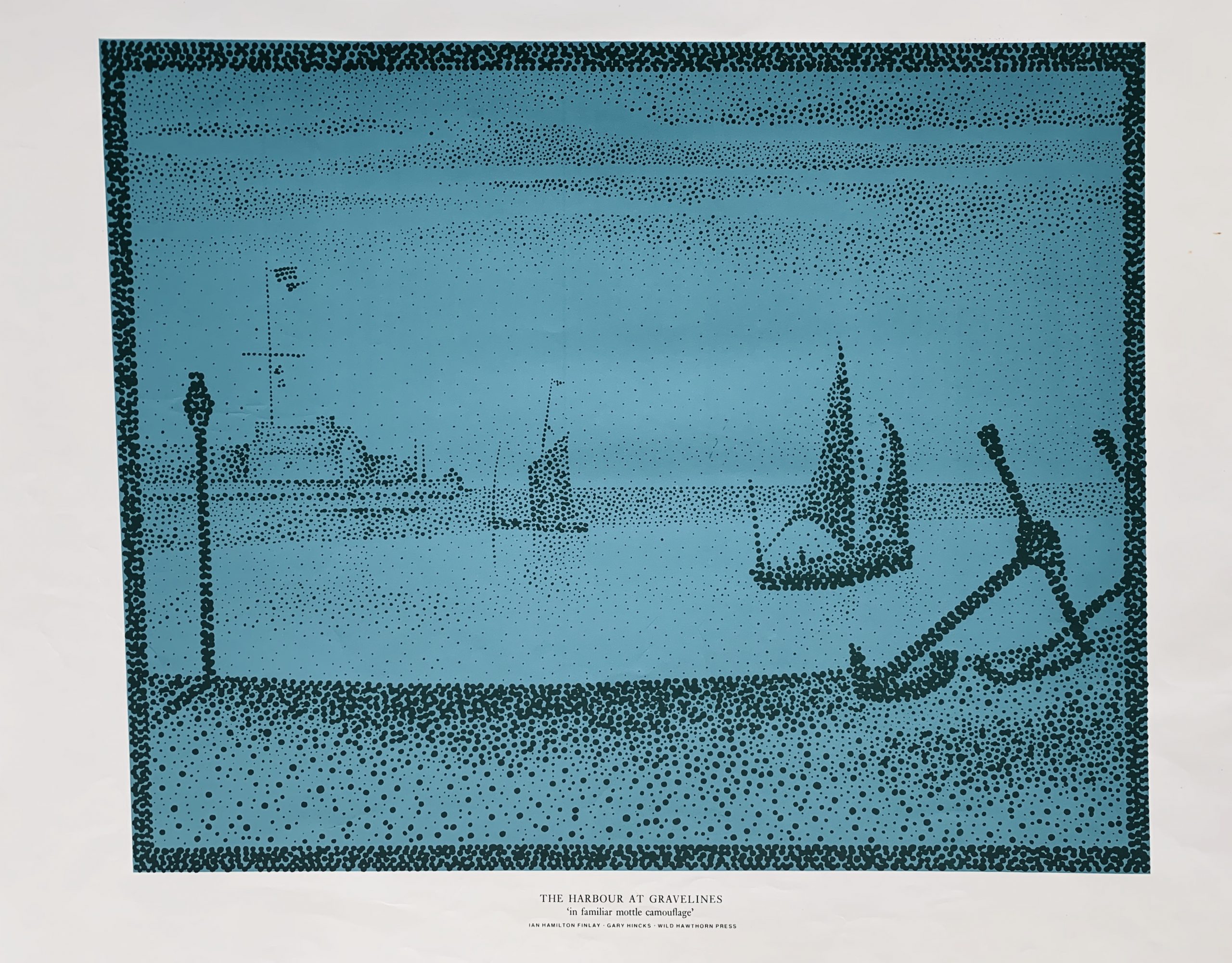
Little Sparta: Wild Hawthorn Press, n.d. (1978) 38 × 47.3cm, blue and black on white screen print showing a harbour at evening time by Gary Hincks in the style of pointillisme (perhaps even Seurat). The work is subtitled "in familiar mottle camouflage" - which is a humorous comment on the style and wartime attempts at disguising ships. VG condition.

...

Firenze: Zona, n.d. (1978)
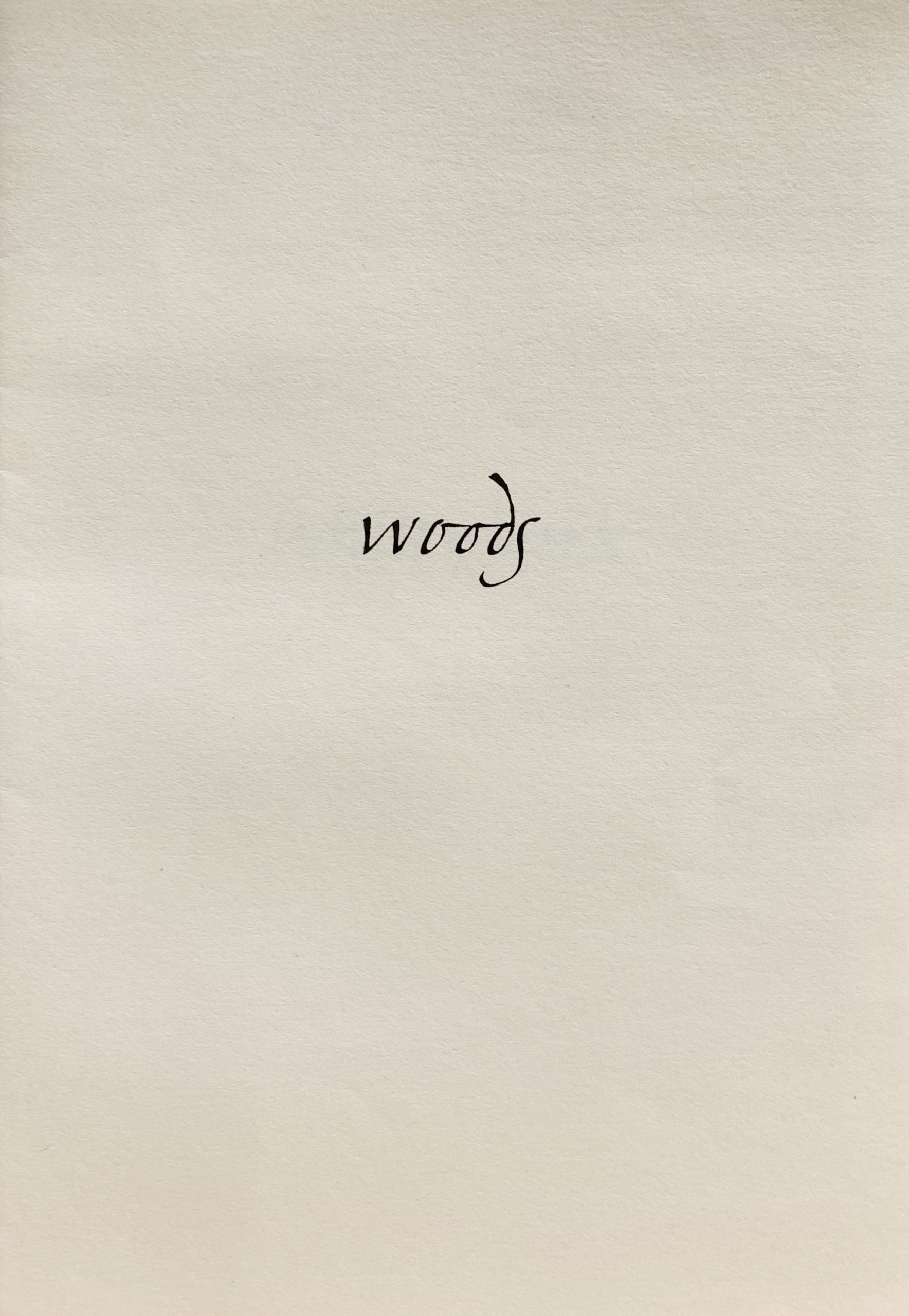
21 x 15cm, 4pp (self cover) no binding. The four sheets with calligraphy by Ron Costley read:
white & bark, black & light, bark & light, white & dark and black& white
The combinations of the words (with the basic structure taken from the last coupling "black and white") along with the title "Woods" create visual images of different woodland scenes (each, of course, will be personal to the reader but in the main bark and light may bring the outside of a Birch tree to mind for instance). Finlay uses this trick of word transposition often in works - the changes causes by minimal alterations to words and their syntax interests him greatly. He feels that small changes in letters or word-combination causes large changes to their meaning or their perceived meaning.
This was published by Maurizio Nannucci of Zona Archives, himself a concrete poet. VG+.

...

Dunsyre: Wild Hawthorn Press, 1978
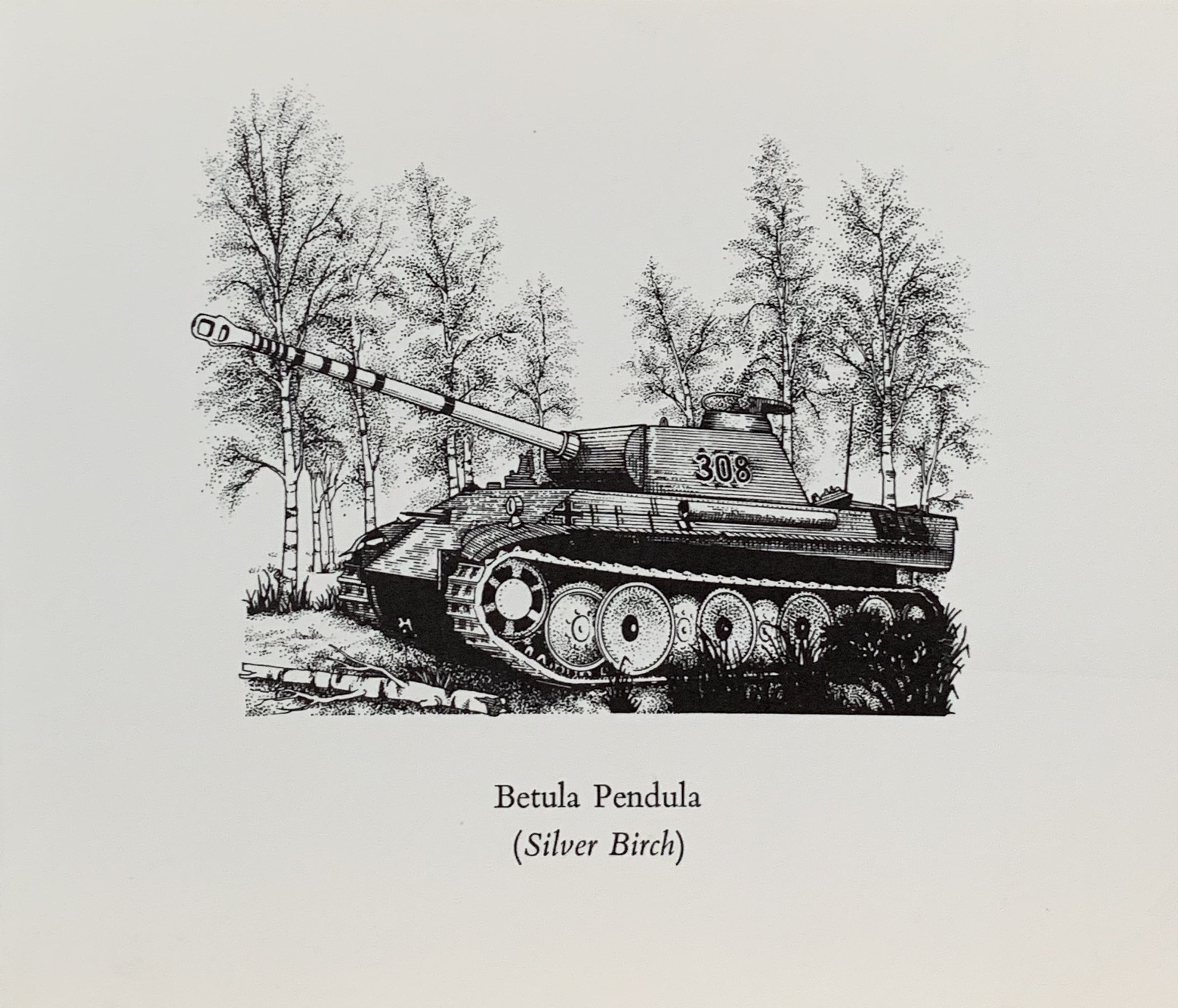
9.6 x 13.8cm, 2pp. Black on white card with a drawing of a German tank amongst silver birch trees by Gary Hincks.
Finlay has a number cards (and some prints) bearing images of the German Panzer force which is often regarded (if not entirely true) as the most effective of the land war weapons of the conflict. This tank pictured by Hincks is specifically a Tiger 308 of the schwere Panzer Abteilung 502 and was one of the heavy weapons to aid in the (failed) push to conquer Russia.
The Silver Birch is also a tree that is found from Scotland to the East - it does not stretch south in Europe except at much higher altitudes - thus may also be regarded as "invading" Russia.
In any case, the tank symbolises death for Finlay and when shown in beautiful landscapes is a real reminder of the painting "In Arcadia Ego" by Poussin which is meant to remind humans that they too will die someday. VG+.

...

Dunsyre: Wild Hawthorn Press, 1978
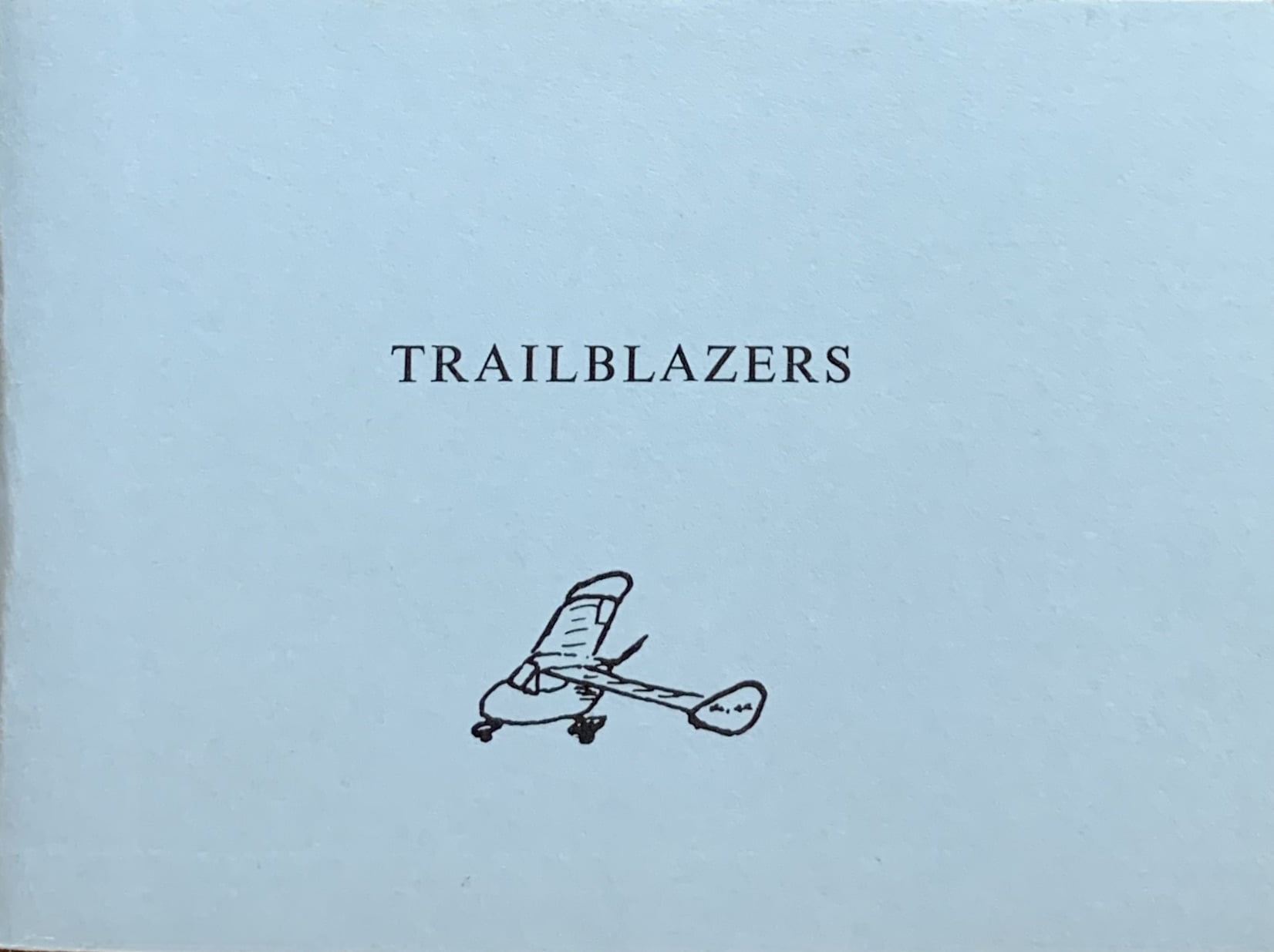
7.0 x 9.5cm, 28pp plus printed card covers. Drawings of early planes based on vintage models by C. Tissiman are joined with their model names ascribed to famous artists, poets and composers such as Warhol, Betjeman and Maxwell.
"Waco Yoc" is suggestde as being by Kust Schwitters presumably because of the latter's interest in sound poetry while "Fokker D" is given to Andy Warhol - possibly because of its mass production in German factories. But it is hard to know all of the associations of the names for Finlay - was Bücker Bestmann assigned to John Betjeman just because of the similarity in names (Betjeman comes from St Benjamin apparently)? However the book title "Trailblazers" suggests that Finlay is saying these artists are foremost and revolutionary - which given his enemy Hugh McDiarmid is included is a little surprising (although I guess Finlay had to accept McDiarmid's role in re-popularising Scottish poetry even if they were no longer friends although McDiarmid had been Finlay's best man at his first marriage). VG+ condition.

...

Dunsyre: Wild Hawthorn Press, 1978
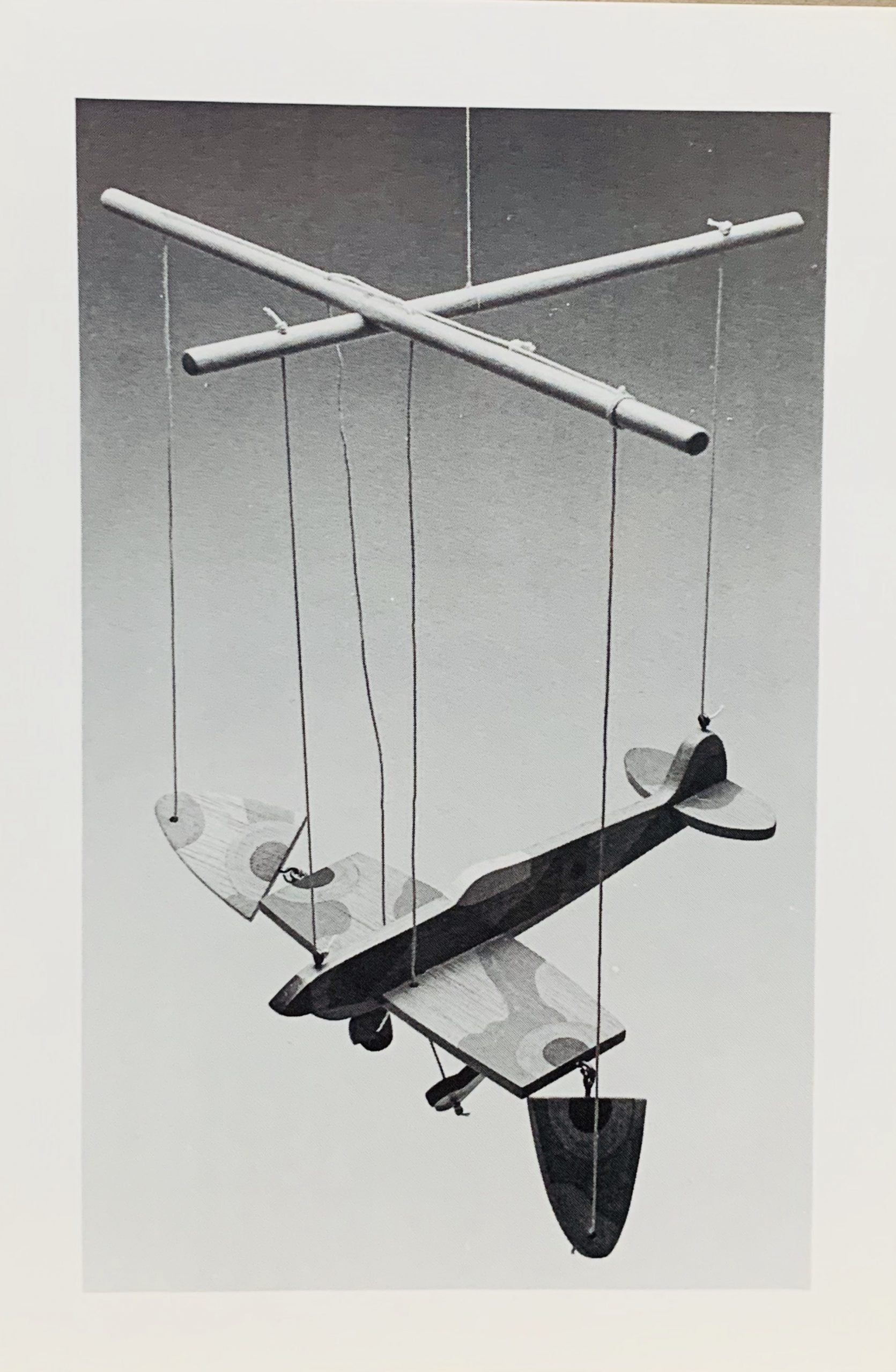
15 x 10.5cm, 2pp. Black on white card with a photograph by Dave Paterson of a toy military airplane made by Finlay which has been attached to a cross bar with string to create a marionette. The plane is painted in British camouflage and decals. The wings both are in two parts and one has been allowed to drop as if the plane has been damaged in a dogfight. This is a companion card to the previous one (Marionette 1) and presumably shows the after effect of encounter with an enemy. VG+.

...

Dunsyre: Wild Hawthorn Press, 1978
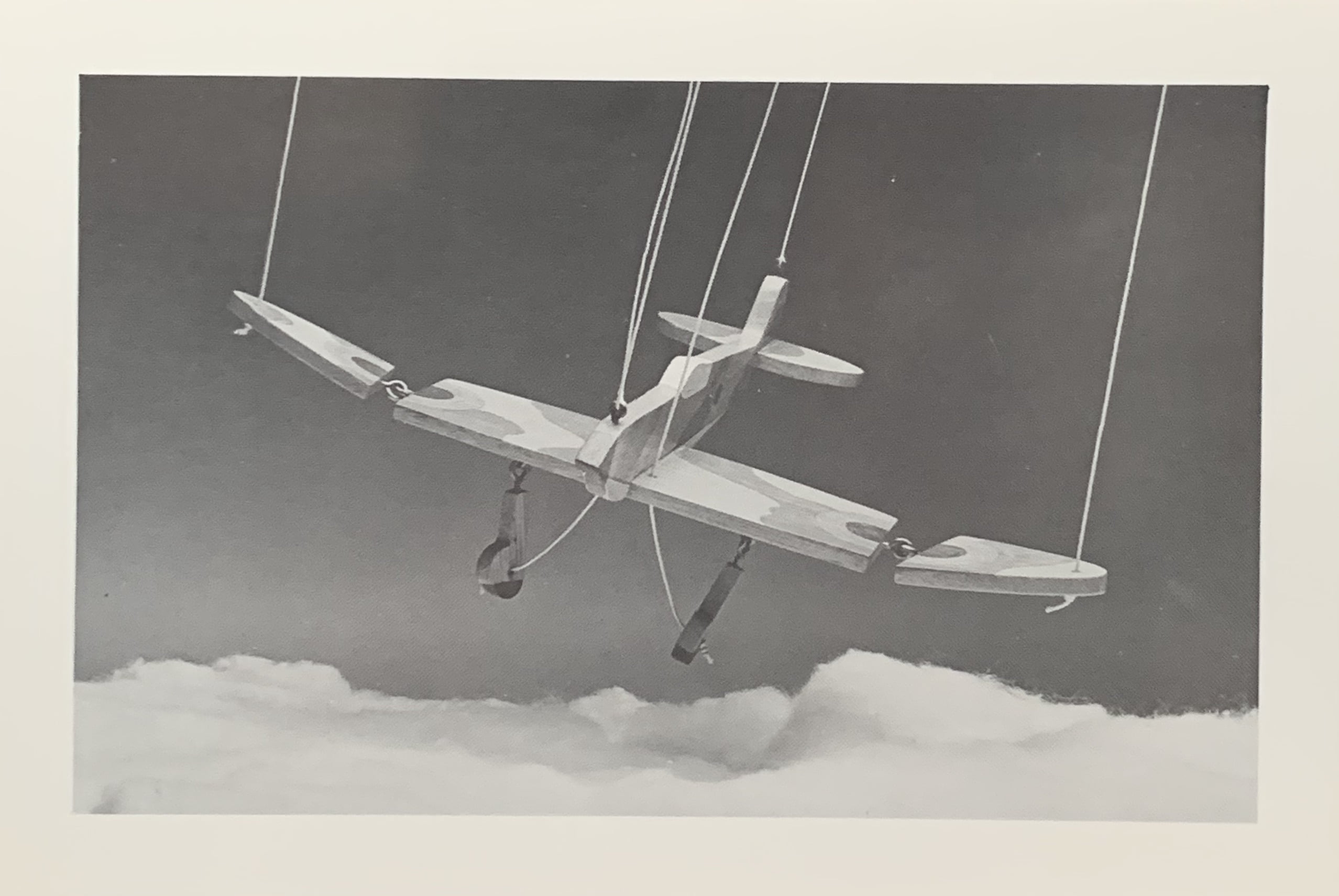
15 x 10.5cm, 2pp. Black on white card with a photograph by Dave Paterson of a toy military airplane made by Finlay which has been attached to a cross bar with string to create a marionette. The plane is painted in British camouflage and decals. The plane is flying amidst clouds (cottonwool?) and ready for battle. This is a companion card to the next one (Marionette 12) and presumably shows the fighter before any encounter with an enemy. VG+.

...

N.p.(Edinburgh): Robert Matthew, Johnson-Marshall and Partners, 1978
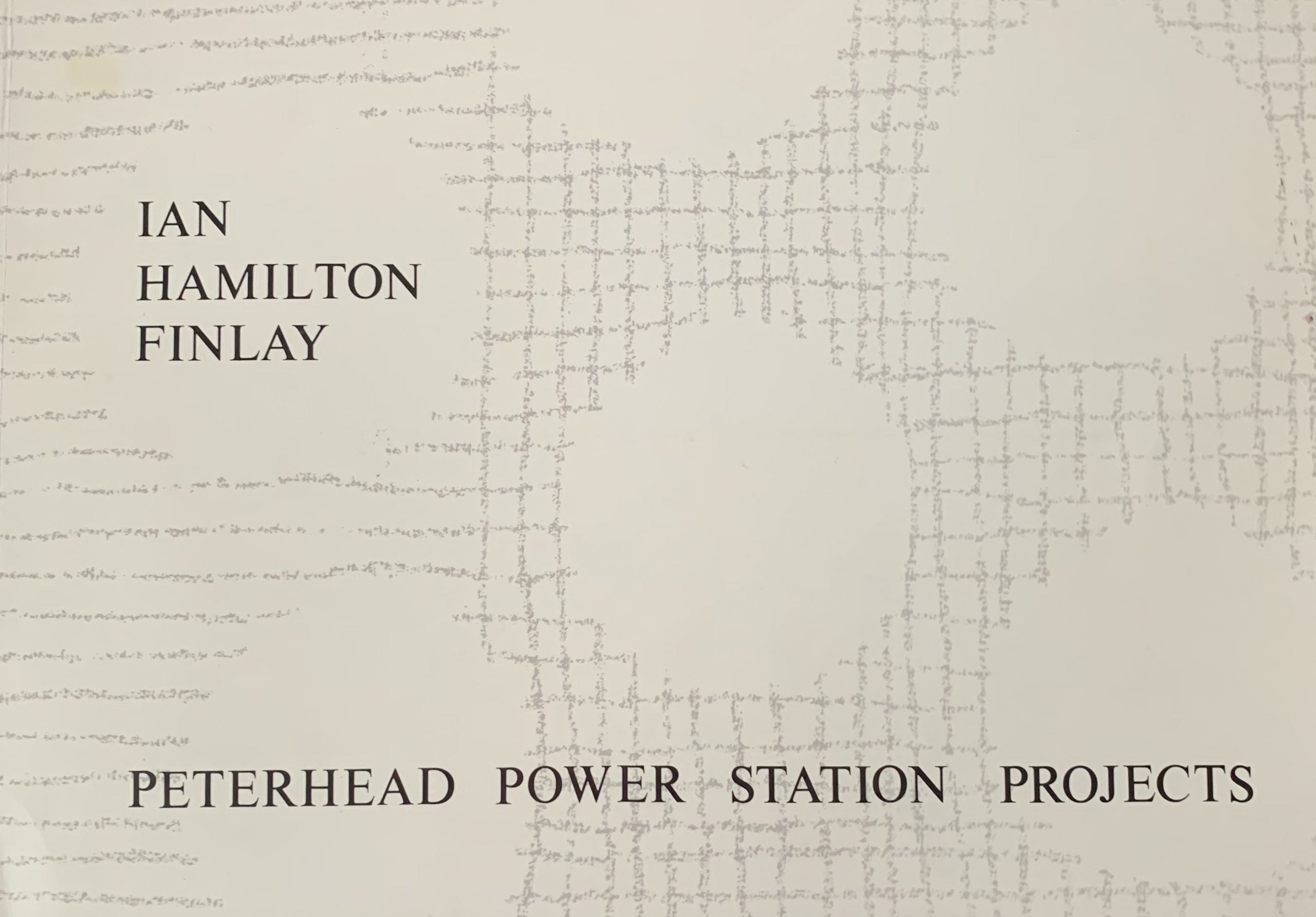
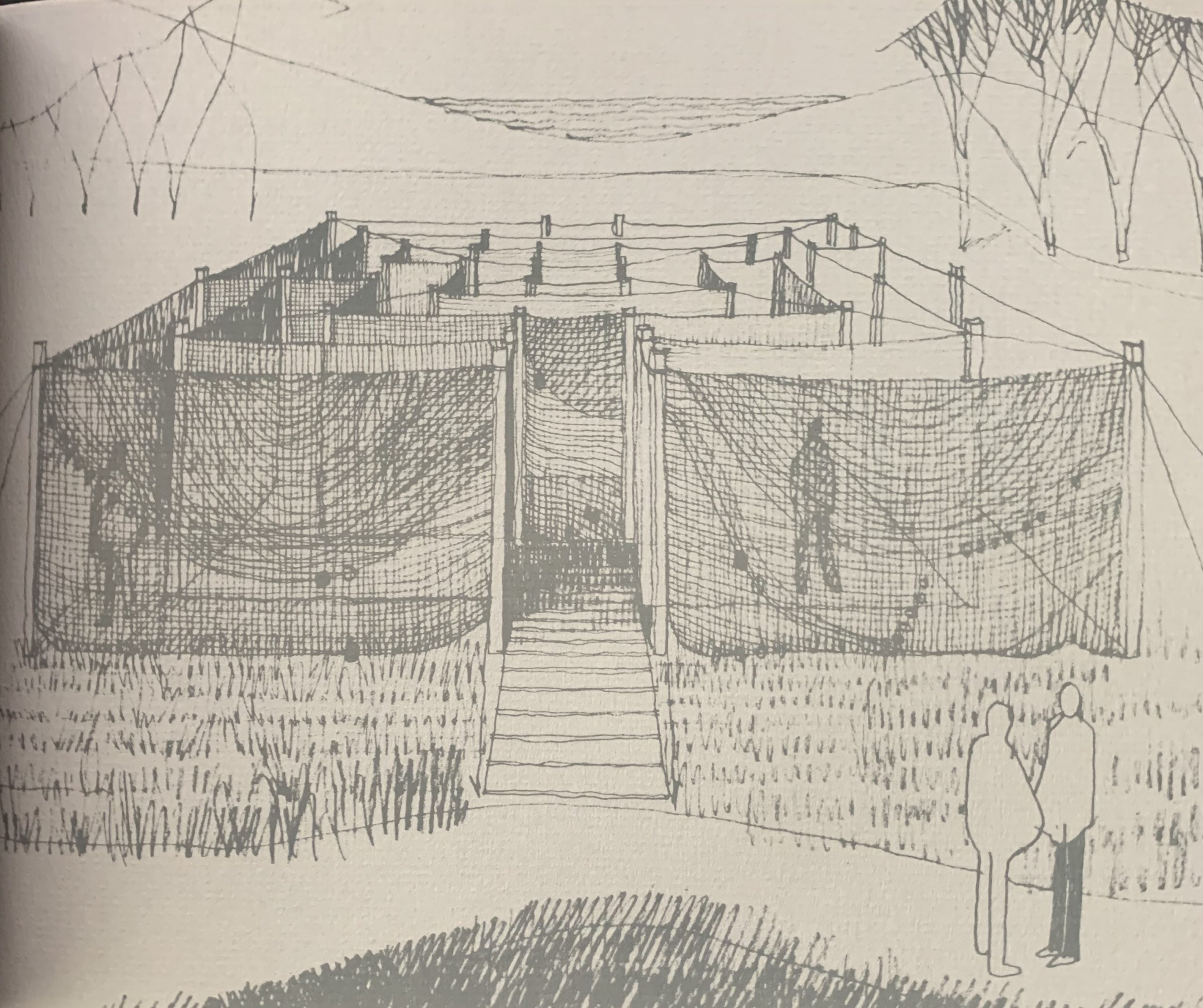
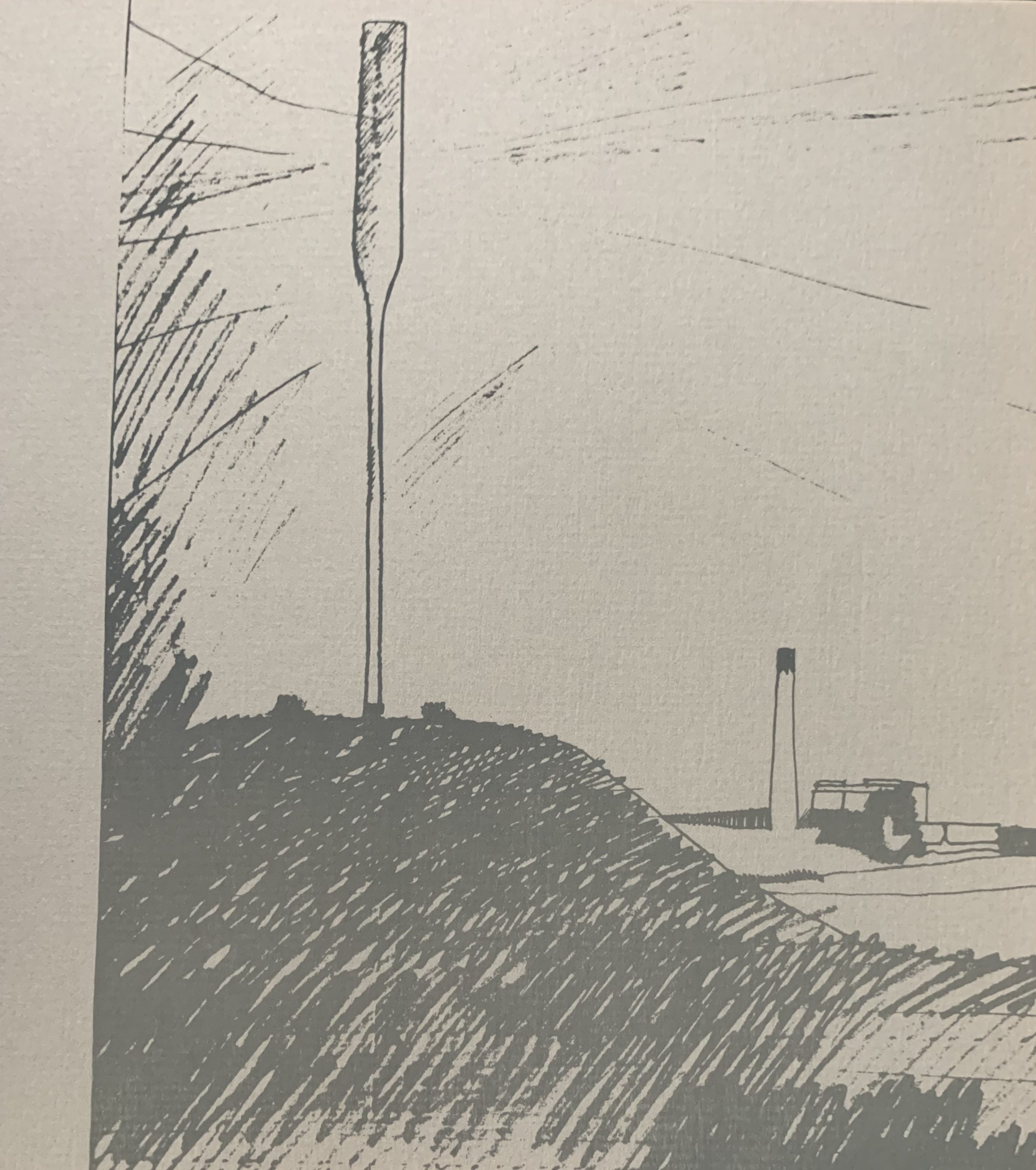
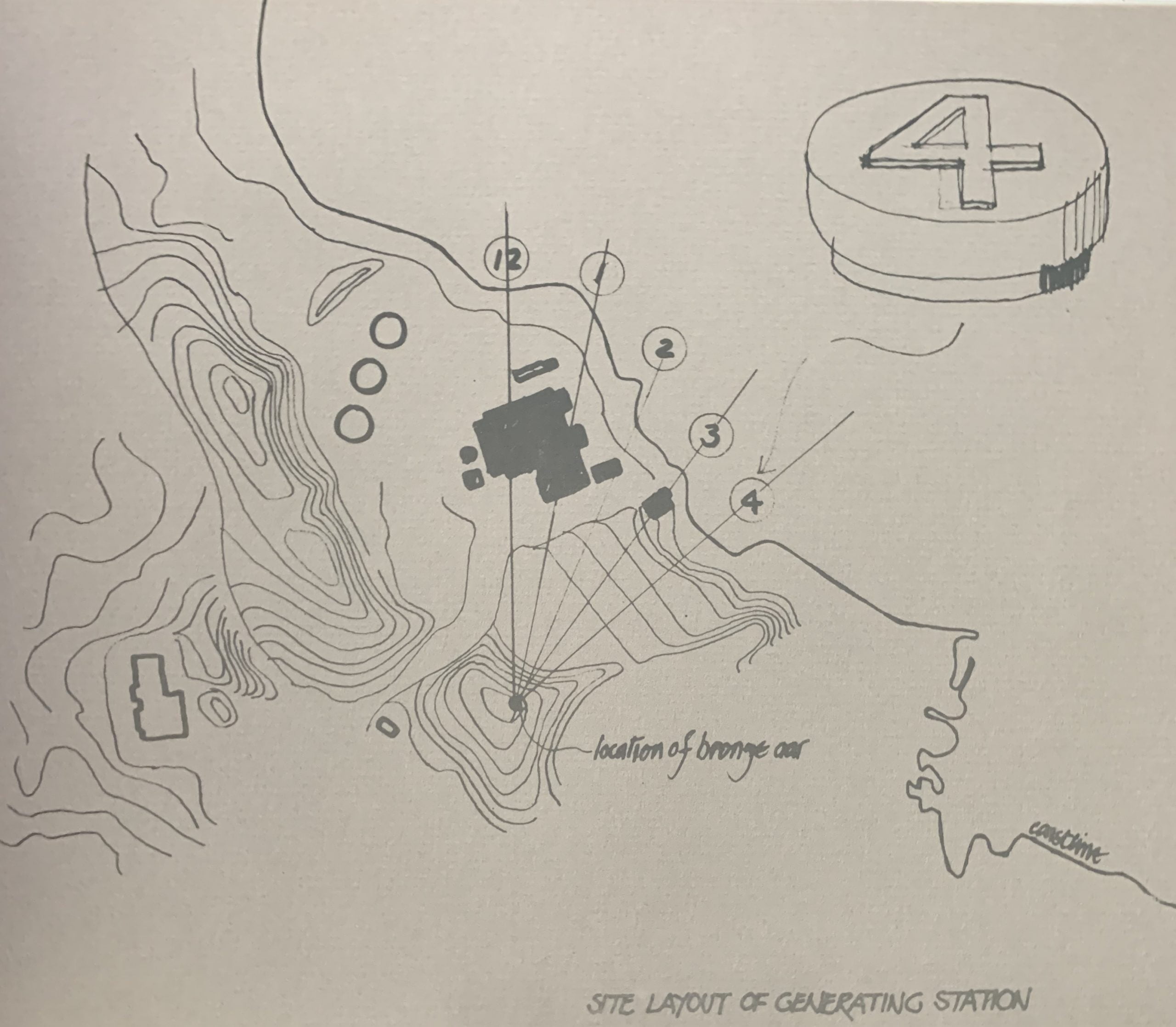
21 x 30cm, 43pp plus printed glossy covers. A set of proposals by Finlay for architectural and sculptural interventions in the Peterhead Power Station which was to be build. The book was published by the architects as part of the proposals for the site. The drawings by Ian Appleton are given very clear explanations by Finlay - proposed are a wall of glass floats, four stones with carves words indicating the theoretical structure of classical and other universes in fours (suits of cards, directions, elements, primary colours), a maze made out of fishermen's nets (which we would dearly like to see realised), a large stone carving of the SEA'S WAVES'S SHEAVES (which was installed elsewhere eventually), a concrete poem TERRA/MARE to be carved in Caithness Stone, various inscriptions of natural boulders (including SEApink) to be placed on site which remind one of the later PEBBLES series of works, a sundial with the inscriptions Rete Luci Tentu/A Net for the Light, names of fishing boats carved into garden slabs, a large sculpture of a bronze oar placed on a hill far away from the station which would visually reflect the chimney of the newly built station and also be a sort of sundial gnomon along with a site layout which shows the various shadows cast by the oar on the landscape at different times, a large rock with "It's Scotland's Atlantis" carved on it (with the word oil crossed out) an unusually political work by Finlay, and, finally, a carved oar into the face of a heap of sawn boulders (referencing `Ullysses).
To the best of our knowledge none were actualised. The sheer number of wonderful ideas proffered by Finlay for this project is quite astonishing.
This is a wonderful book although the style of the architectural drawings are strange for a Finlay collaboration - one suspects he did not choose the artist.
Murray places this book in amongst other artist's books by Finlay but we have recategorised it as a "proposal" as it clearly is just that and because of the style of the book it does not feel or look like a Finlay publication. This is a rarity and very hard to find. VG+.

...

Dunsyre: Wild Hawthorn Press, 1978
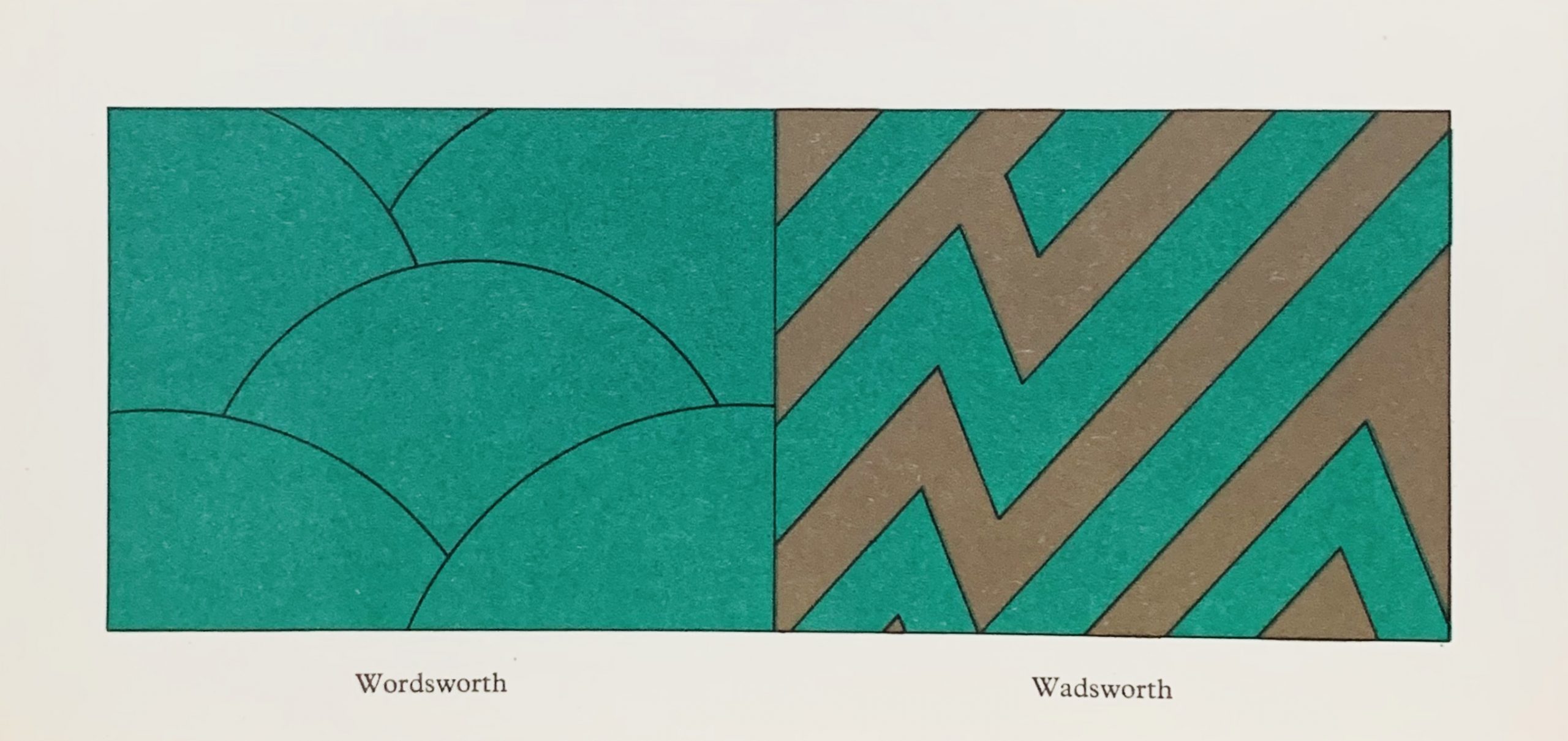
8 x 16.6cm, 2pp. A card with two abstract drawings by Jim Downie - one representing the romantic interest of Wordsworth (trees) and the other the Dazzle form of camouflage invented by Edward Wadsworth to help defend ships at sea. Finlay clearly enjoys the slight change in spelling between the names and the resulting hard edge vs organic images. VG+.

...

Little Sparta: Wild Hawthorn Press, 1977
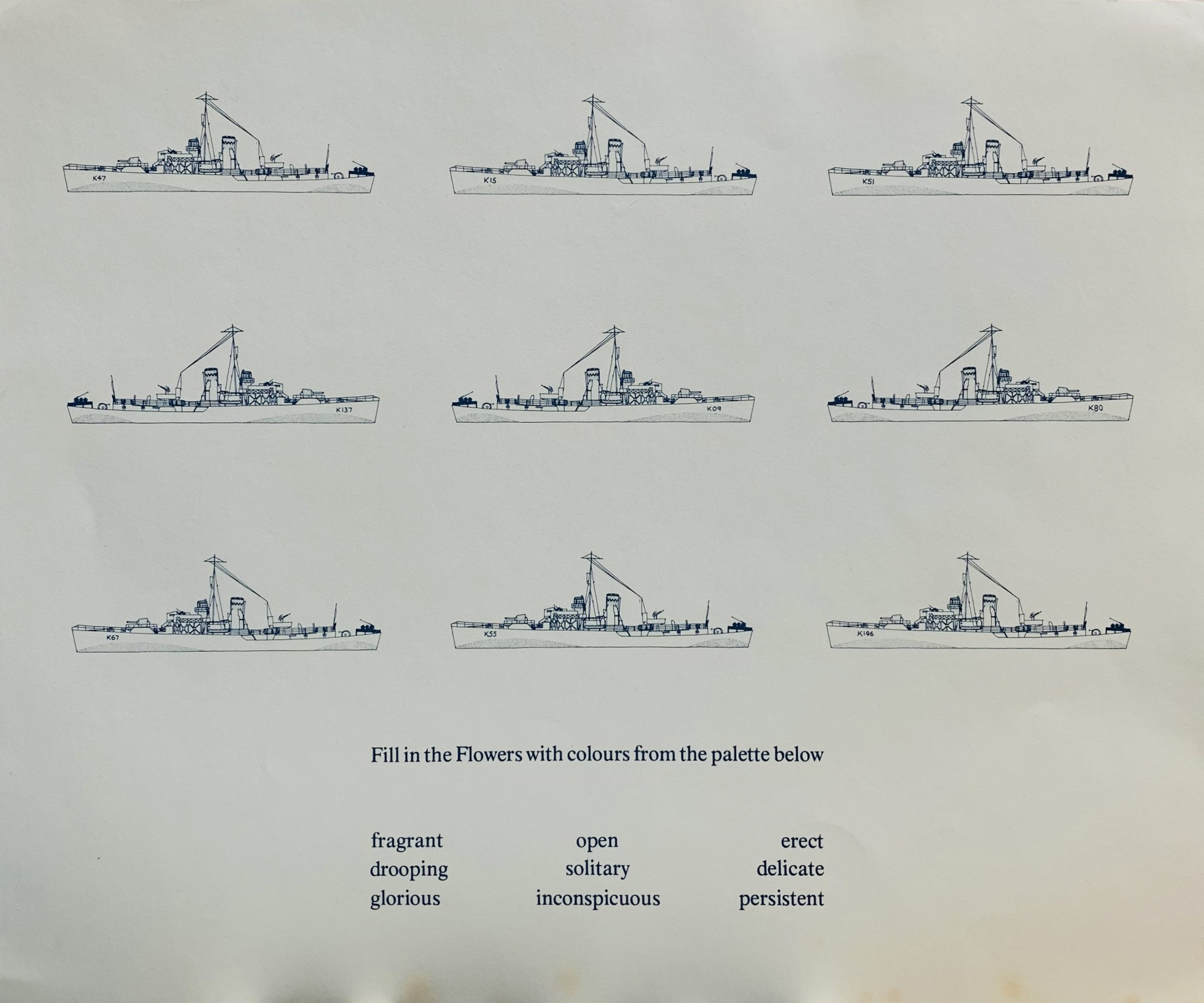
22.9 x 28.8cm, blue on white paper in folded 6pp blue folder. Nine warships all of the Flower Class corvette class. The names of the ships were all after flowerrs. The print asks the owner to "fill in the Flowers with colours from the palette below" - the 'colours' are all words such as "fragrant", "open", "erect", "drooping" obviously not actual colours. The idea came from a work from Tom and Laurie Clark of the Moschatel Press (who were friends of Finlay).
This is one of 350 signed and numbered copies on the inside of the folder. Two slight faint marks at bottom of the print else VG in like folder.

...

Shopping cart0
There are no products in the cart!
Continue shopping