Dunsyre, Lanark: Wild Hawthorn Press, n.d. (1975)
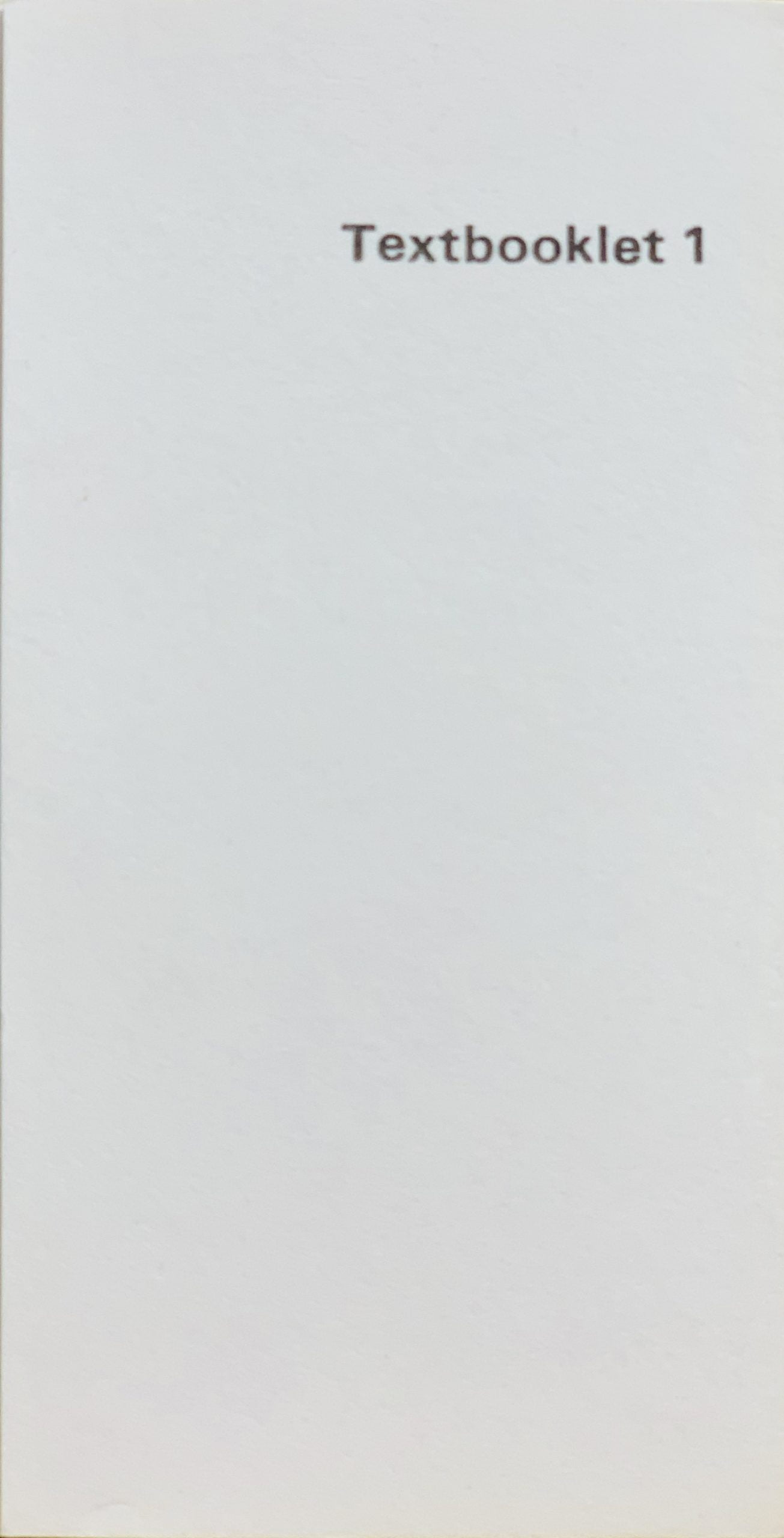
10 x 5.2cm, 18pp (printed on one side only) accordion fold.
The first of three such "textbooklet"s which have similar formats. Here three texts are all displayed vertically: "Concrete effect?", "Crossword effect?" and "Weather effect?".
Finlay is playing with the three reasons why text might be shown in such an unusual manner - the concrete poem that uses verticality in many ways including inferring direction and falling, the crossword which needs vertical text to allow the words to be, well, crossed, and the weather where rain and snow falls and is a direct reference to the famous (and one of the first ever concrete poems) by Apollinaire "Il pleut" which Finlay knew well as he later parodied it in an artist's card. VG+.

...
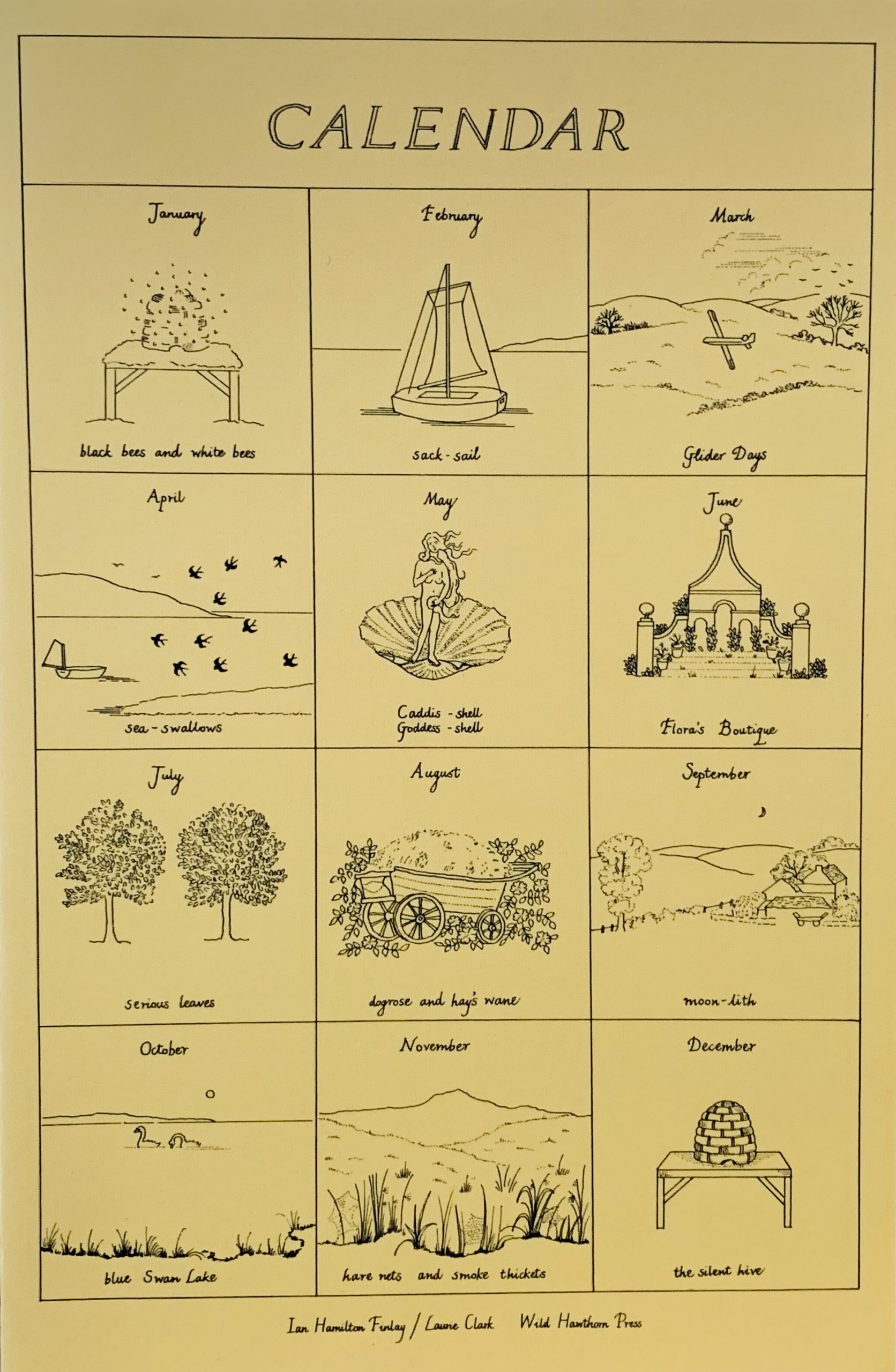
Dunsyre: Wild Hawthorn Press, 1975.
22.2 x 14.6cm, 8pp (single card folded twice) . A "calendar" designed by Laurie Clark for Finlay with each of the months being given new symbolism. For example, January has a drawing of "black bees and white bees", March is "glider-days", October - blue swan lake and December - the silent hive.
The use of symbols for each month is reminiscent of Le Calendrier Republican that was introduced on 24 October 1793 by the National Convention where the names of months were replaced with objects relevant for that season or month with the year beginning in March. Finlay/Clark's is less radical in that the names and dates of the months are not replaced but the symbolism is similar if more modern.VG+.

...

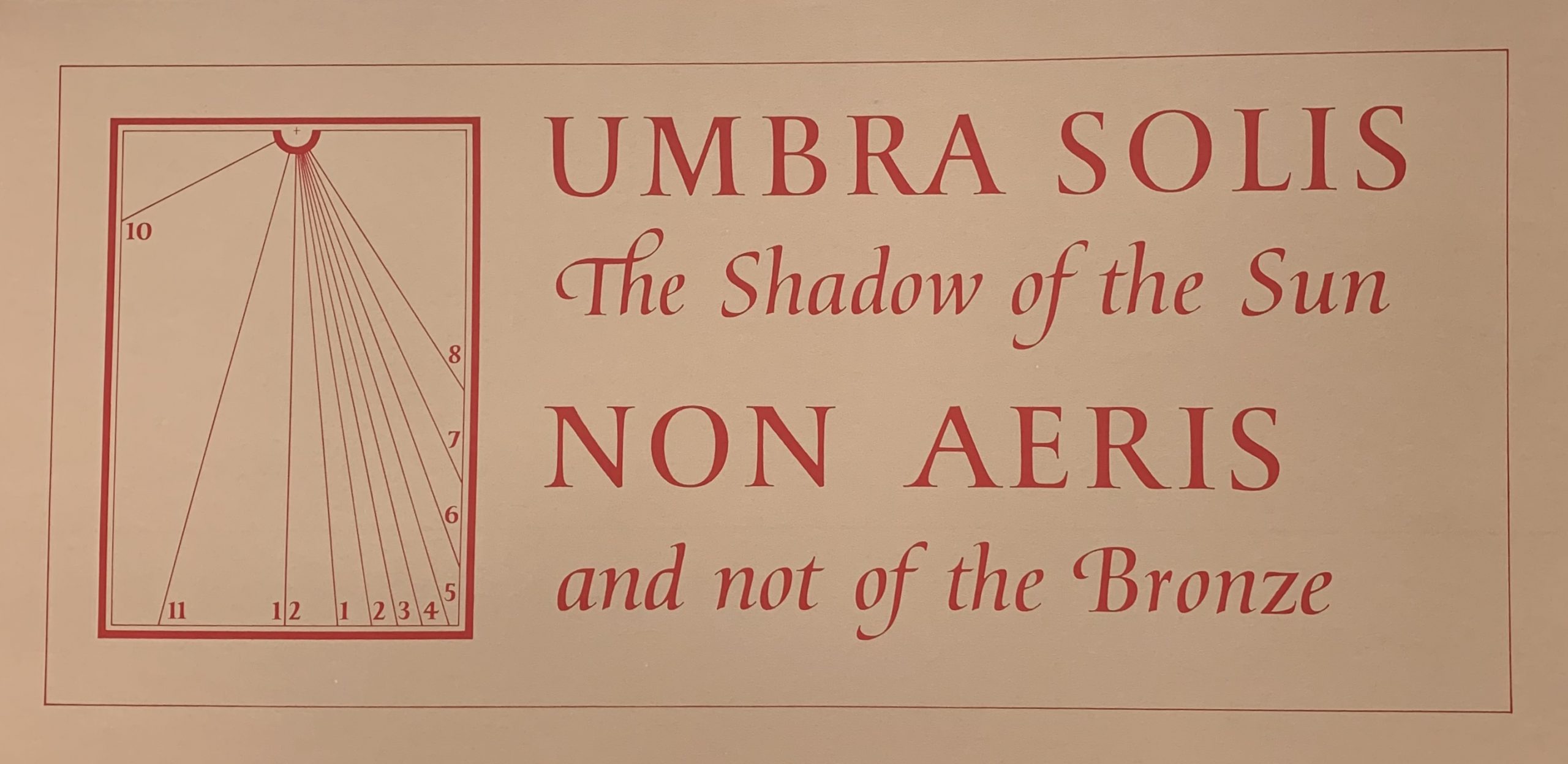
Dunsyre: Wild Hawthorn Press 1975
74.9 × 36.8cm, red on light brown silkscreen. A diagramatic drawing and typography by Michael Harvey is of a sundial and is joined with the Latin inscription UMBRA SOLIS/NON AERIS and the English alternative "The shadow of the sun and not of the Bronze."
The Latin and English phrases together remind one that the source of the shadow is in fact the sun not the gnomon in itself.

...

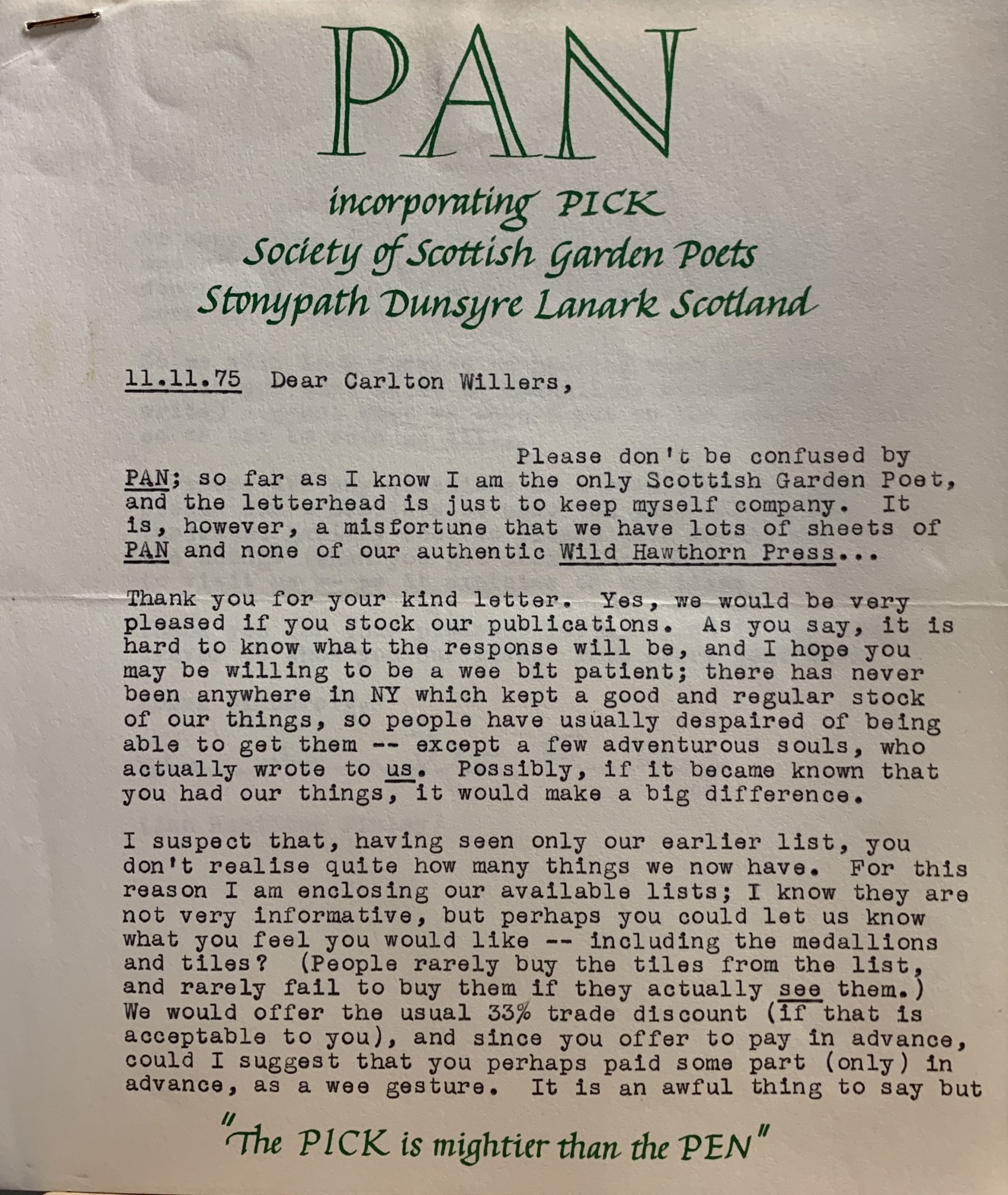
Little Sparta: Finlay, 11 November 1975.
21 x 18cm, 2pp (both recto) original typed letter on white letter head note paper (PAN incorporating PICK) which is hand signed at the end in ink by Finlay. A letter to Carlton Williers- which firstly explains the PAN letterhead - "so far as I know I am the only Scottish Garden Poet and the letterhead is just to keep me company".
Willers (of Philadelphia) was a known collector of art and a friend and one-time lover of Andy Warhol.
Finlay then thanks Willers for his "kind letter: and happily agree to let him stock the press' publication. Finlay bemoans the lack of a new York outlet for his work and he hopes Willers might make a difference.
Finlay points out that the Press now has a much greater inventory of printed material and encloses some lists of available works as well as pushing the medallions and ceramic tiles - "People rarely buy the tiles from the list and rarely fail to buy them if they actually see them.)"
A 33% trade discount is offered and there is a short discussion on how many US bookshops had cheated Finlay by "simply not paying"

...

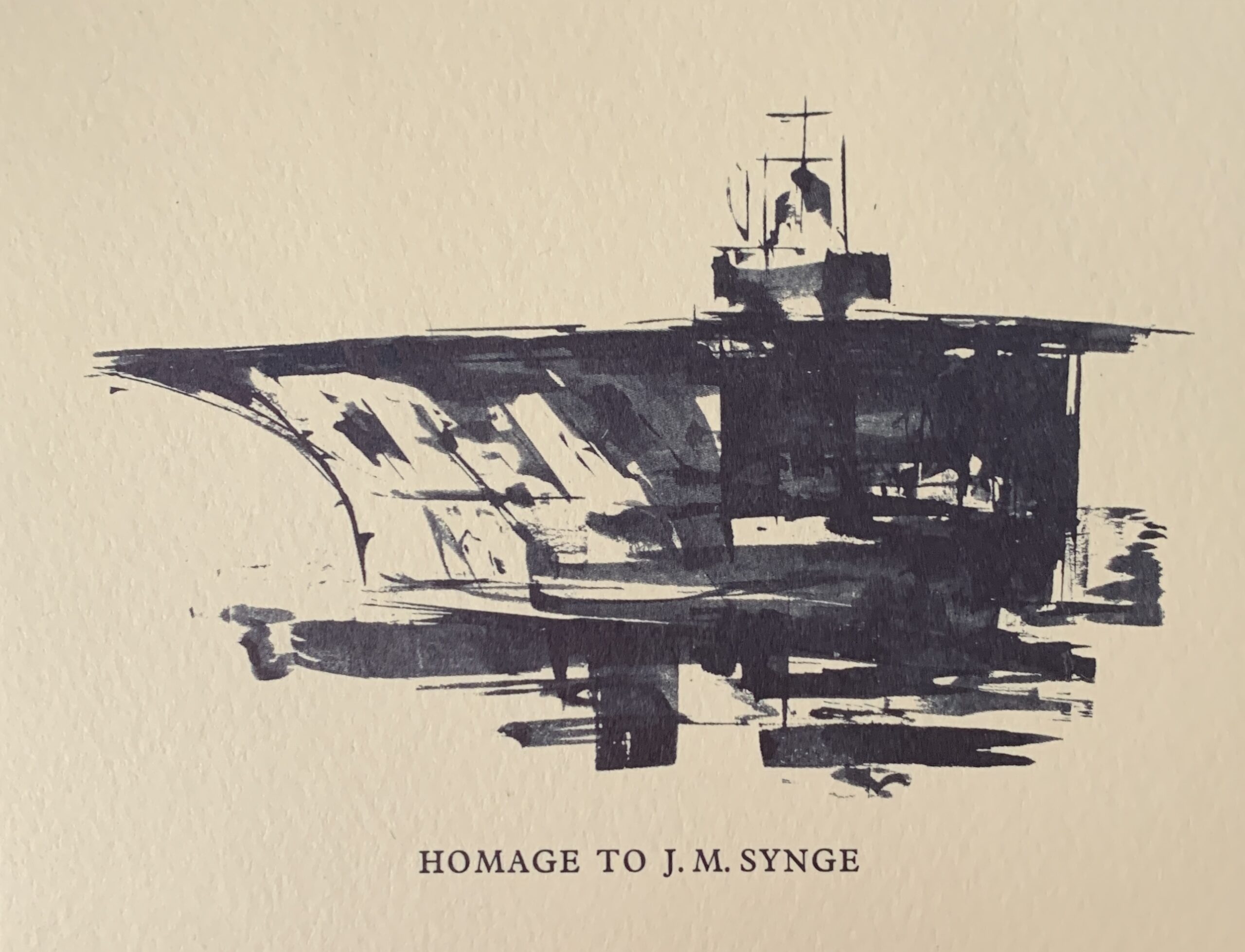
Little Sparta: Wild Hawthorn Press, n.d. (1975)
11.8x 15.1cm, 2pp artist postcard with a reproduced painting by Manduca of an air craft carrier. J. M. (Edmund John Millington) Synge was an Irish playwright, poet, writer, collector of folklore, and a key figure in the Irish Literary Revival who wrote the bleak and realitic play The Playboy of the Western World. VG+. ...

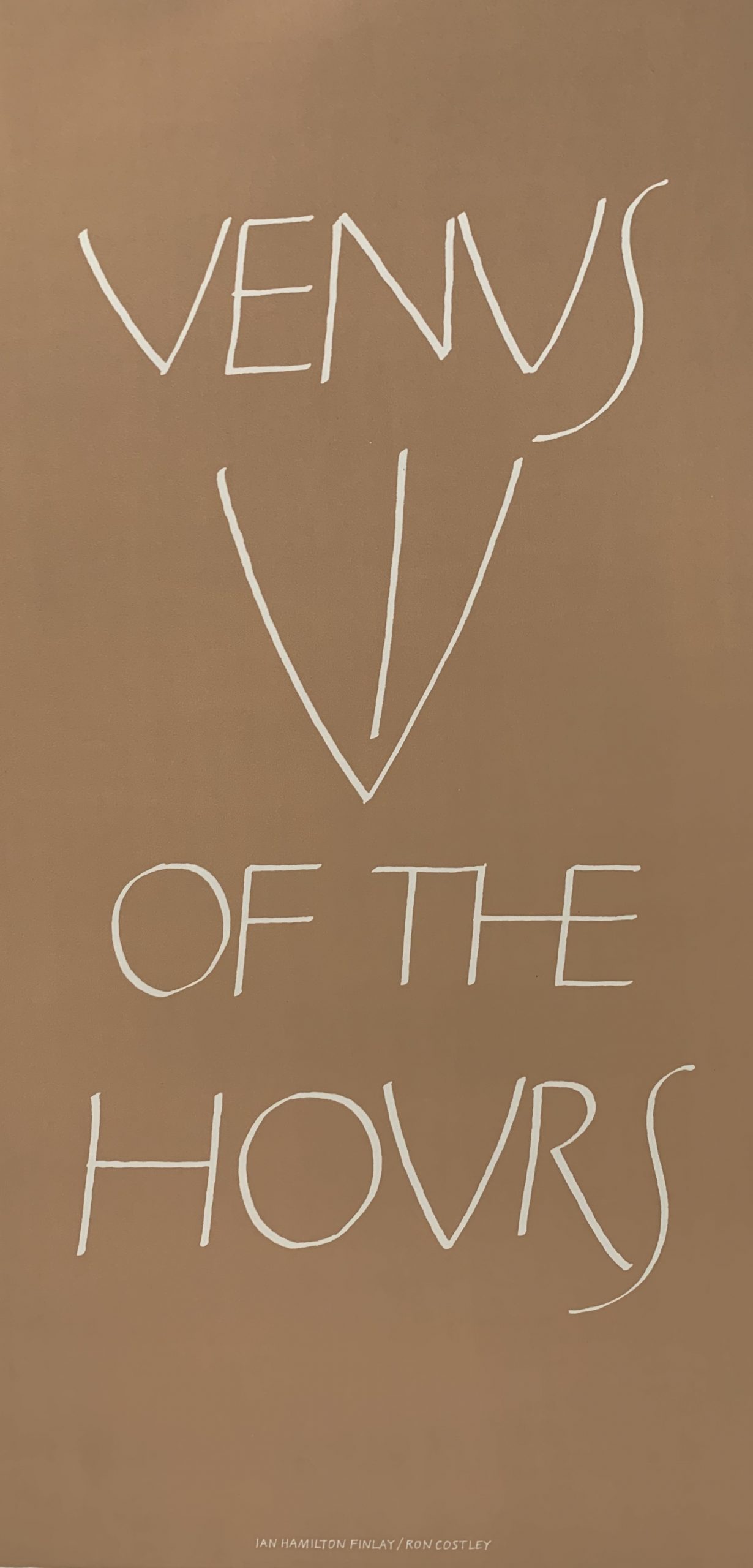
Dunsyre: Wild Hawthorn Press 1975
74.9 × 36.8cm, light brown on white silkscreen on thick paper. The drawing by Ron Costley (from Finlay's instruction) is in faux Roman lettering - an attractive typography which has under the first word a drawing that doubles as both a symbolic sundial and a female vaginal mound. Venus, of course, was the goddess of love (sex) - and the shape of the gnomon and its shadows creates a capital "V" to again symbolise the female sex symbol.
One of c. 300 printed - this has slight marks in the margins but is overall VG. Scarce item.

...

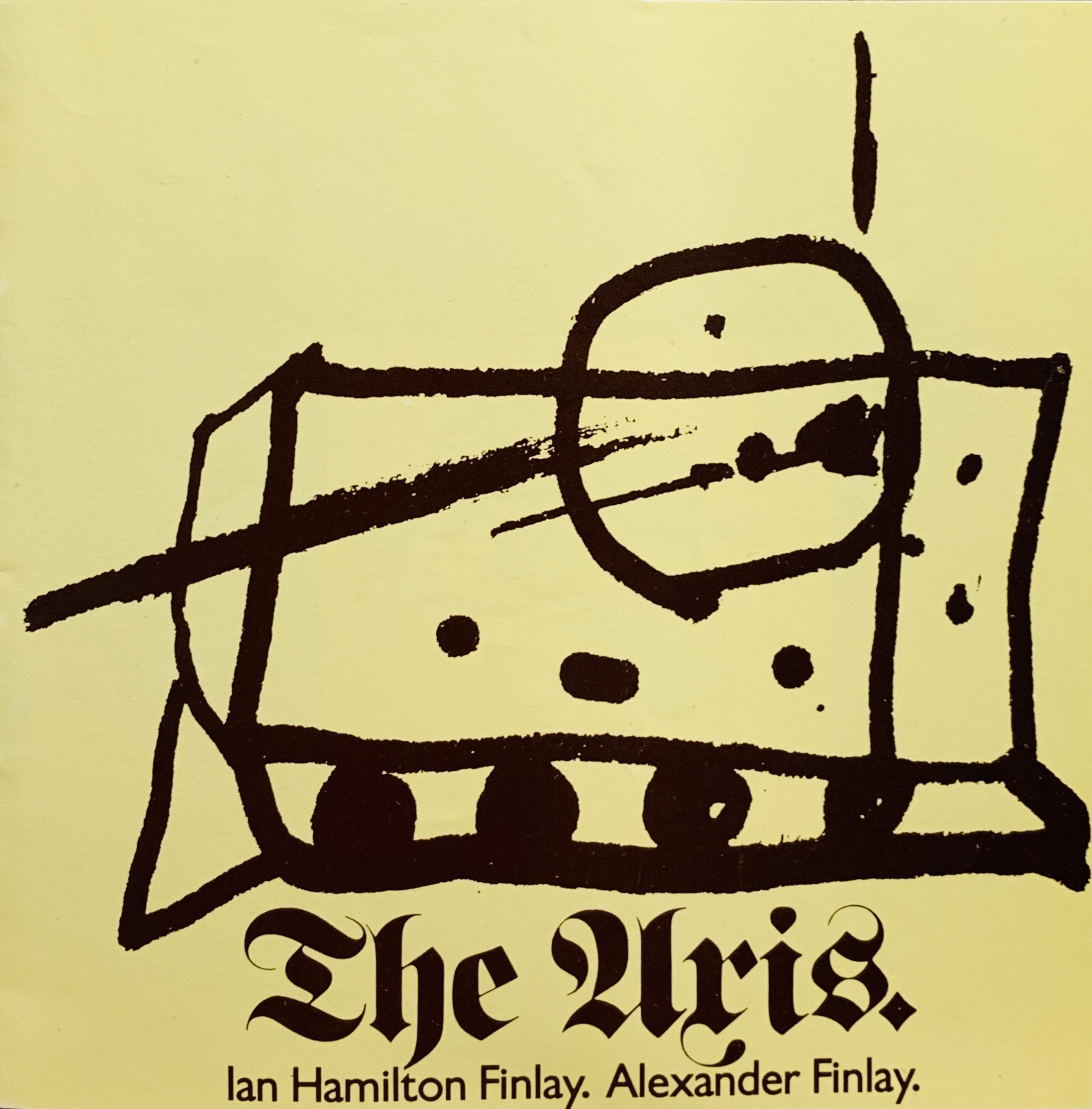
Dunsyre, Lanark: Wild Hawthorn Press, 1975
11 x 11.2cm, 16pp (self cover). Drawings of tanks and war planes by Alexander Finlay (later Alex Finlay) from when he was young with short text works by Finlay that reflect the imagery.
Nocturne has a drawing of a man parachuting from a plane - Finlay's text shows the words "schräge musik" with two dots being repeated op the page diagonally. Schräge Musik was the German term for an autocannon that the Luftwaffe mounted in fighters but was also the contemporary German colloquialism for shaky, off-tune music ie slanted or oblique music. The slant of the text reflects that origin as a well as the way the bullets tragectory.
A very scarce Finlay book and charming in the way his son was involved in the production. Later Alex Finlay would publish many books - we think this was his first. VG+. ...

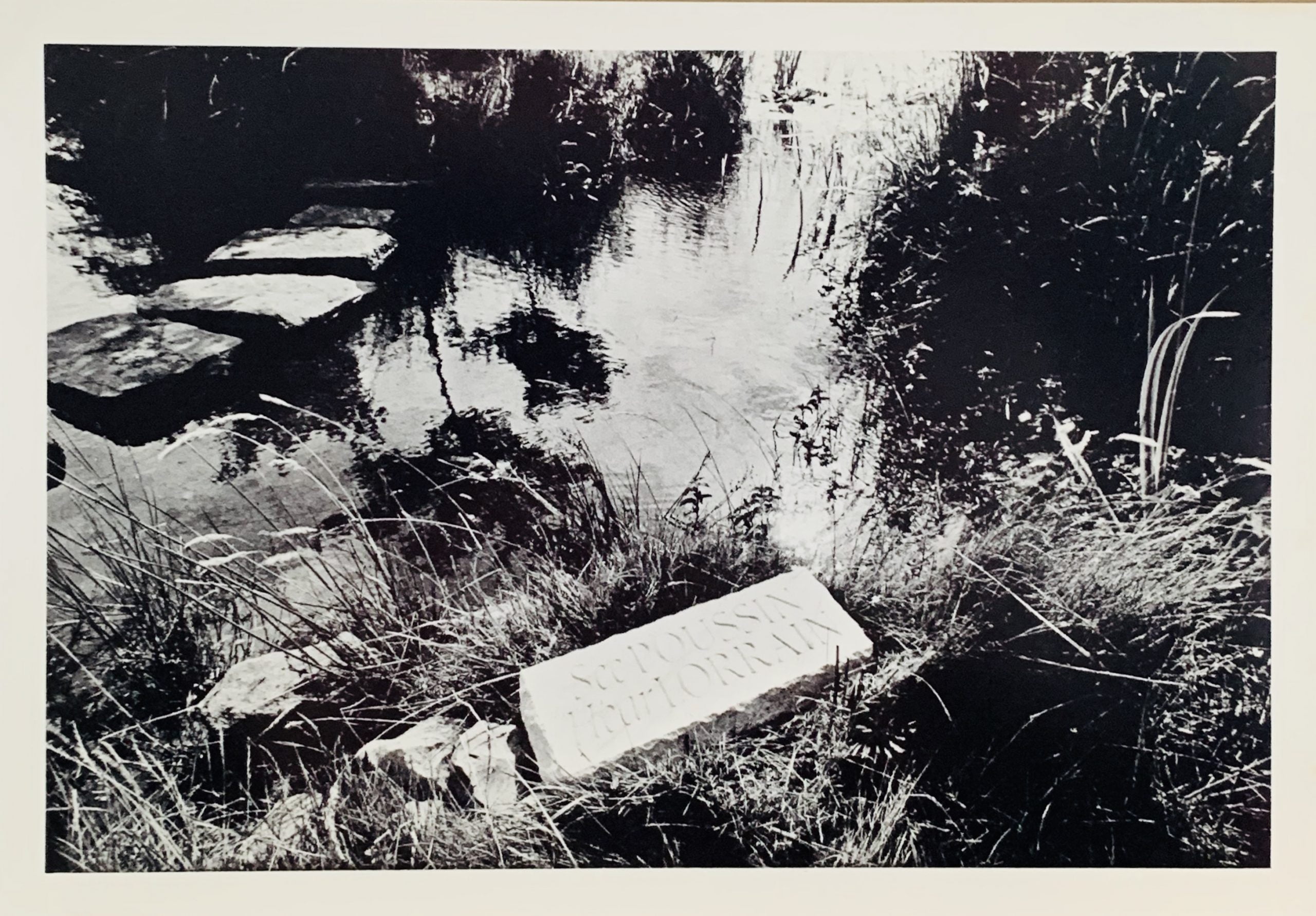
Dunsyre: Wild Hawthorn Press, 1975.
20 x 15.2cm, 2pp. A photograph of an installation in the Stonypath (later Little Sparta) of a ground stone that reads "See POUSSIN, Hear LORRAINE." in front of a small lake. Both names are painters, the first tending to paint arcadian scenes, the other views of rivers and sea ports. Photo by Michael McQueen, the sculpture who worked to Finlay's instruction was John Andrew. VG+. ...

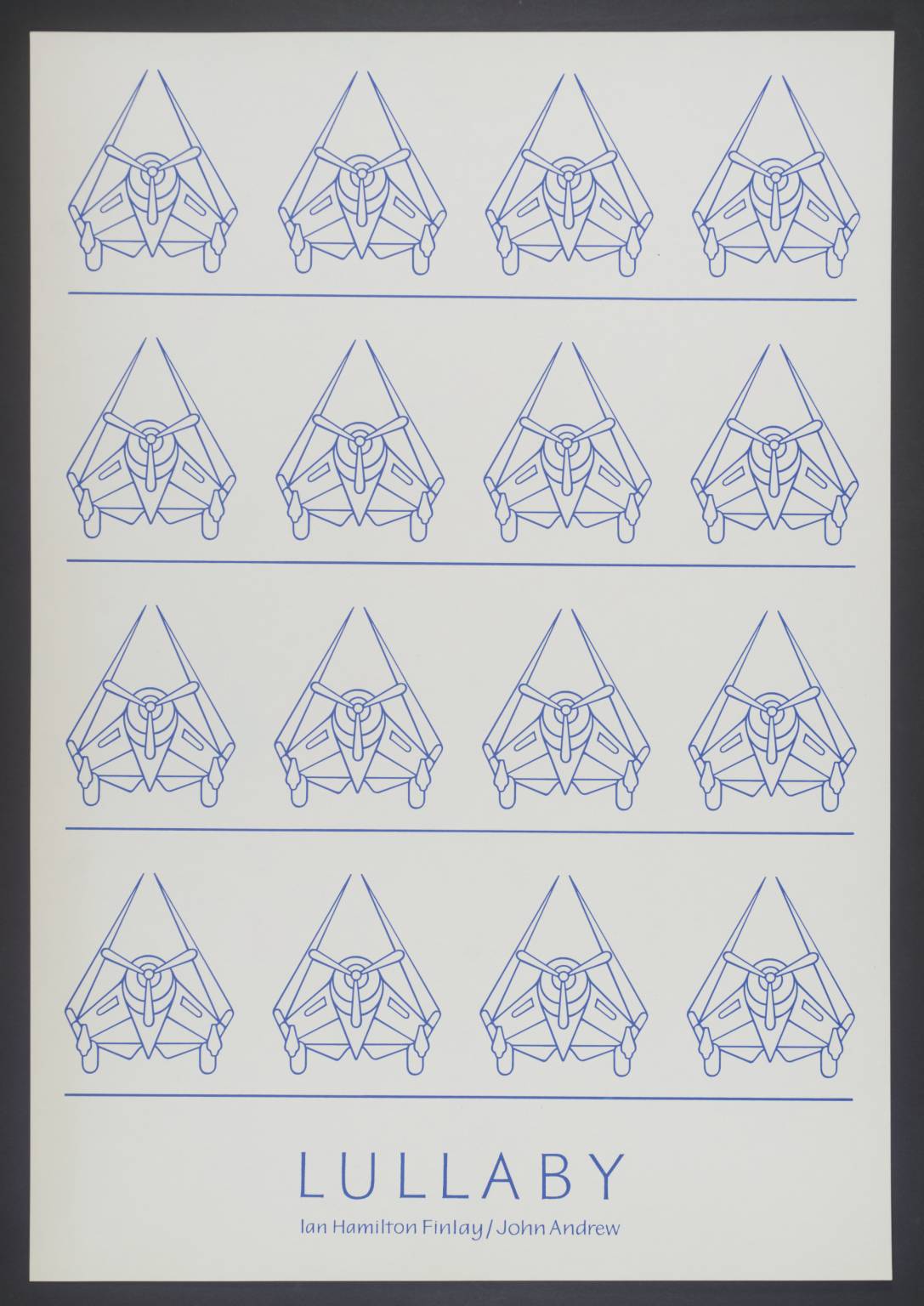
Dunsyre: Wild Hawthorn Press, 1975
58.5 x 48.5cm, blue on white silkscreen. The image is of a number of airplanes with their wings raised (as found in the belly of an aircraft carrier) so to allow them to be placed more closely to each other. Finlay by adding the title Lullaby indicates that these planes might be seen as somehow sleeping - and the visual image reminds one of young birds in a nest. Hence this is a visual poem - the image having double meanings and hinting at subtle meanings.
The image we have used here is from a publication - the print we hold is framed in wood and glass and hard to image without reflections - but the work is in VG+ condition.

...

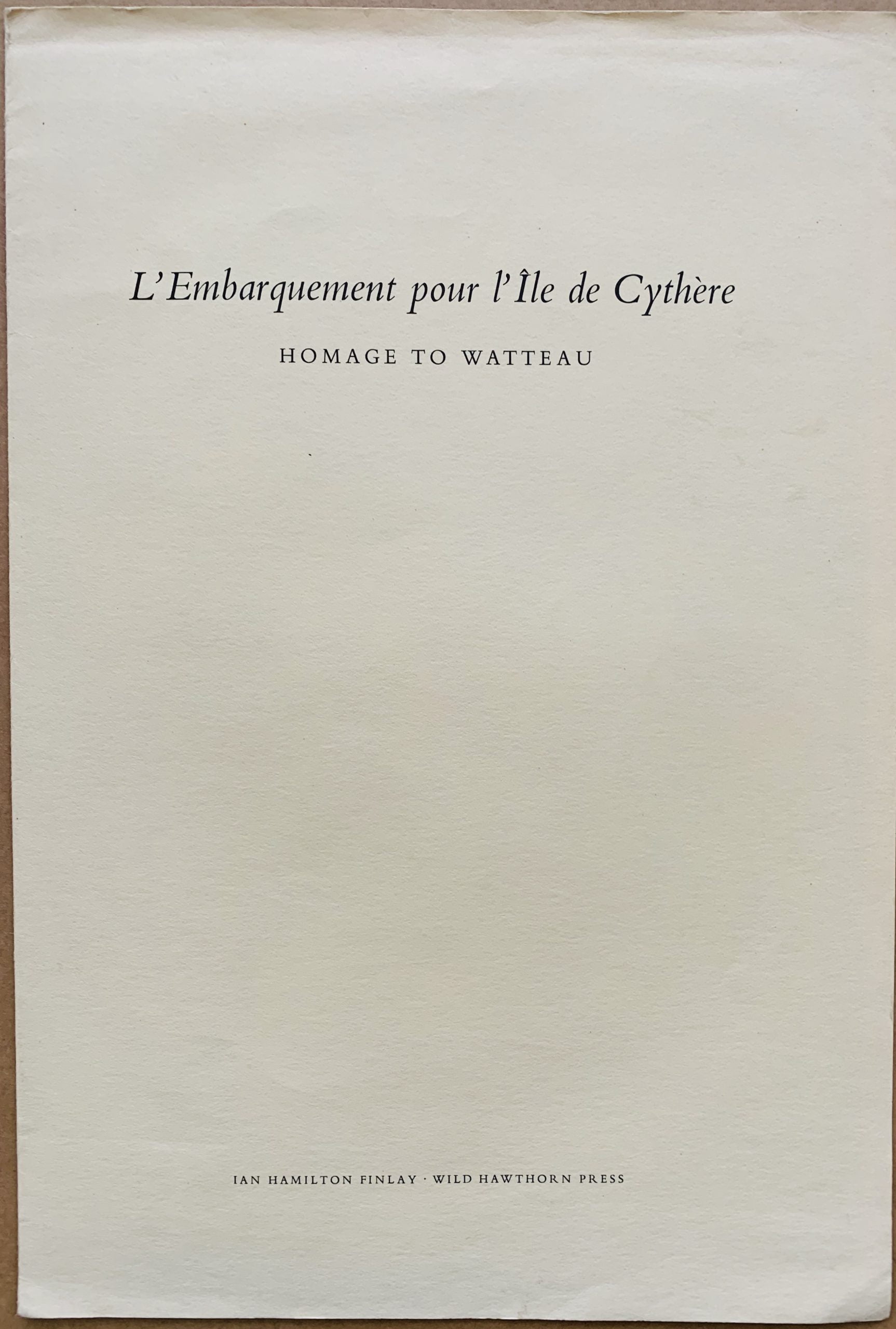
Little Sparta: Wild Hawthorn Press, 1975
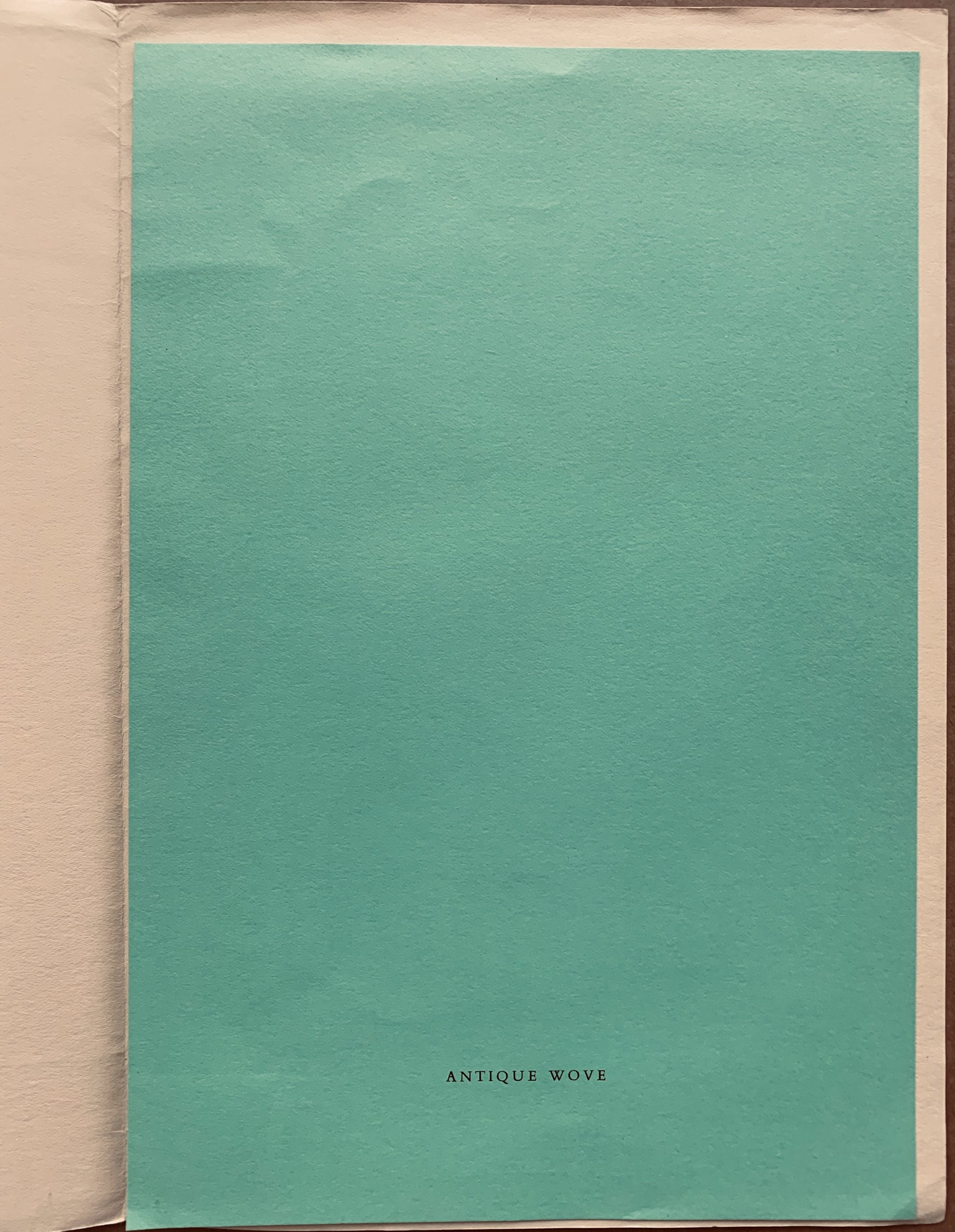
34.1 × 22.8cm, 4pp printed outer folder (black on cream) with the title text and inside a single sheet of green wove paper with the words ANTIQUE WOVE printed at the bottom.
This was one of the first of such works where the paper choice added within a folder is a comment on the subject matter. The choice of green antique wove paper is a reference to the verdant countryside of the Watteau painting, the fact it is a classical "antique" theme.
This innovation of creating a poem using the very materials employed in the printing is to the best of our knowledge a Finlay invention and, as we say, used in similar such works by the poet in later years.
Very slight grubbiness to outer folder else VG.

...

Dunsyre, Lanark: Wild Hawthorn Press, 1975
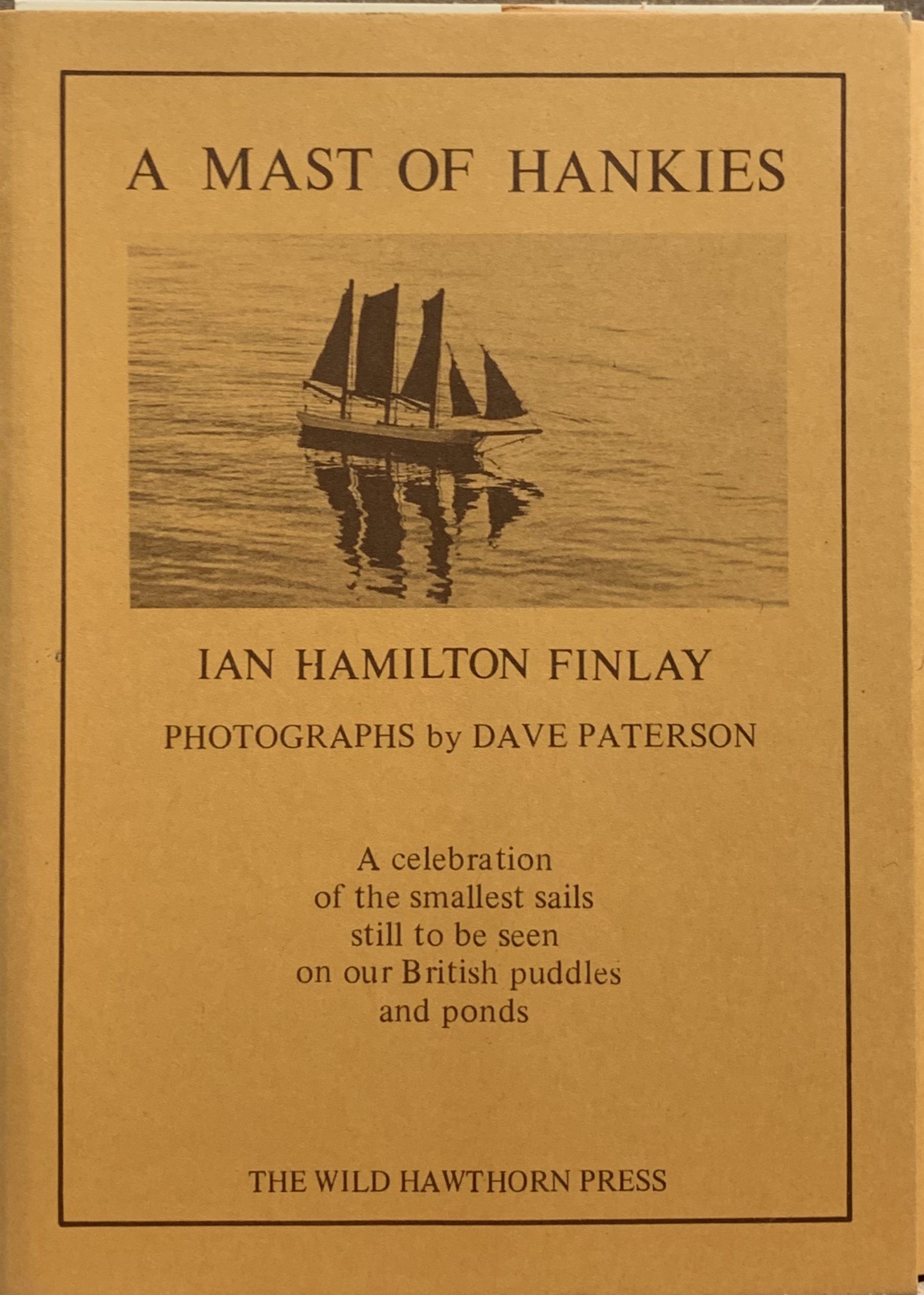
14.7 x 10.5cm, printed outer folder in orange with nine 14.5 x 10cm, 1pp postcards inside. Each card has a photograph by Dave Paterson of Finlay's toy boats in water, reeds and other outdoor situations. Below each photograph is a poem by Finlay in a rhyming scheme which tell the tales of the adventures of the boats and their owner as well as copious remarks on their structures including the ubiquitous handkerchief sails. Is this an artist's book or a collection of artist's postcard - debatable but we have kept it with the books because of the linked stories. VG+.

...

Dunsyre: Wild Hawthorn Press, 1975.
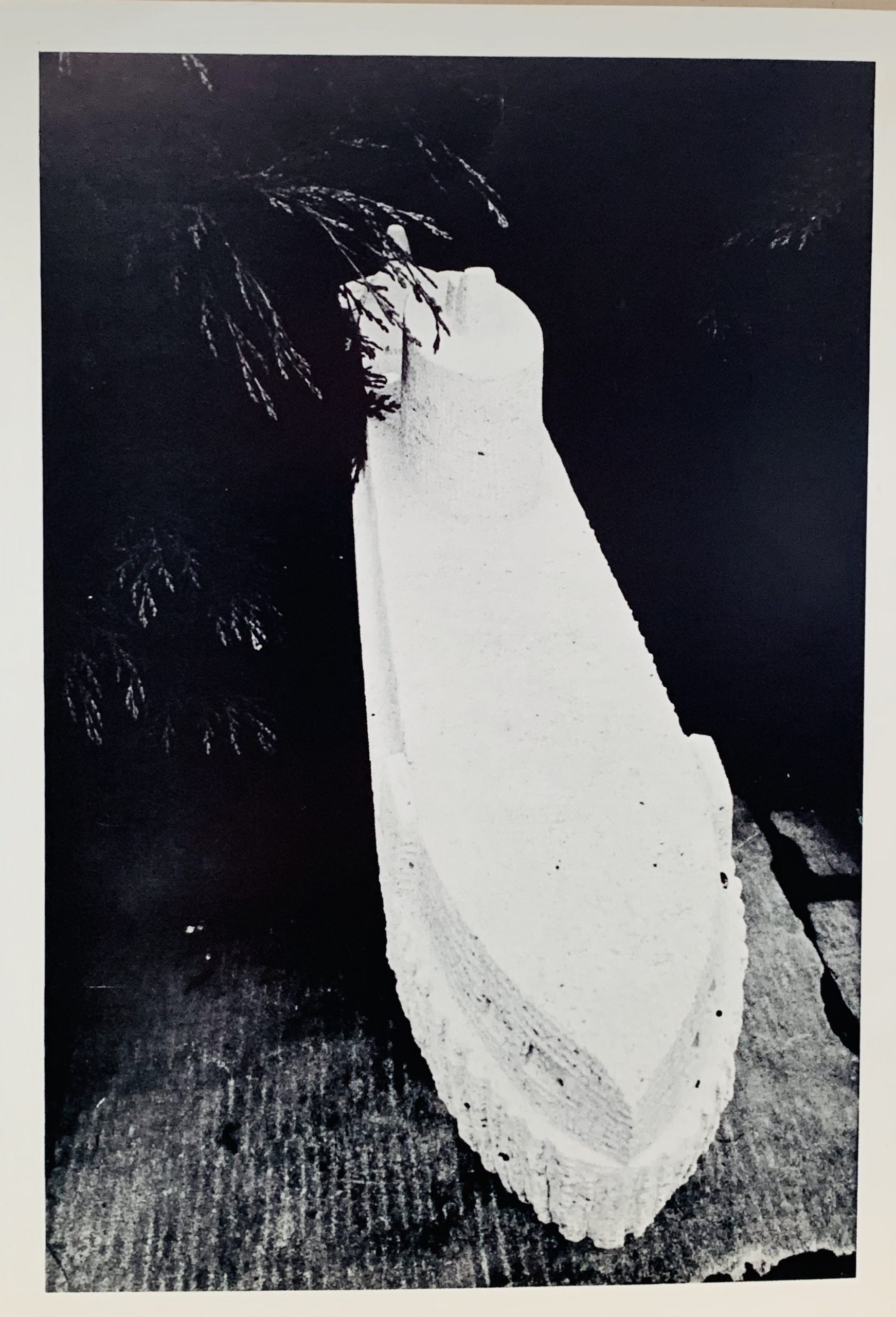
20 x 15.2cm, 2pp. A photograph of a garden sculpture depicting the world's first ever nuclear submarine - USS Nautilus. The work is in concrete and an abstracted shape of the hull and towers. Photo by Michael McQueen, the sculpture who worked to Finlay's instruction was John Andrew. VG+.

...

Shopping cart0
There are no products in the cart!
Continue shopping