Alsbach: Verlaggalerie Leaman, 1982
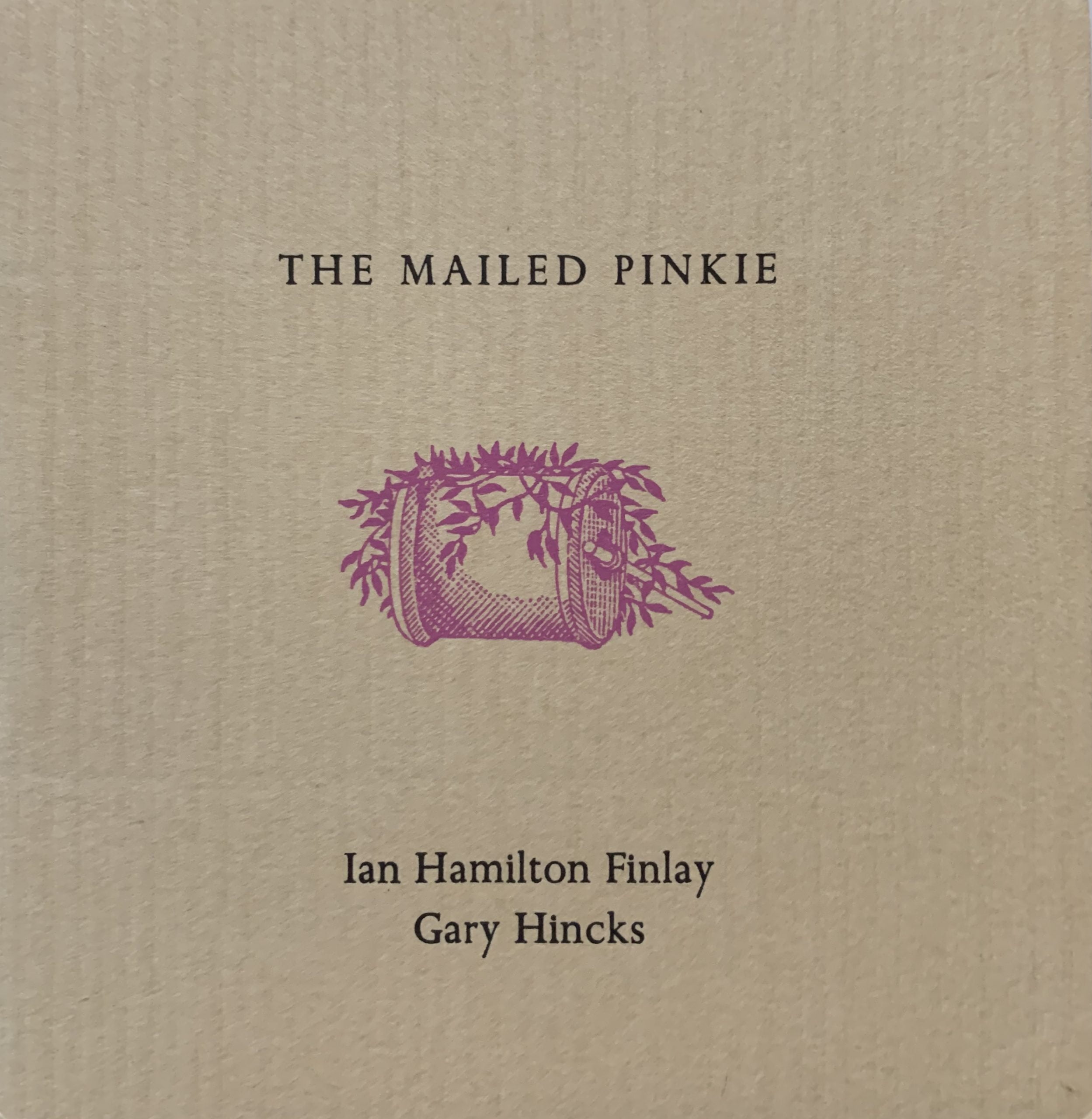
11.5 x 11.2cm, 20pp plus oversize wrappers. Artist's book containing five drawings by Gary Hincks and poems by Finlay.

IMPROVISATIONS

leaf-boat
cottonreel-tank

cottonreel-boat
leaf-tank

which is illustrated with drawings of bobbins used in toy model making.
One of 500 copies. VG+.

...

Little Sparta: Wild Hawthorn Press, 1982
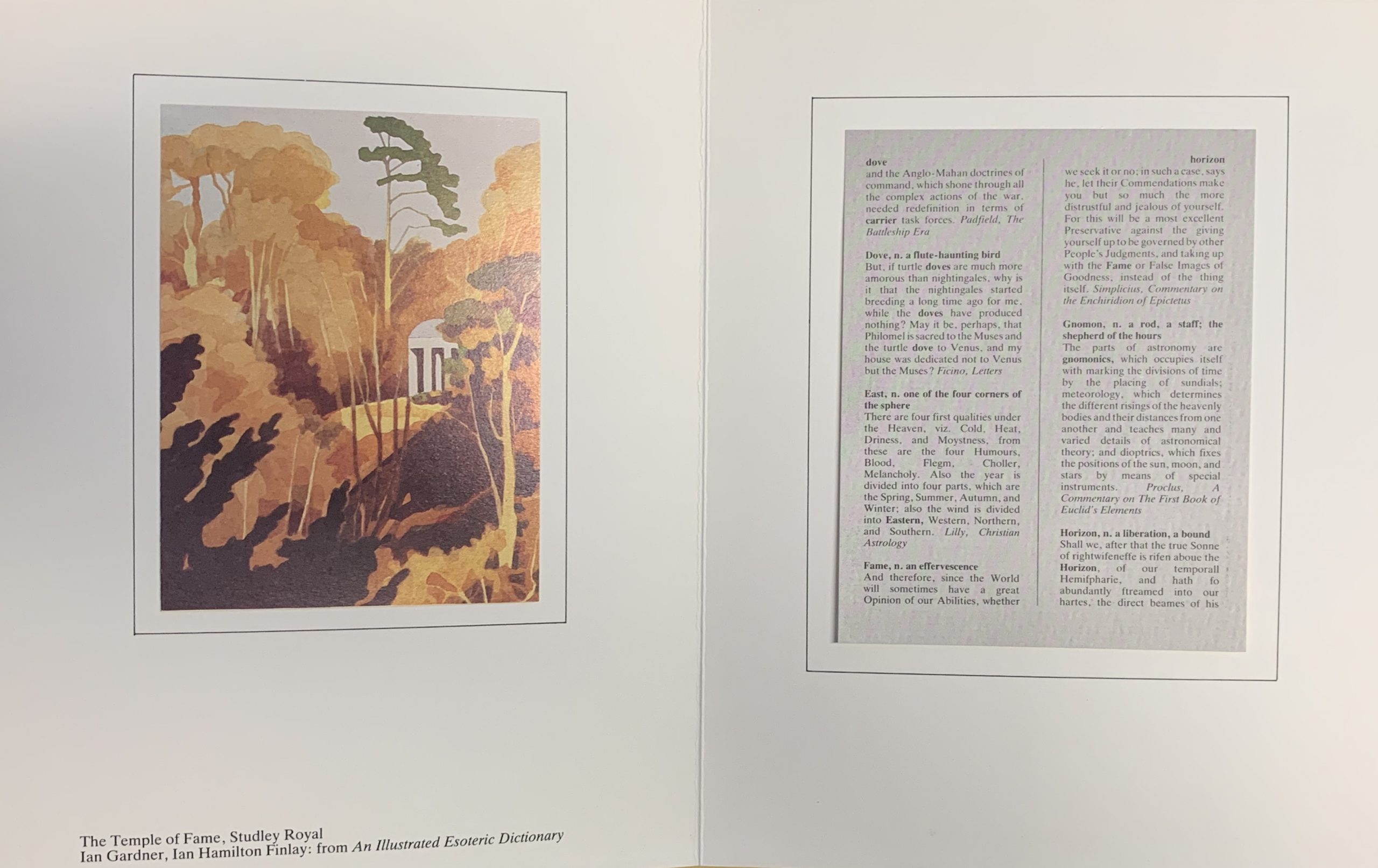
24x 18cm, folded card with two tipped on images - the first a painting by Ian Gardner of The Temple of Fame, Studley Royal - a wooden "temple" built for William Aislabie in 1770 amongst woodlands and a extract in appears to be a facsimile of dictionary definitions but in fact gathered from various sources by Finlay for the words Dove, East, Fame, Gnomon and Horizon. VG.

...

Dunsyre: Wild Hawthorn Press, (1982)
13 x 25.2cm, 8pp plus card wrappers and printed white dust jacket.
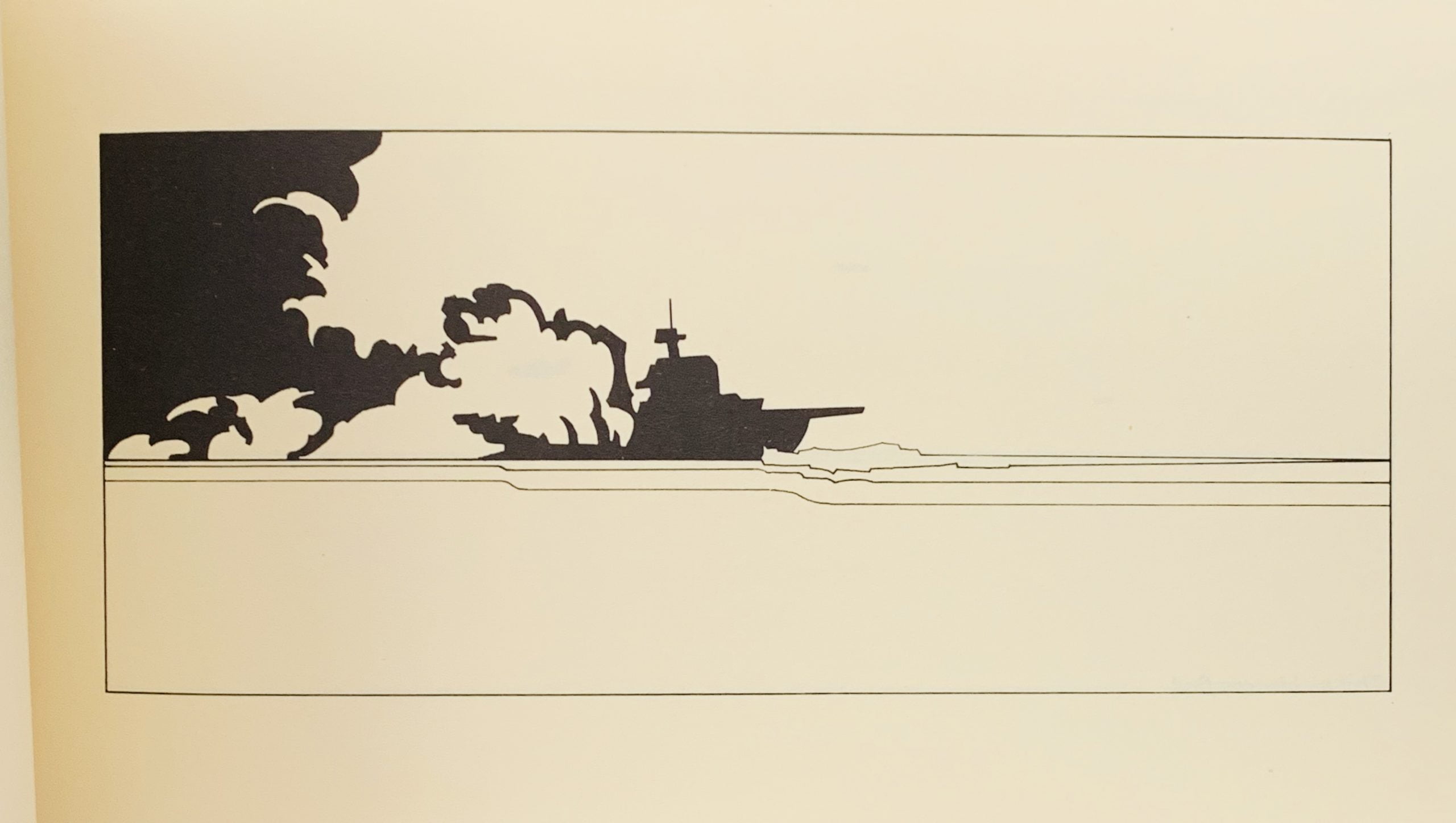
Artist's book with two drawings of the Japanese planes trying to return to their aircraft carrier which is on fire as a result most had to crash into the seas and the pilots drown. The quotation is "The last honey by the water that no hive can find." from Austin Clarke's The Cattledrive in Connaught" 1925. The Clarke quotation has its flaws - it is the bee that seeks the pollen not the hive so the line is rather reversed but Finlay ignores that (as he does in other publications such as the Black Sparrow Press, publication also of 1982 called "Honey by the water." VG+.

...

Dunsyre: Wild Hawthorn Press, (1982)
9.9 x 11.1cm, 28pp plus card wrappers and printed white dust jacket.
Artist's book with three sections - the first shows a unit (a dot), a line (two dots) and a plane (three dots). The second is Unit, line panzer (altering the dots into representing military units) and then, finally, unit, line, plane (the last page has two crosses and a dot instead of three dots. The simplest of changes creates significant differences in meaning. VG+

...

Little Sparta: Wild Hawthorn Press, 1983
Two folding cards.
The first card is
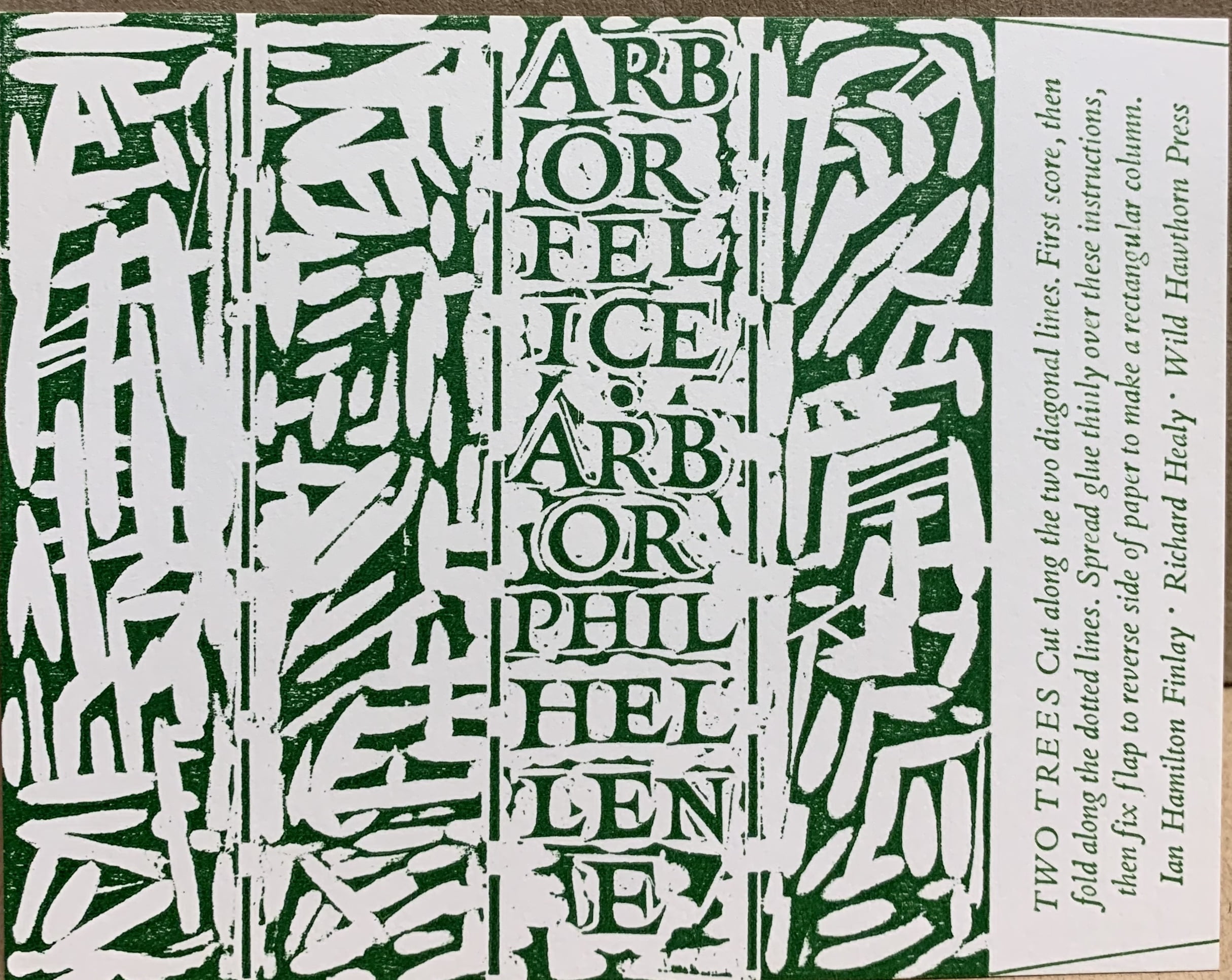
ARBOR FELICE ARBOR PHILHELLENE
9.3 x 11.7cm, 1pp green on white. A four sided stand up to create a geometric form of tree trunk with the text "ARBOR FELICE ARBOR PHILHELLENE". One translation is "The tree "suckles you" you lover of Greeks" (our flawed translation) but there are other alternatives it seems. VG+
The second card is
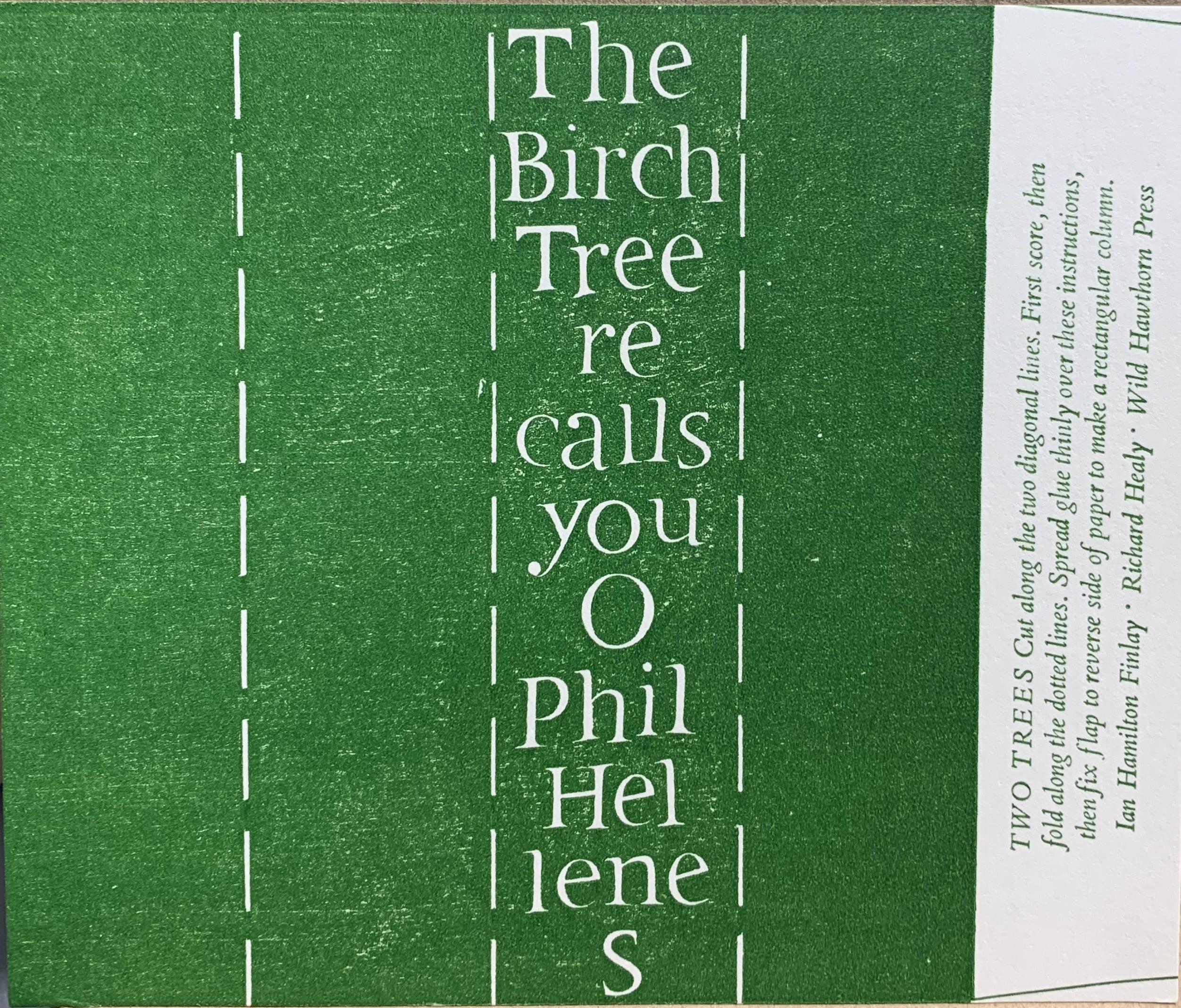
THE BIRCH TREE RECALLS YOU O PHILHELLENES
11.6 x 14cm, 1pp green on white. A four sided stand up to create a geometric form of tree trunk with the title text. Again praise for those who praise the Greeks. Birch trees only just grow on the northern borders of Greece and also in colder, higher areas.
These two card sculptures are paired - and there are large scale tree plaques by Finlay that also bear the inscriptions and are expected to be exhibited/installed together. VG+.

...

Dunsyre, : Wild Hawthorn Press, (1982)
7.5 x 9.5cm, 12pp plus card wrappers and printed white dust jacket.
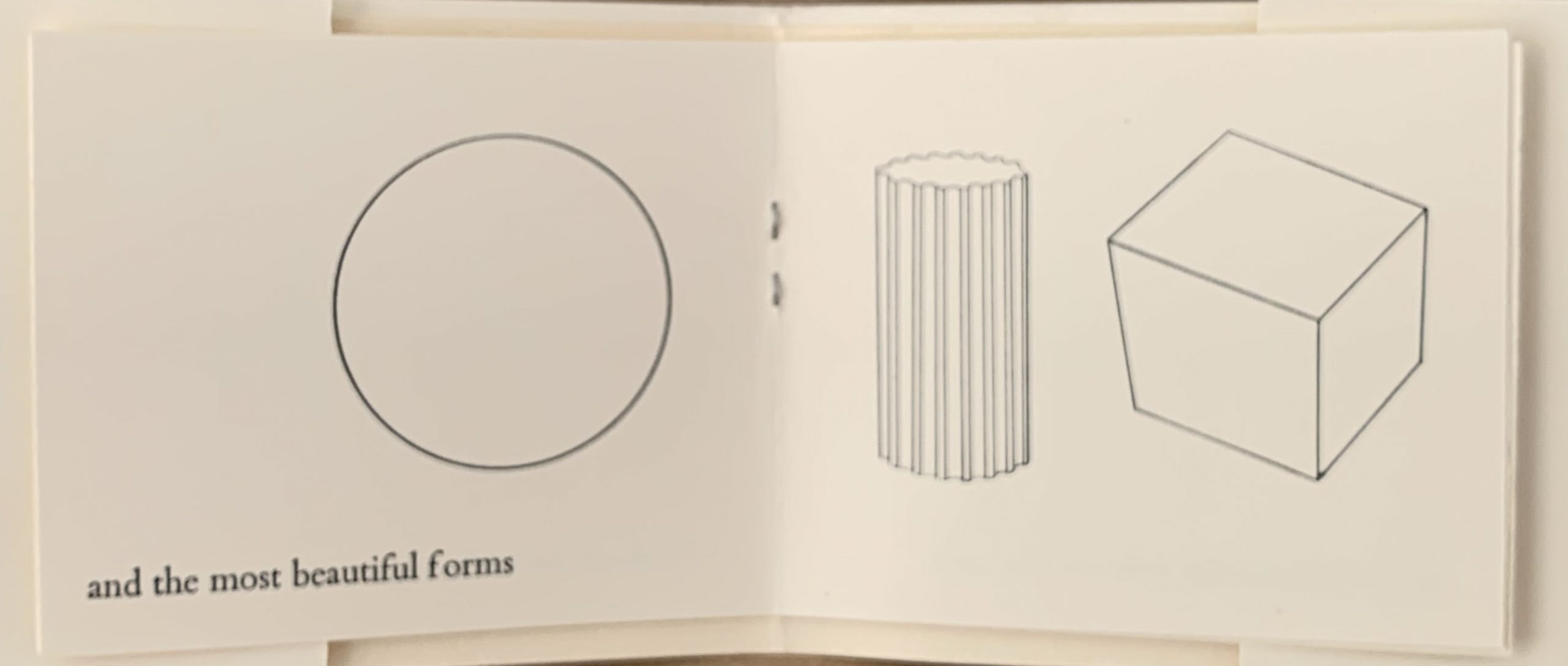
Artist's book with a drawing of a circle, a classical column and a cube by Ian Gardner. The text is "Volume makes beauty/ and the most beautiful forms" with the latter on the page with the drawings "are the sphere, the cylinder, the cube." a quote from Vitulio from the 12th century. (One is reminded of Paul Cezanne's similar statement).
Finlay has replaced the cylinder with a classical column - changing Vitulio's statement into a promotion of neo-classicism. VG+

...

Dunsyre, : Wild Hawthorn Press, (1982)
7.5 x 9.5cm, 12pp plus card wrappers and printed pink dust jacket.
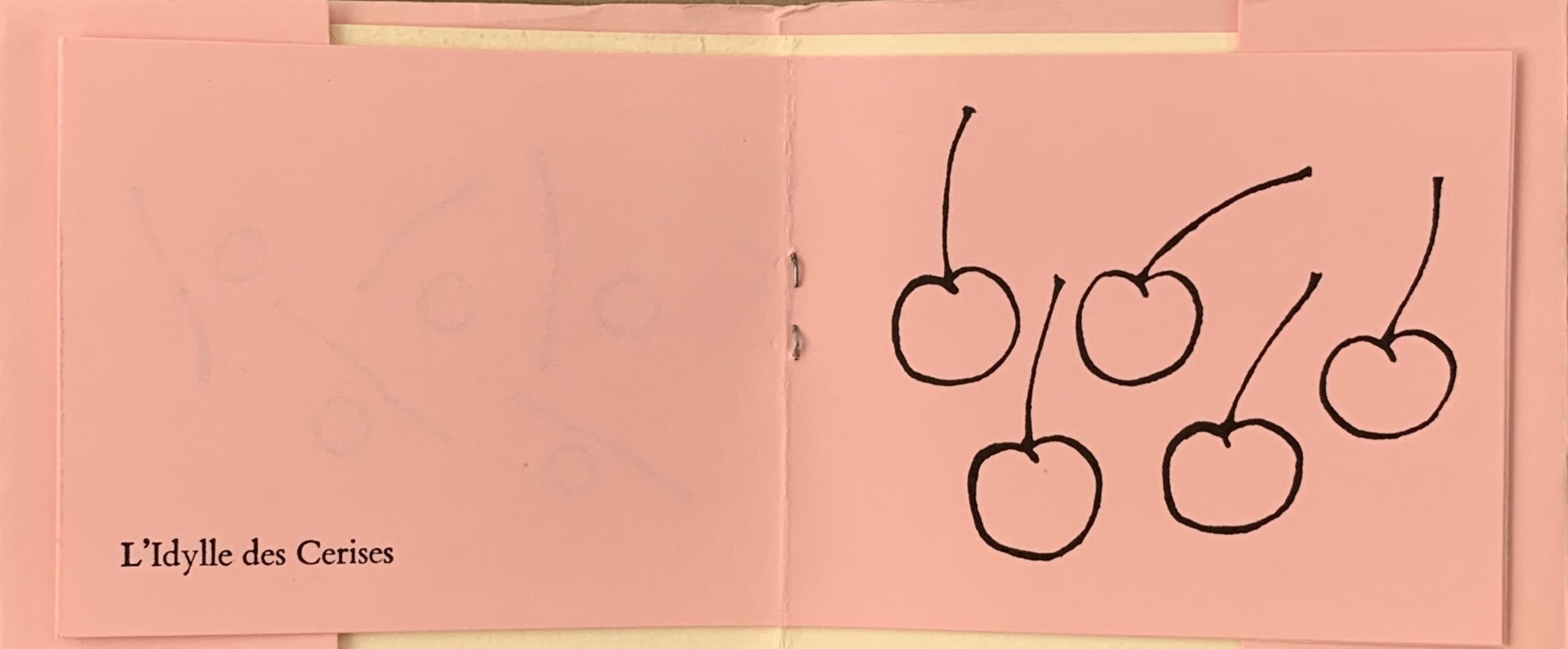
Artist's book with two drawings by Ian Gardner - one entitled The Orgy of The Cherries - where the stalks and stones are scattered and L'Idylle de Cerises where the cherries are uneaten and the stalks still attached. The L'Idylle de Cerises is a reference from a chapter heading from Rousseau's Les Confessions. Cherries are associated with sexual pleasure and Rousseau mentions them in a context of mild desire. The book (printed on pink to reflect the colour of the fruit) shows the detritus of cherry eating - with all the stones scattered - as a metaphor for an orgy when all the participants are exhausted and strewn across the bed. VG+.

...

Crown Point Press, 1982
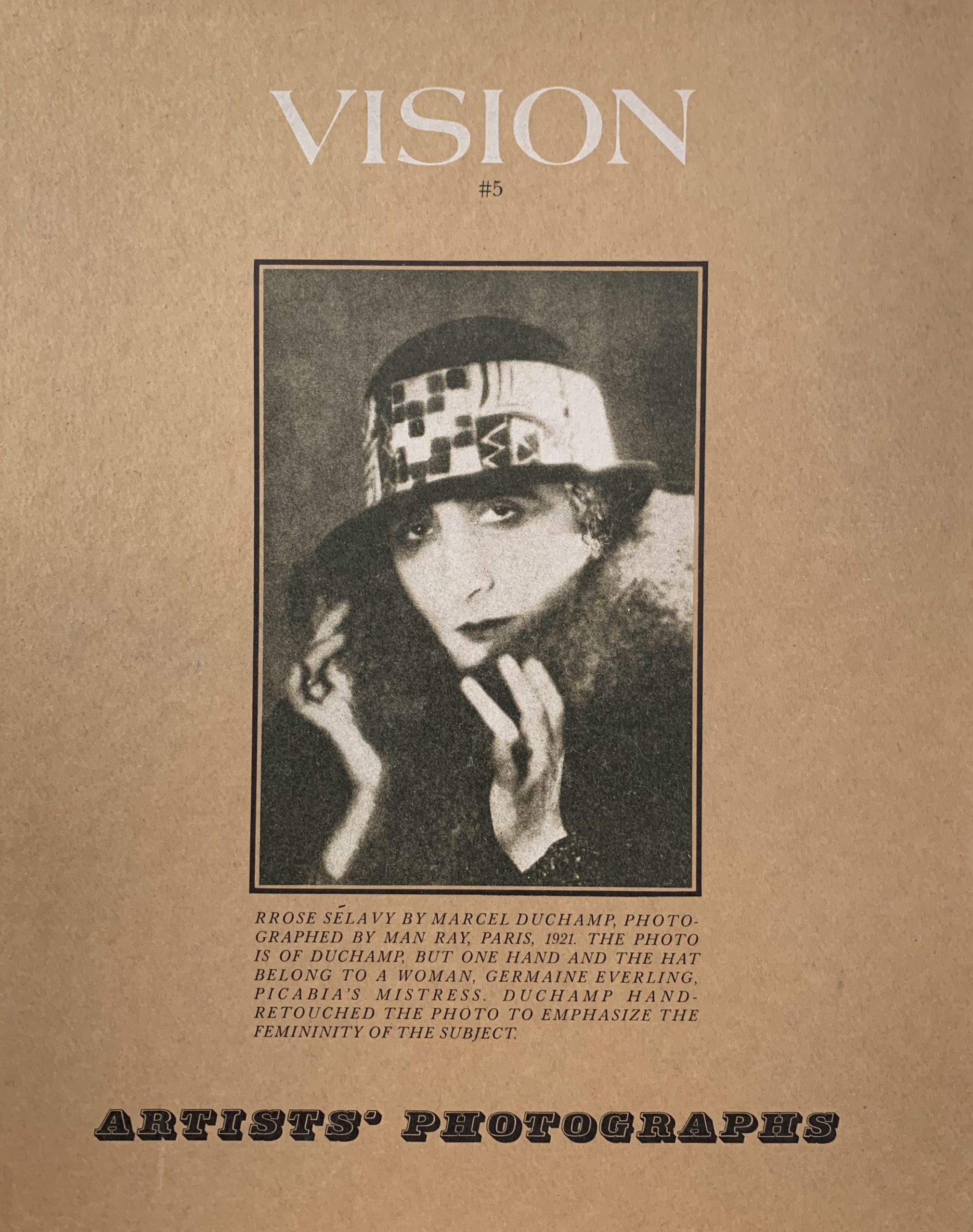
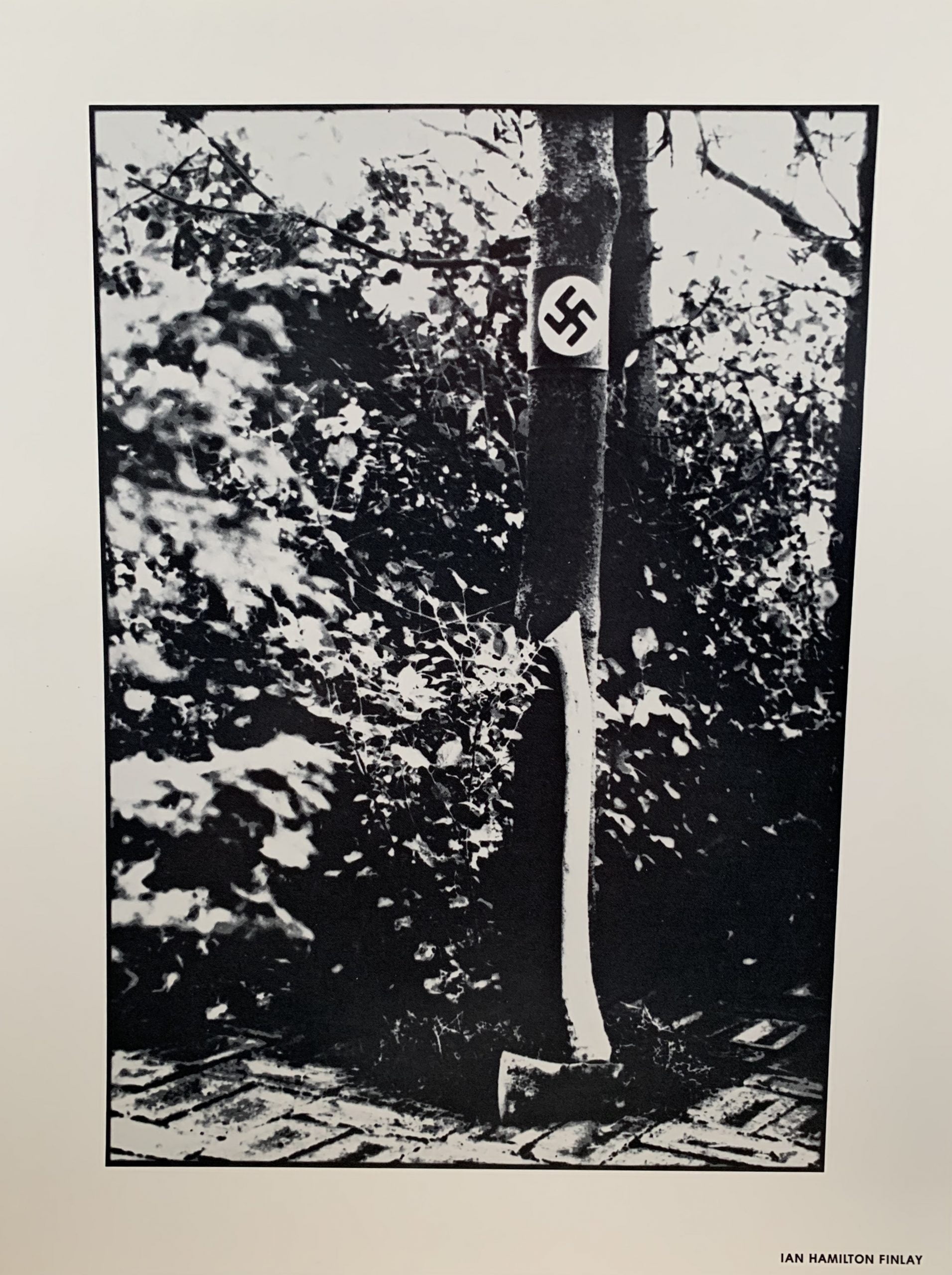
26 x 21cm, two part folding portfolio box with tipped on label. Vision is a monographic journal of contemporary art edited and curated by Tom Marioni. This boxed catalog of artists' photo reproductions, each printed on glossy heavy weight paper. Artists include Vito Acconci, John Baldessari, John Cage, Joan Jonas, Sol LeWitt, Ricahrd Tuttle, Richard Long, Dorothea Rockburne as well as Ian Hamilton Finlay. who has an untitled view of a tree with a swastica band and an axe sculpture. Limited edition but edition size is not noted. VG+ in like box.

...

Dunsyre, : Wild Hawthorn Press, (1981)
12 x 12cm, 40pp plus card wrappers and printed photo-pictorial dust jacket.
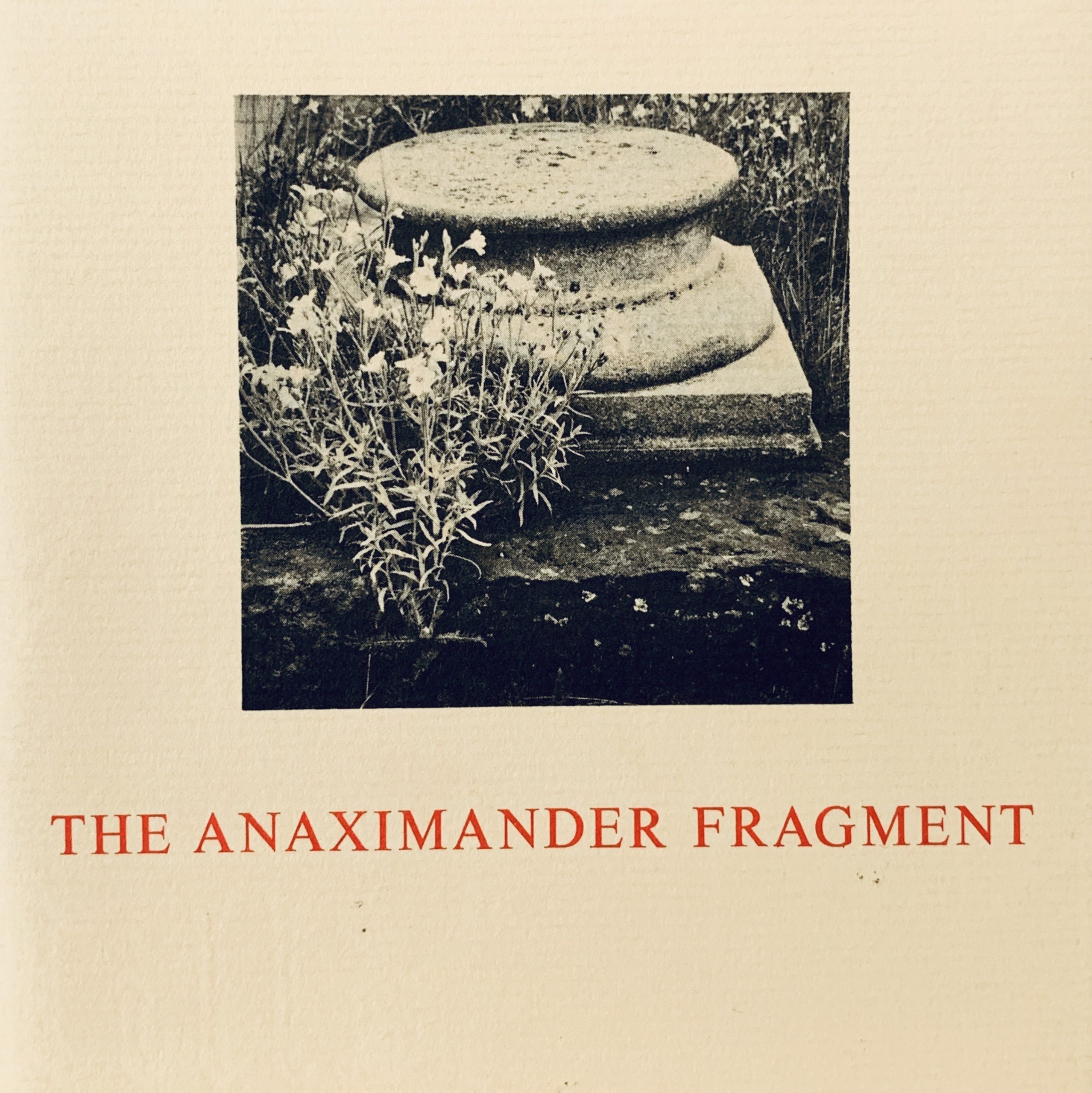
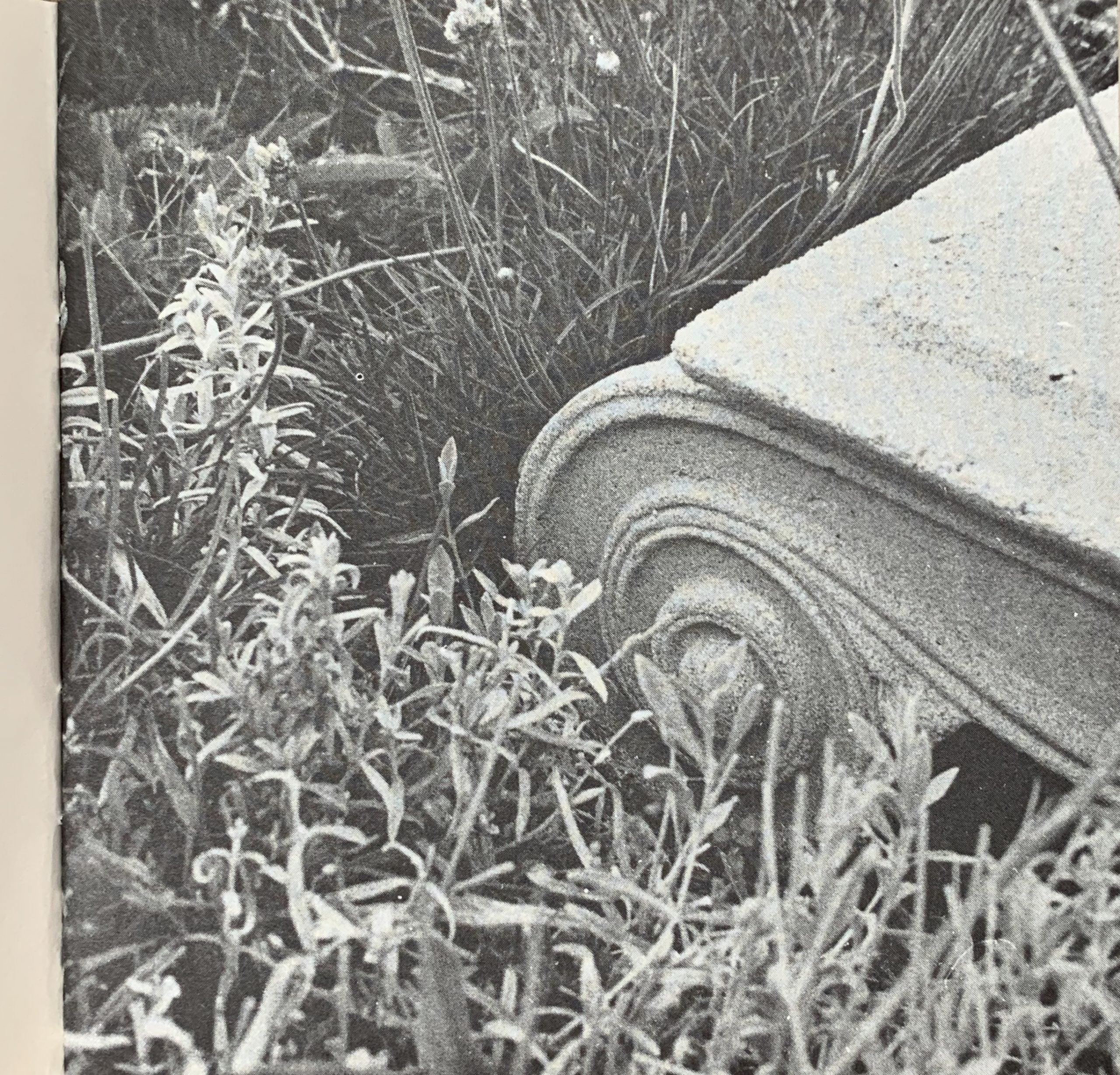
Artist's book where Finlay has placed translations of the Anaximander Fragment (the earliest known extant philosophical thesis) opposite images of a broken classical column and its base found in the extended grounds of Little Sparta (then Stoneypath). The column was of course deliberately partly destroyed as the original artwork. The images, in b/w , were by Harvey Dwight.
The philosophers cited here are Diels, Nietzsche, Heidegger, Jaeger, Weil, Kahn, Kirk, Hussey, Burnet, Lloyd-Jones and Jaspers.
The fragment from Anaximander (600 BC) is a statement about how life has to make way for death out of necessity and each translation has subtle different meanings. Of course, the fact that only a tiny amount of the thoughts of Anaximander has survived into the present day is a mirror of the ruined (by intent) column.
The consideration of man's death is a major theme running through much of Finlay's output - and this falls heavily in the middle of his fascination of momento mori and similar works. VG+ example of a very scarce book.

...

Dunsyre, : Wild Hawthorn Press, (1981)
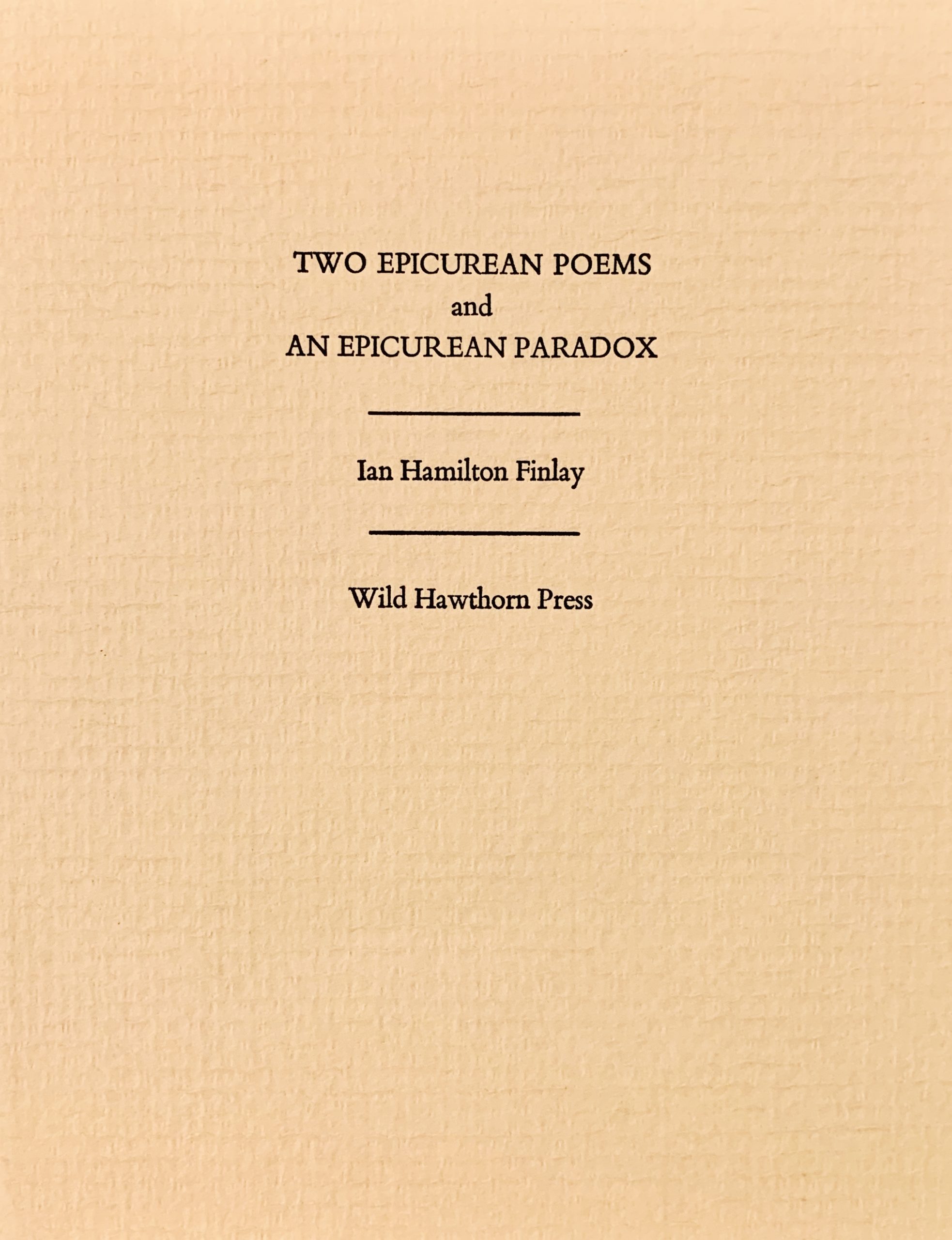
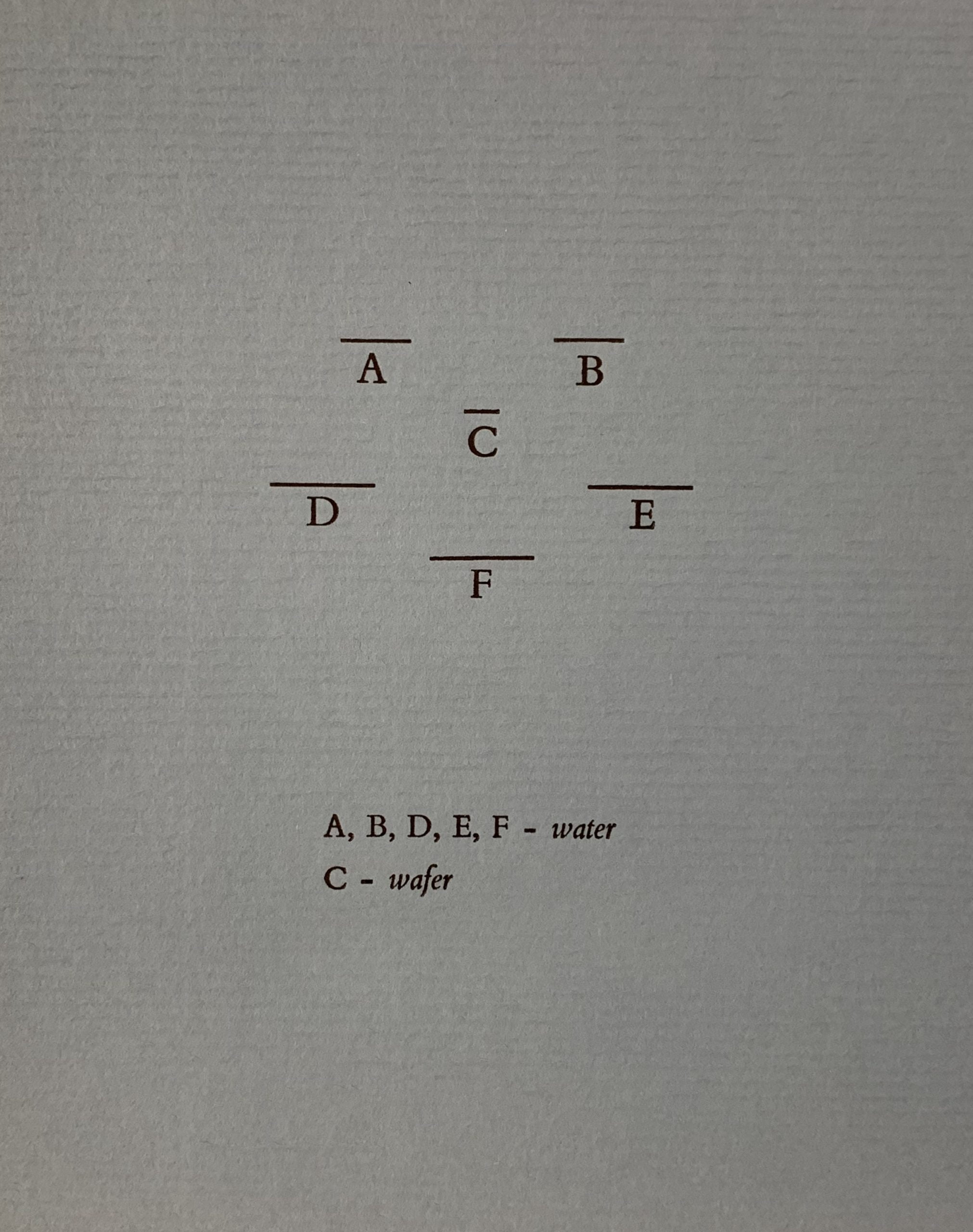
17.8 x 13.9cm, light brown outer folder content of three 1pp sheets each with a concrete poem on them. The first two are on blue card and are presumably the two epicurian poems - the first has lines which represents a wafer surrounded by water (a wafer being a dry slice of something may be seen as land and the water as sea hence the whole an island), the second shows descending lines of water and one representing a bird swooping vertically down. These works remind one of a modern typographic equivalent of Apollinaire's calligrammes.
The final work is on orange paper (Finlay often used these colour combinations)and shows a triangle and a circle - the first is meant to be the scent of oranges, the second the scent of pears. The citrus of oranges is sharp like the corners of the triangle. This latter poem is meant to be a paradox and that is because of the shapes - the "Sharp" orange is not round while the pair is not a triangle which broadly is the shape of a pair..
Epicurean philosophy promoted simplicity, enjoyment and calmness as the way to a better life. In modern times the word is more associated with someone who enjoys food. Finlay seems to be happy with the simple life.
These works are usually placed in the artist's book section of Finlay's raisonne but there is a strong case for them to be small prints. But for now we have retained them in the former category. VG+ in like folder.

...

Little Sparta: Wild Hawthorn Press, 1981
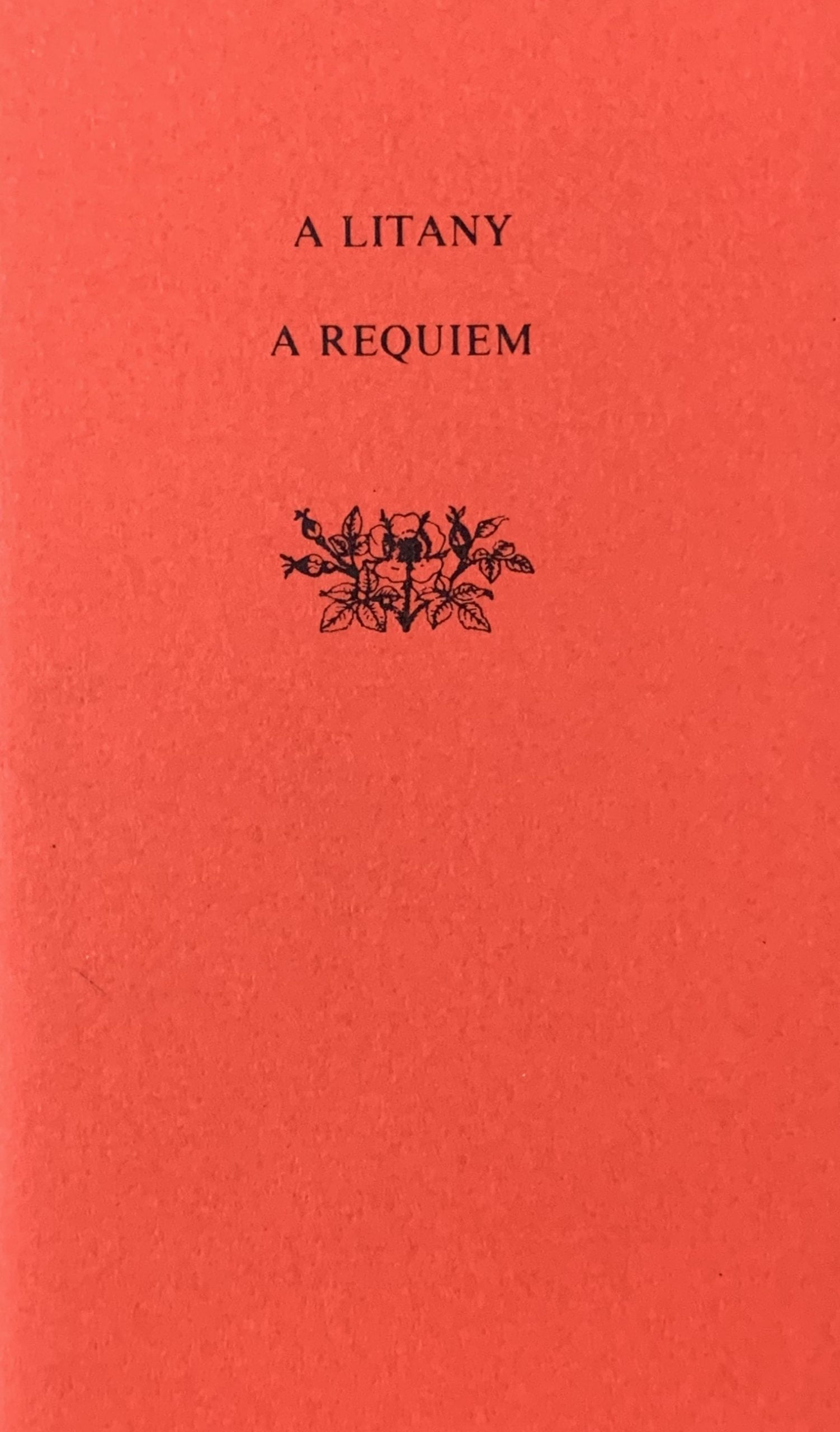
9.7 x 5.7cm, 8pp plus printed red wrappers. Artist's book which lists two groups of names - the first Angelique, Tilleul, Pavot, Serpolet, Cheverefgeuille and Thym are listed as "a litany for Prairial". These are French names for herbs and Prairial is not only the Ninth revolutionary month (beginning in May) but also the time when the Law of 22 Prairial, also known as the loi de la Grande Terreur, was passed that gave power to the Committee of Public Safety that Robespierre turned into the dictatorship of the Terror. Herbs, of course, are picked and chopped up and consumed.
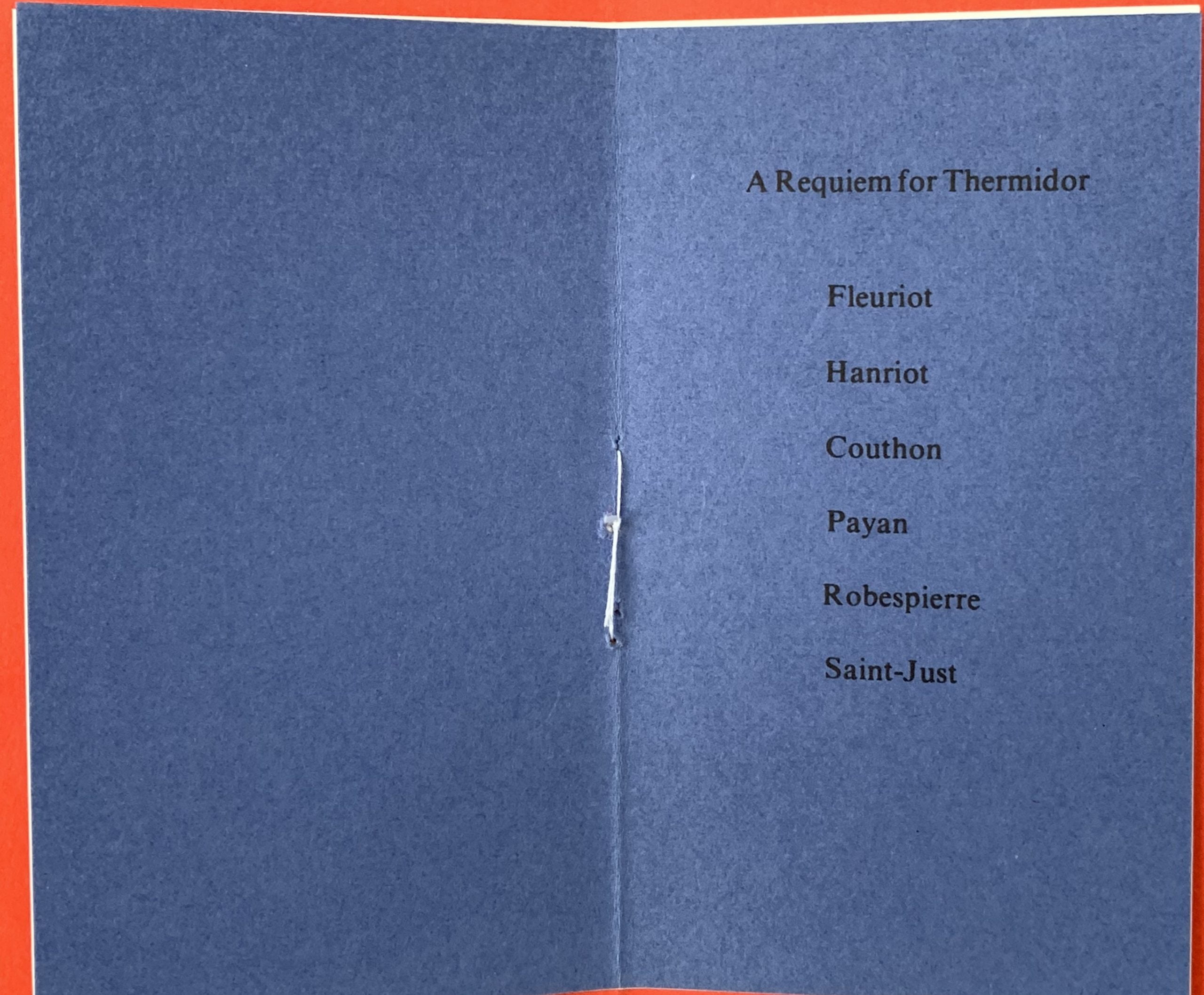
The second list "A requiem for Thermidor" has the names of the members of the Committee of Public Safety - Fleuriot, Hanriot, Couthon, Payan, Robespierre and Saint-Just. These were the victims of their own Terror when they were guillotined during the Thermidorian reaction (Robespierre went to his death in severe pain as he had tried to commit suicide only to partially blow off his own jaw in the attempt, Saint-Just was dignified and stoic).
The colours of the book papers are red, white and blue - the colours of the republic's tricolour.
The Litany is one of religious praise - here for the spring but with foreboding and foreshadowing of the destruction of the Terrorists. The requiem a cry of pain for the deposed leaders who killed so many by dictat.

...

Little Sparta: Wild Hawthorn Press, 1981
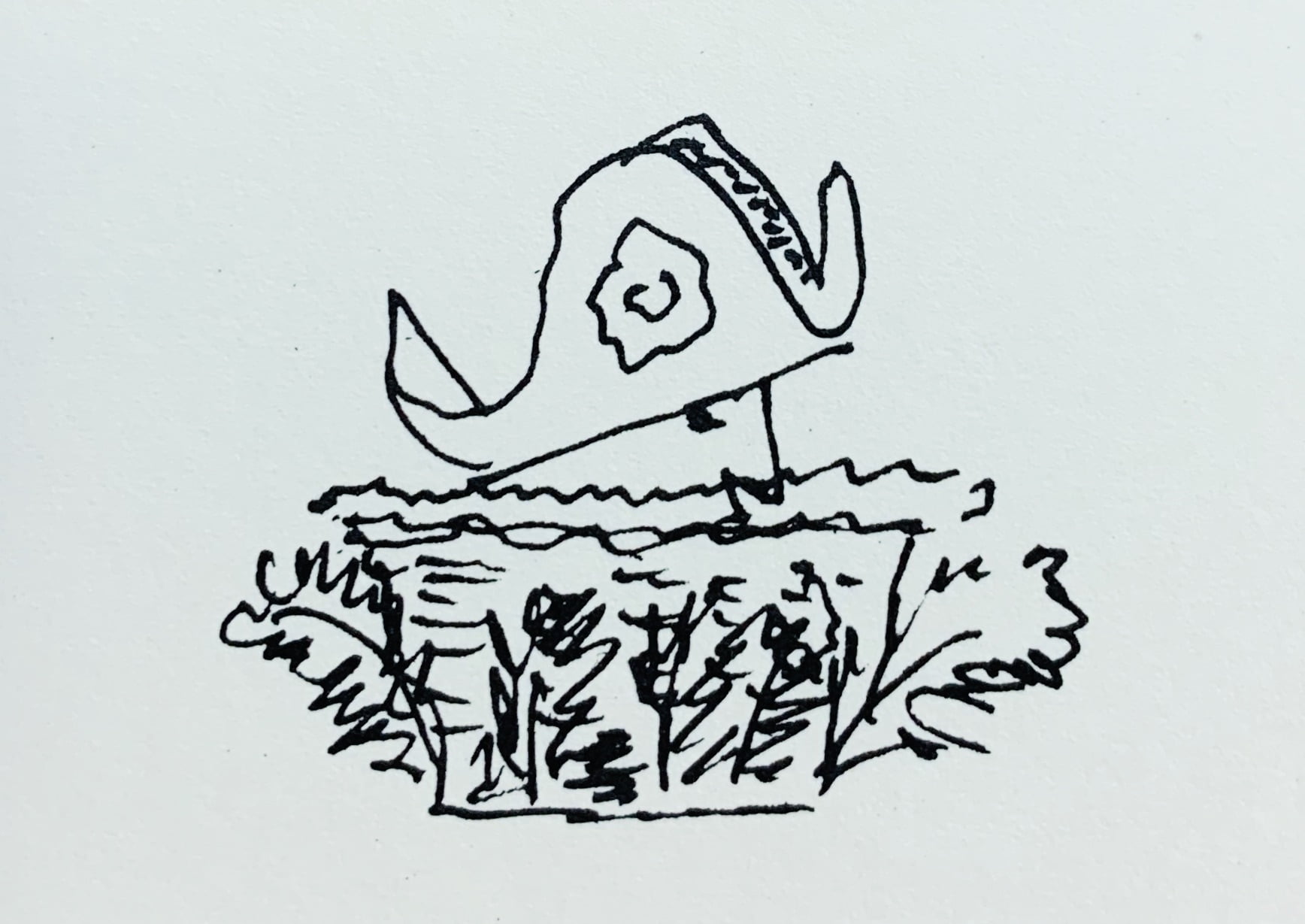
5 x 7cm, 4pp. One of Finlay's smallest cards - here with a drawing by Lucius Burckhardt of a face with a republican hat above a capital from a classical column. not the best sketch ever as it looks jumbled and hard to see but there you have it. Inside the card is one of Finlay's "definition" works - the double meaning of the "A REPUBLICAN CROWN" is joined with a quotation from Gerd Neumann about Callimachus the Greek poet of the disappearance of a capital which reads like word salad. You can take from the above that this is not my favourite of cards.

...

Shopping cart0
There are no products in the cart!
Continue shopping