Dunsyre: Wild Hawthorn Press, n.d. (1979)
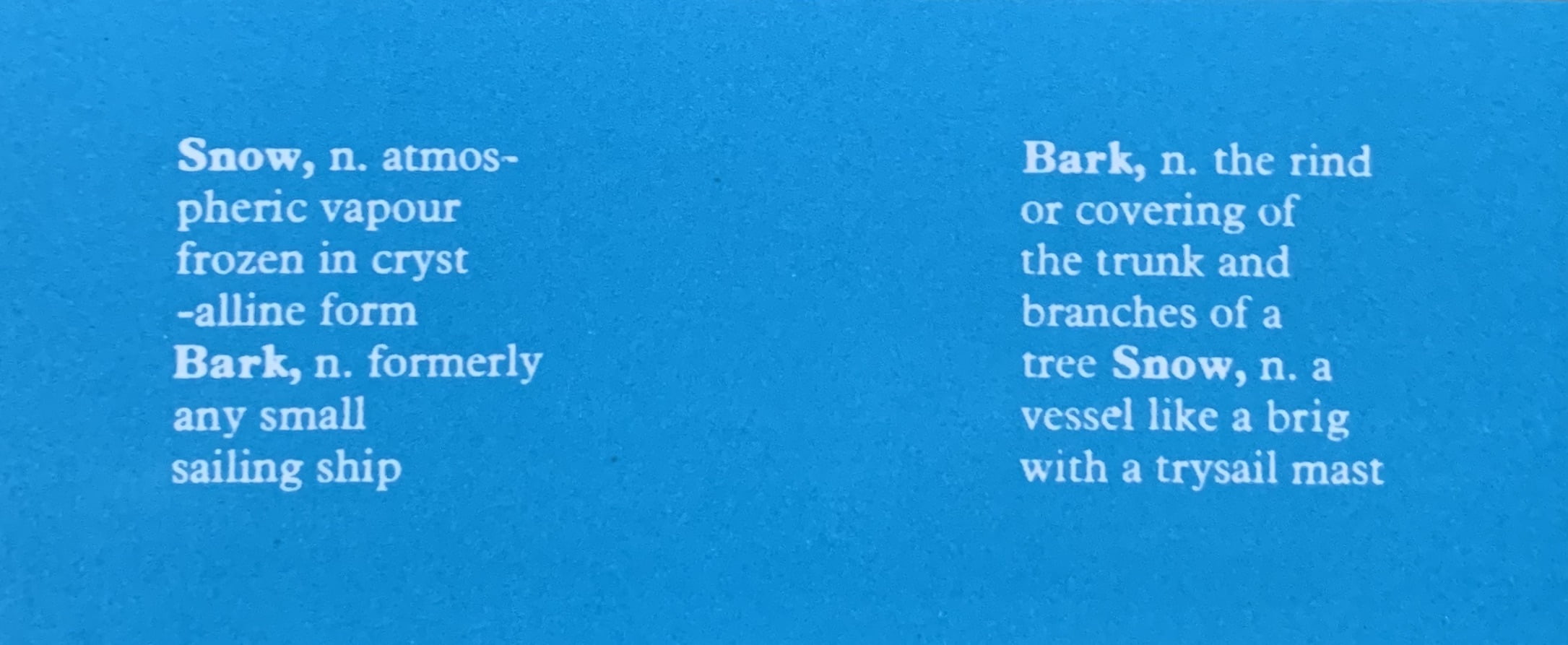
5.5 x 13.5cm, 1pp blue on white card. The words Snow and Bark are both given definitions with on the left hand side the order being Snow then Bark. That combination of the words and definitions together conjure up an image of a white boat (possibly in snowy weather). On the right when reversed (so that the words read Bark then Snow) then the image is of a different ship - a wooden boat.
Both snow and bark can be names of types of boats.
A typical Finlay word picture - a poem created by combinations of double meanings. VG+.

...
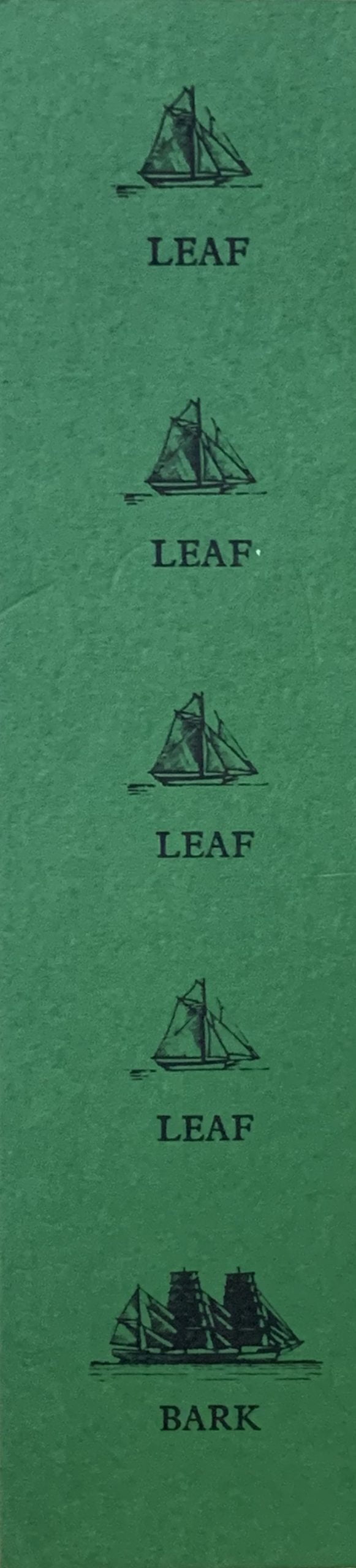
DUnsyre: Wild Hawthorn Press, n.d. (1979)
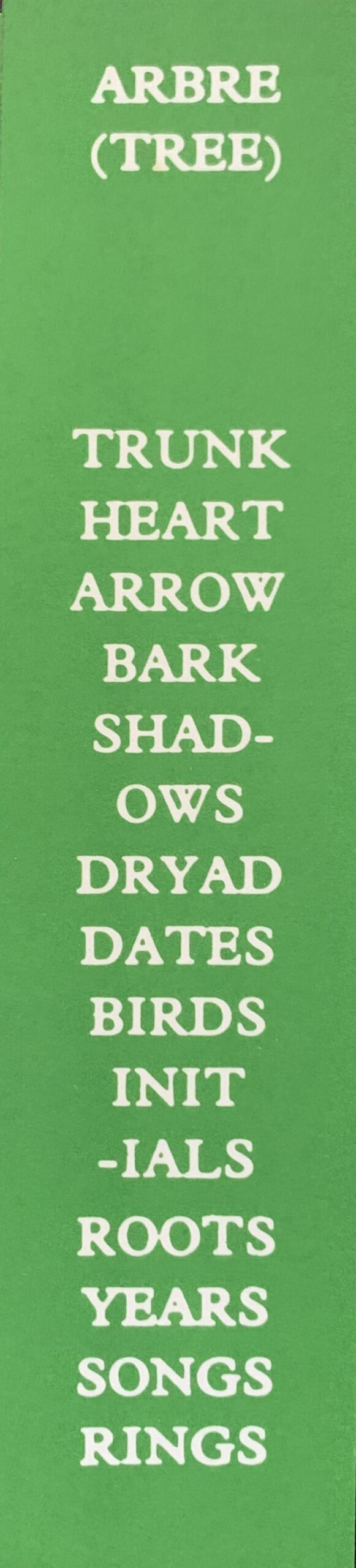
15.8 x 3.6 cm, 1pp green on white card/bookmark. The text is a list of words associated with a tree including mythical beings such as a Dryad, insults to the trunk - carved "initials", and ways of considering the tree as a person - heart. The long column of words of course also reflecting the shape of the tall tree. Arguably an object multiple as much as a postcard but we have decided to retain it in the artist's card section. VG+.

...

Dunsyre: Wild Hawthorn Press, n.d. (1979)
19.8x 16.6cm, 16pp plus card covers and printed dustjacket. Finlay's artist book examines six variations of the nazi SS logo - taking the original FF found in literature and noting how the letters were commonly substituted for SS in 17th century texts and, through typography developing the type into the double lightning strike of the notorious fascist organisation. Hence Finlay suggests there is some poetic equivalence between the evil of the Nazis and the "wildness" of nature - which Finlay makes clear in a note at the end of the book. (And anyone wishing to slur Finlay as being pro-fascist should read his description here of the SS as "notorious". Typography by George L.Thomson. VG+. Scarce.

...

Little Sparta: Wild Hawthorn Press, n.d. (1979) 15.8 x 3.6cm, 1pp bookmark - the first edition of this small paper multiple which lists various words associated with trees in a column with the placing of each word relative to the physical structure of the arboreal structure. The bookmark was reprinted by the Morningstar Press, VG+. ...

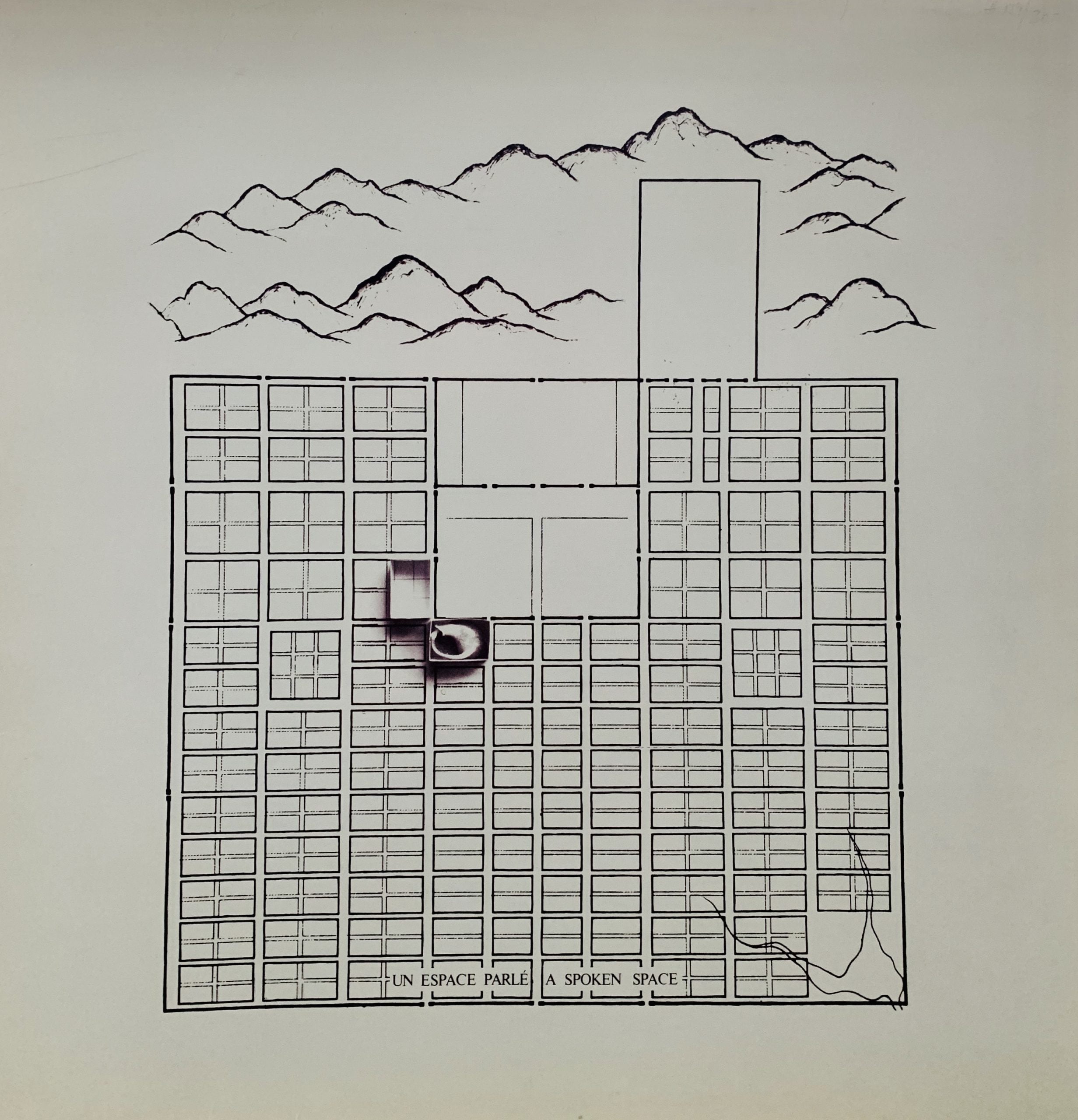
Geneva: Galérie Gaëtan,1979 31 x 31cm, double gate fold record sleeve content of a 30.5 x 30.5cm, 12pp exhibition catalogue for a group show of spoken and sound work to which Finlay is credited as a contributor.
Finlay has made very few sound works (this may well be the only one designed to primarily exhibited as a work in sound) and the reading is based on the paintings of Ivon Hitchens.
The work is called IVON HITCHENS: AN IMAGINARY EXHIBITION. The texts were read by Ronnie Duncan and Henriette Duncan. The work was only available via automatic answering machine for 24 hours a day for 8 days.
this is a very hard to find exhibition catalogue in VG+ condition.

...

Dunsyre: Wild Hawthorn Press, n.d. (1979)
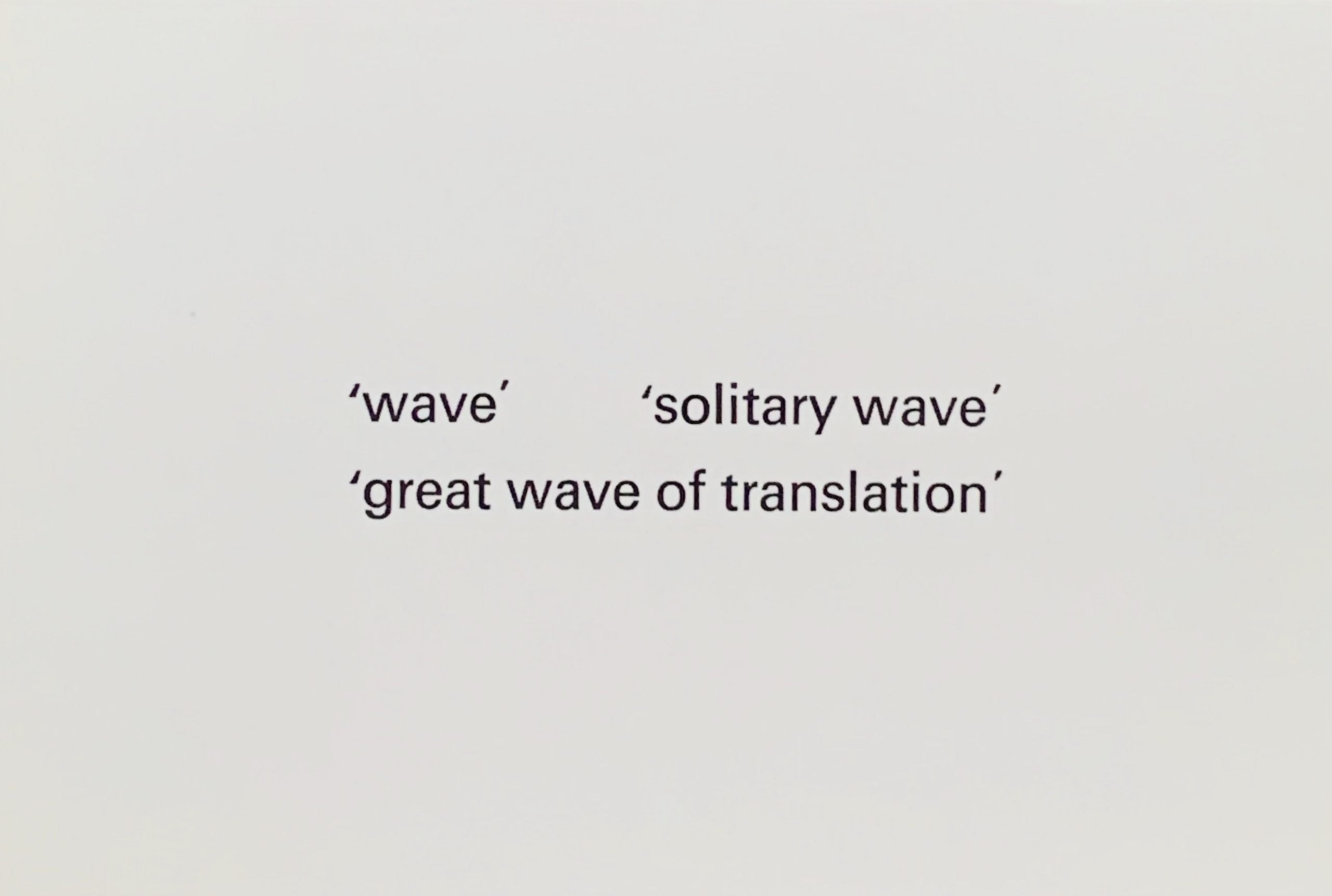
10.5x 15cm, 2pp. A typographic version of Finlay's earlier Wave work in which a word is transformed by the letters being re-ordered. But additionally this is a dialectic with "wave" being thesis, "solitary Wave" being antithesis and "great wave of translation" being the synthesis.
The "great wave of translation" also references the proof-reader's mark for transposition.

...

Little Sparta: Wild Hawthorn Press, 1979
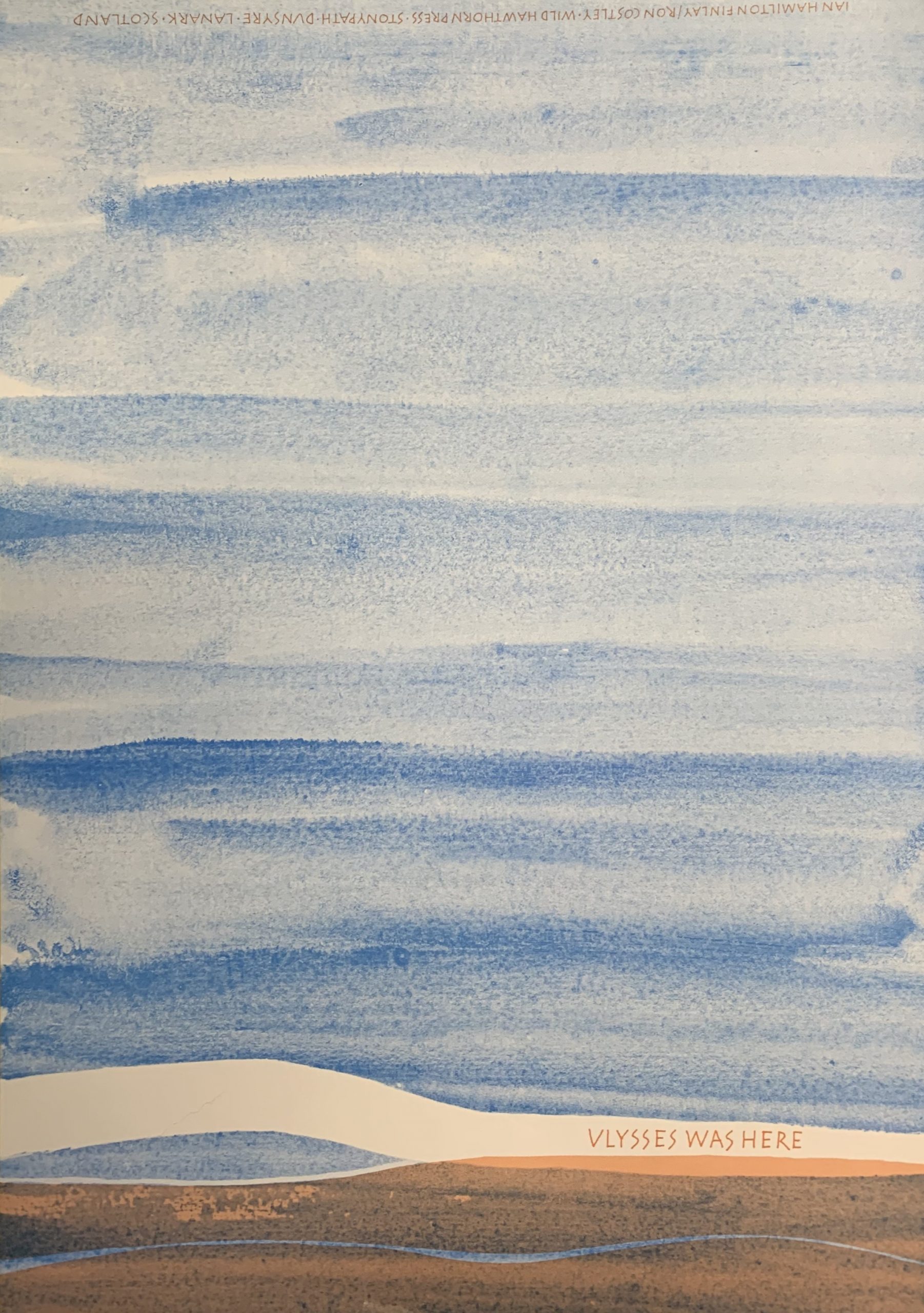
29.6 x 21cm, full colour offset lithograph with a painting by Ron Costley. The landscape shows where Ulysses had been - but without any landmarks to clearly identify the location. Hence like Ulysses you are lost.
Moreover the phrase "Ulysses was here" also refers to the wartime graffiti "Kilroy was here" as if Ulysses had left his mark on an unknown island.
Interestingly this was original designed to be a folding card and as a result the address of Little Sparta is printed upside down at the top of the sheet. Some copies of these prints were folded by G+Finlay but this is one of the unfolded VG+ examples.

...

London: Coracle Press, 1979
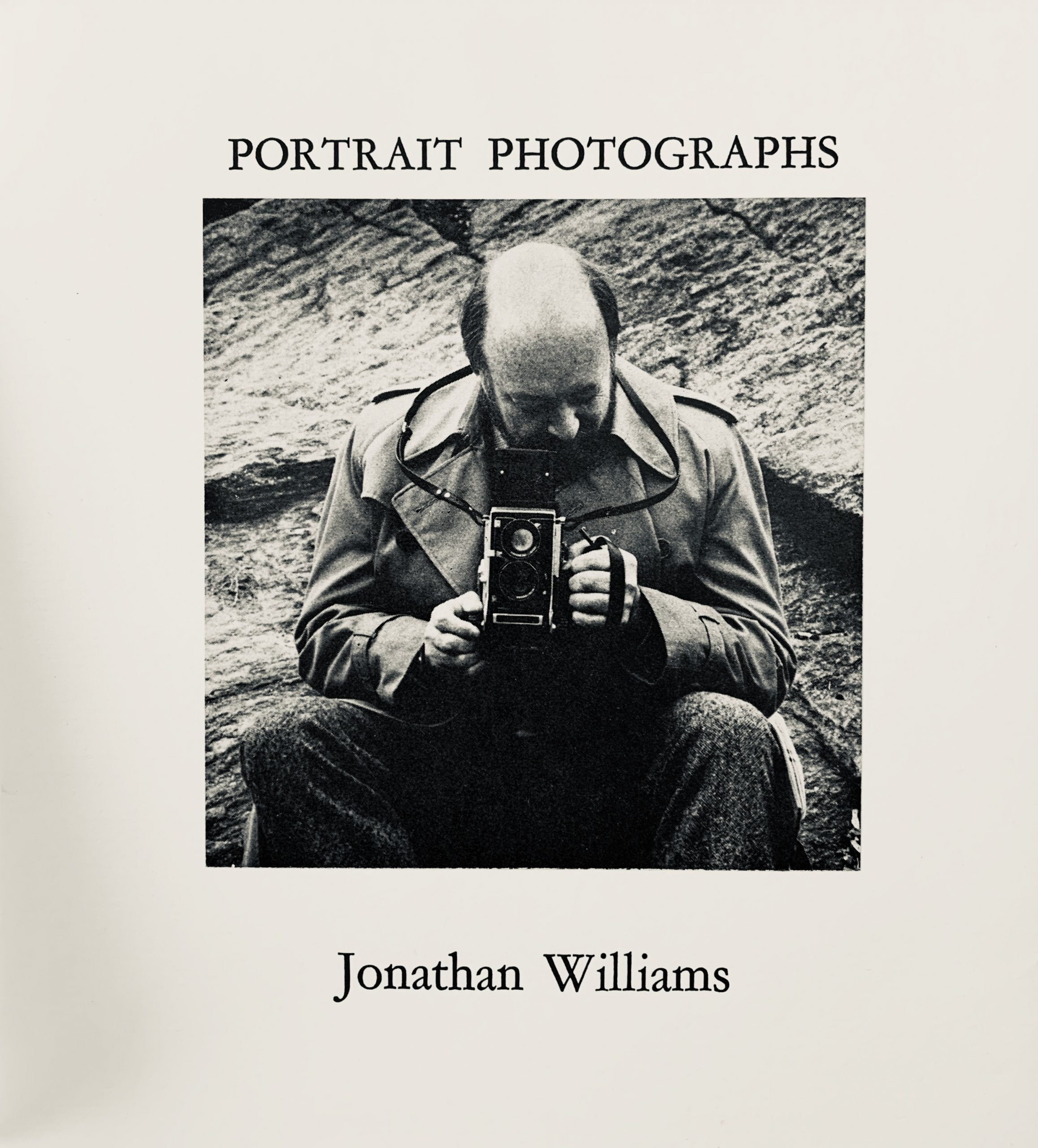
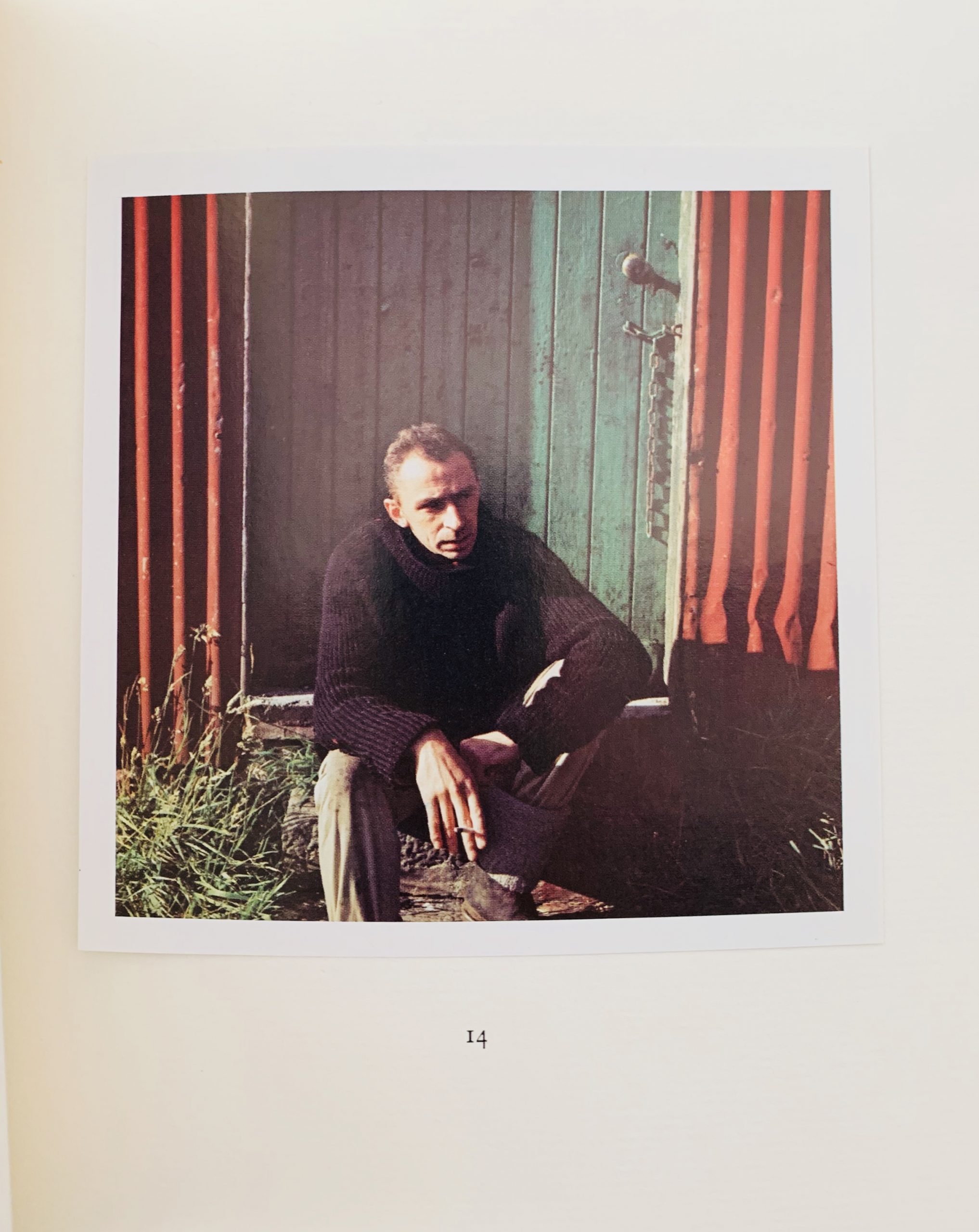
21 x 19cm. 40pp plus card covers with tipped on self-portrait. First edition of William's photographs of poets and artists with reminiscences. There are 30 tipped in colour reproductions including William Carlos Williams, Myrna Loy, Herbert Read, Allen Ginsberg, David Hockney, Dorothy Brett as well as Ian Hamilton Finlay. One of 1800 numbered copies. VG+.

...

Little Sparta: Wild HawthonePress, n.d. (1979)
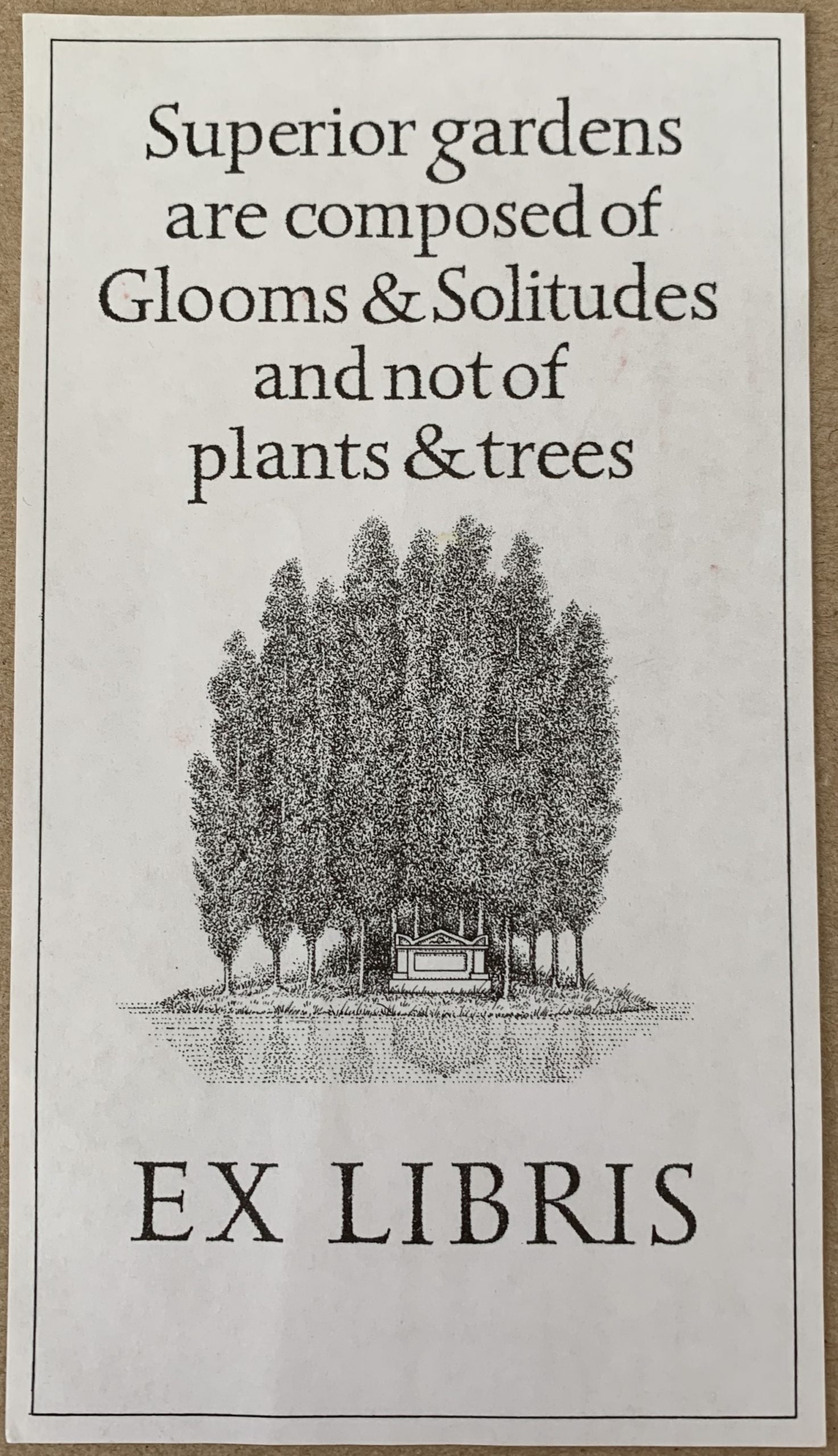
12.5 x 7cm, 1pp, adhesive back ex libris slip. The design has an uncredited drawing of a cemetery island with crypt and the epigram by Finlay: "Superior Gardens are composed of Glooms & Solitudes and not of Plants & Trees." The work might be seen as a momento mori as well as a comment on Finlay's thoughts on how to create a successful and complex garden. Not in Murray.

...

Dunsyre: Wild Hawthorn Press, n.d. (1978)
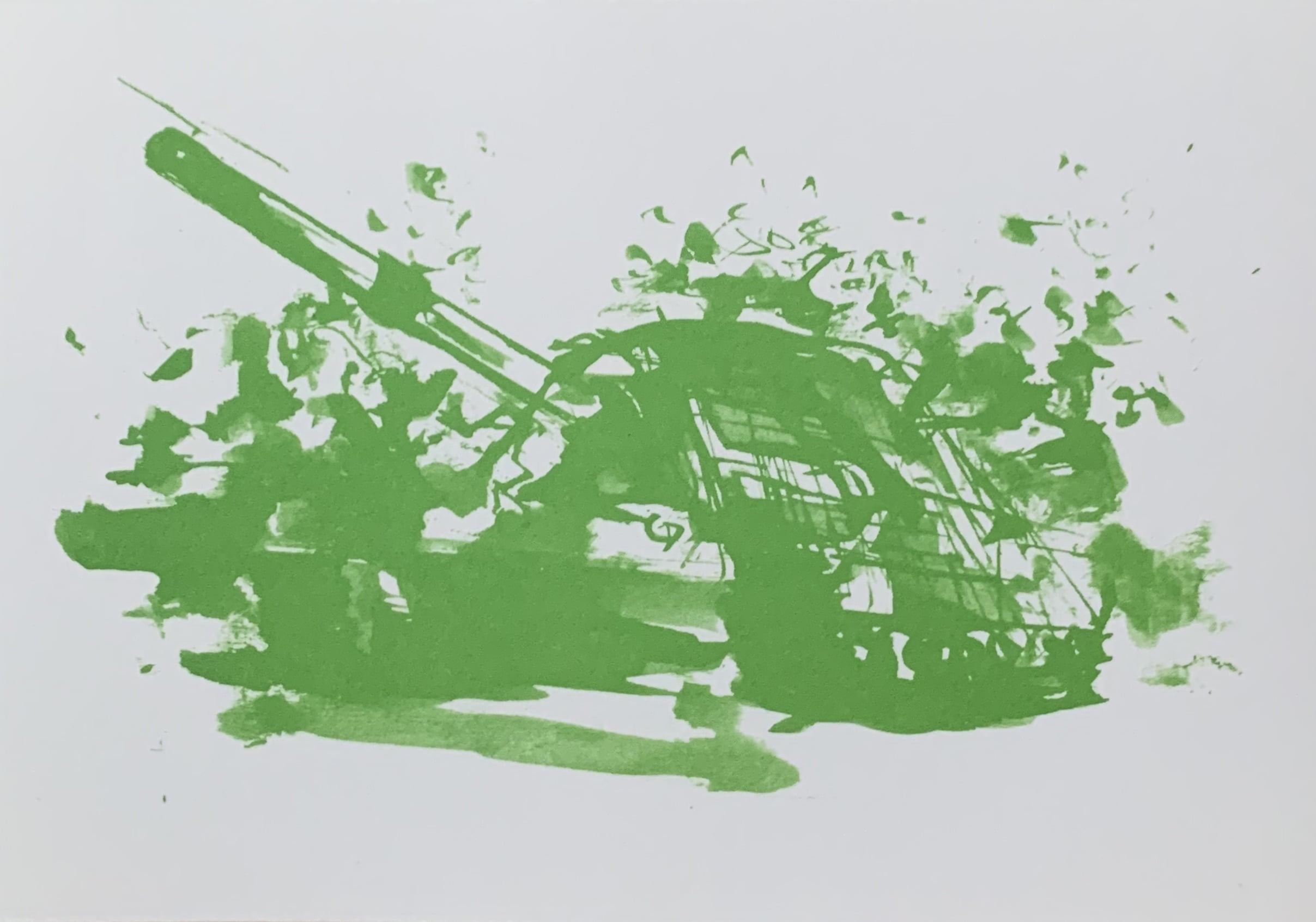
10.5 x 15cm, 2pp. The painting on the front of a tank pushing through the undergrowth is entitled after Stalin's famous rhetorical question "How many divisions does the Pope have?" - only Finlay asks it of Arcady, the mythical rural utopia. This is one of a long number of momento mori by Finlay - the weapons of death have invaded Arcadia and soon all that my be left are ancient skulls.

...

Little Sparta: Wild Hawthorn Press, n.d. (1979)
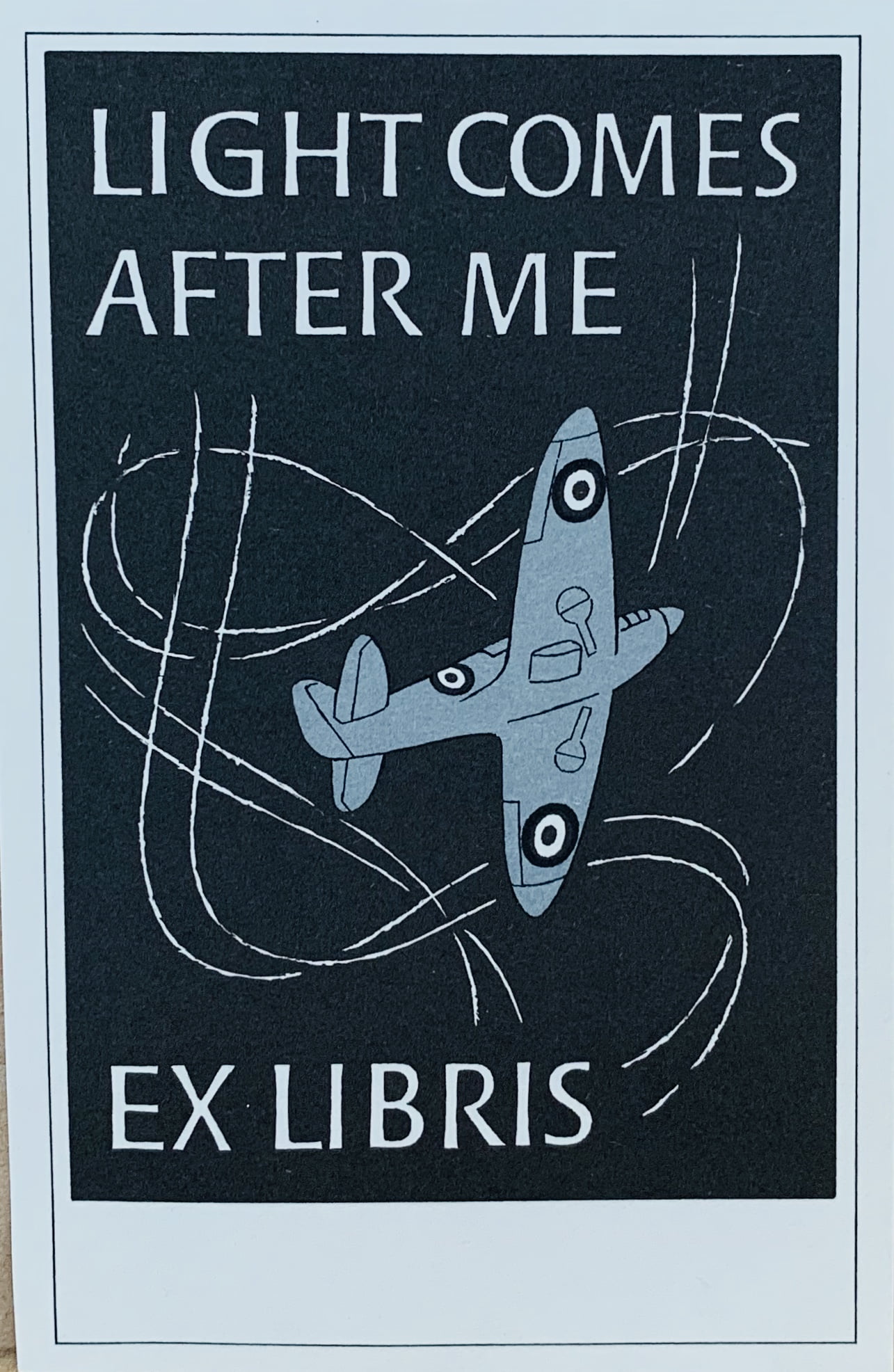
10.8 x 7cm, 1pp, adhesive back ex libris slip. The design has an uncredited drawing of a Spitfire plane moving amongst searchlight. The text being a religious reference. The label was printed for an exhibition in the London V & A. Murray 7.19.

...

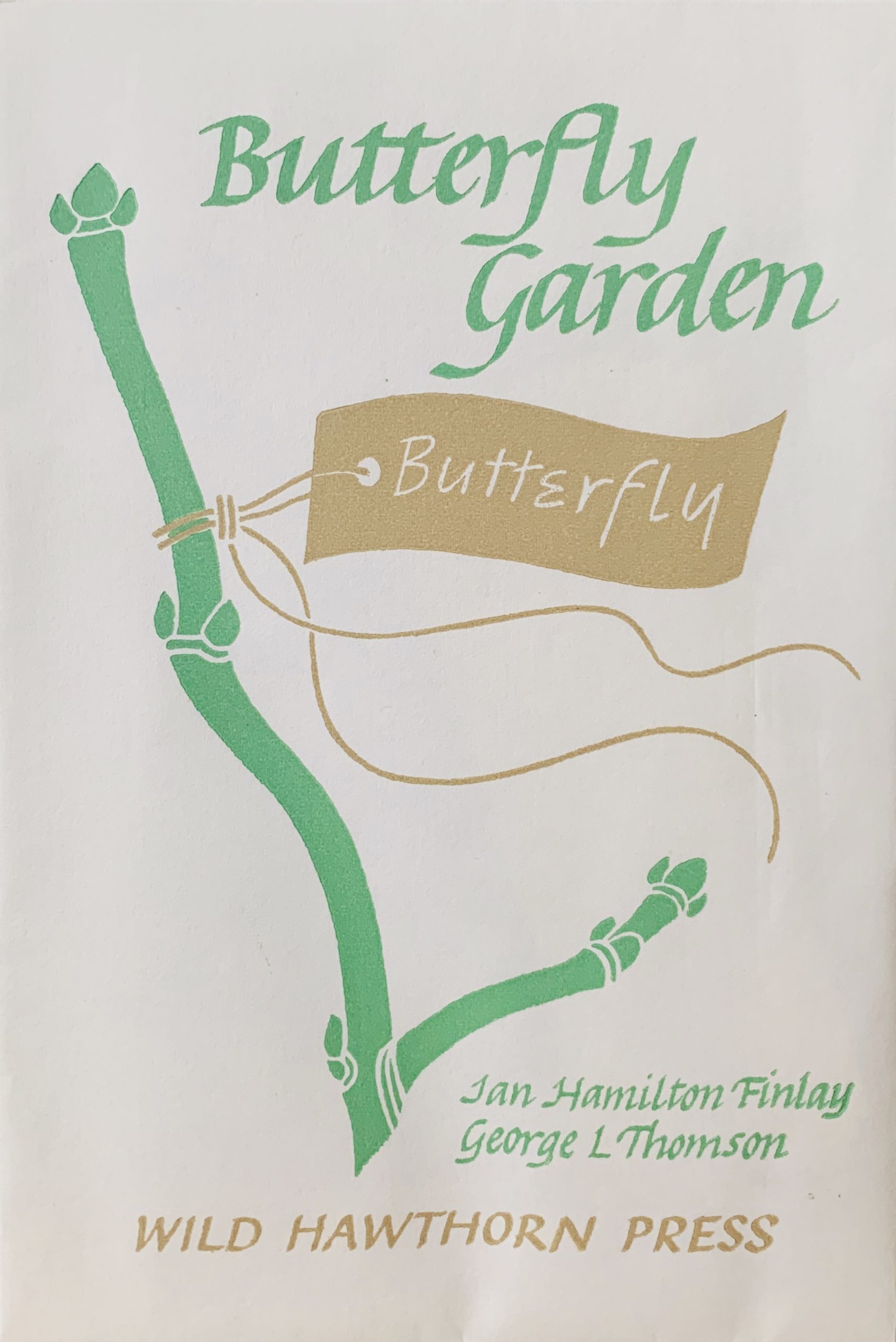
Little Sparta: Wild Hawthorn Press, 1979 19 x 13cm, closed envelope content of twelve tags (each with the word butterfly printed on them) and ties which are to be added to growing plants in a garden to flutter in the wind and hence metaphorically add butterflies to any plot. Drawing by George L. Thomson. VG....

Shopping cart0
There are no products in the cart!
Continue shopping