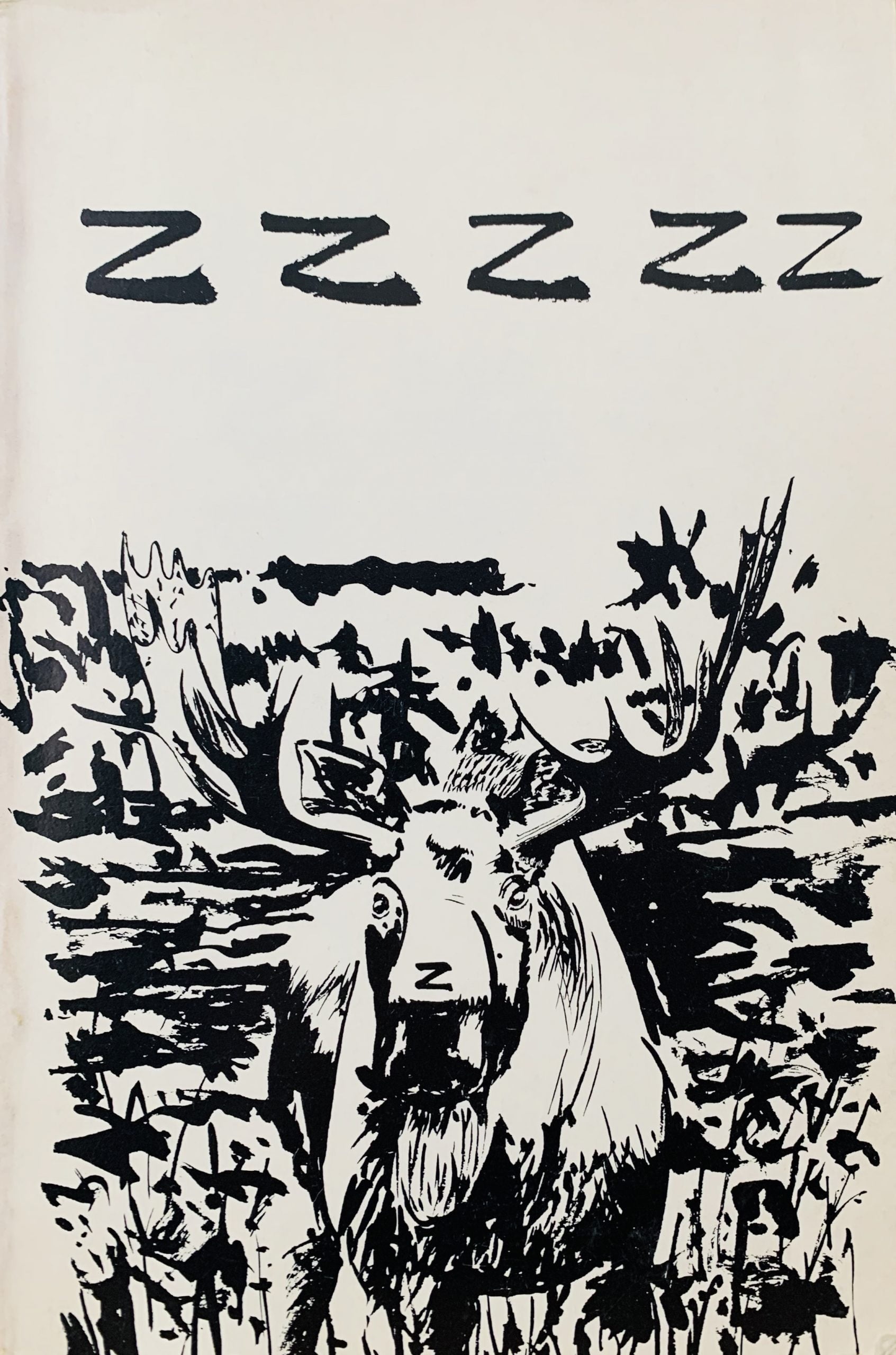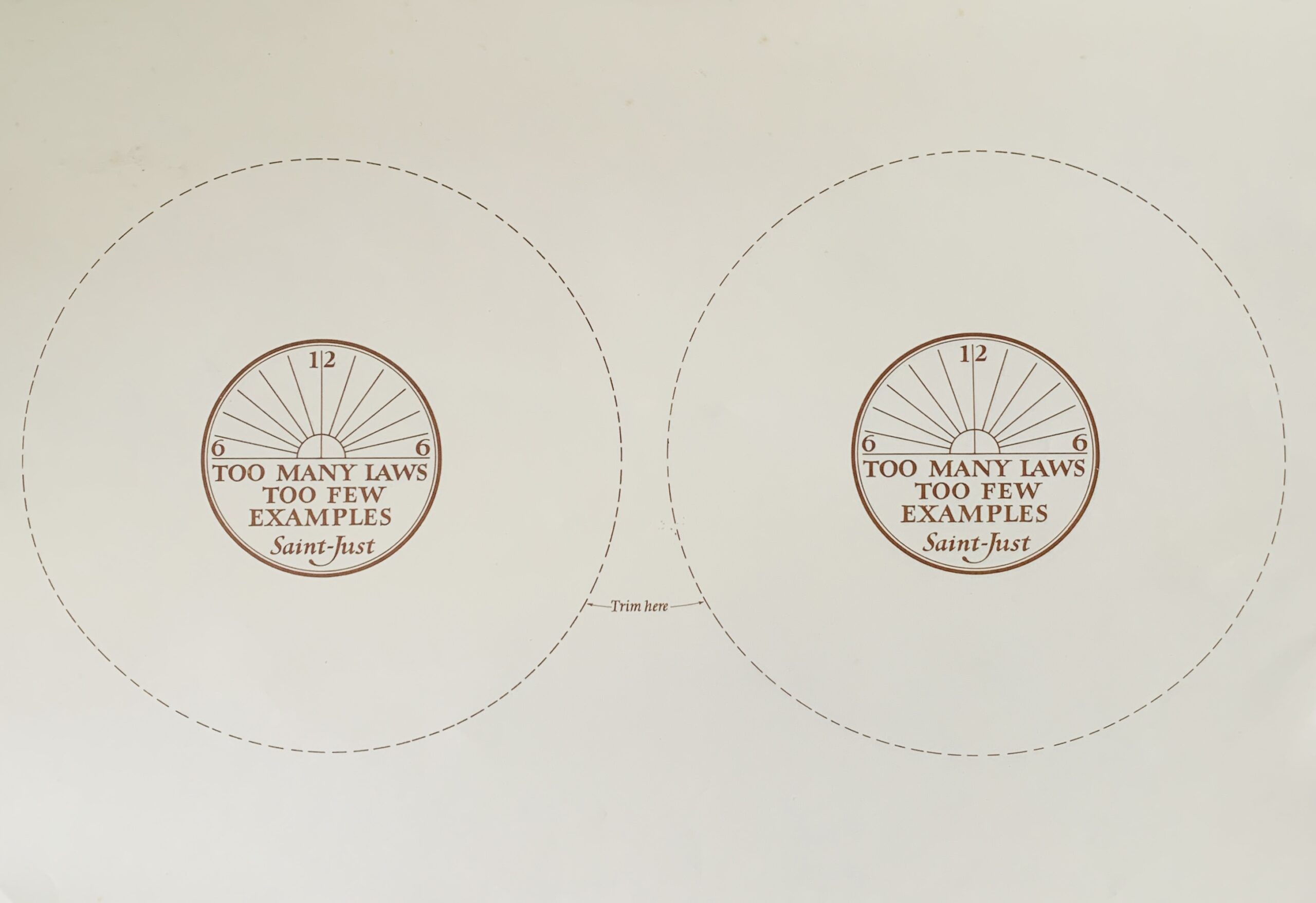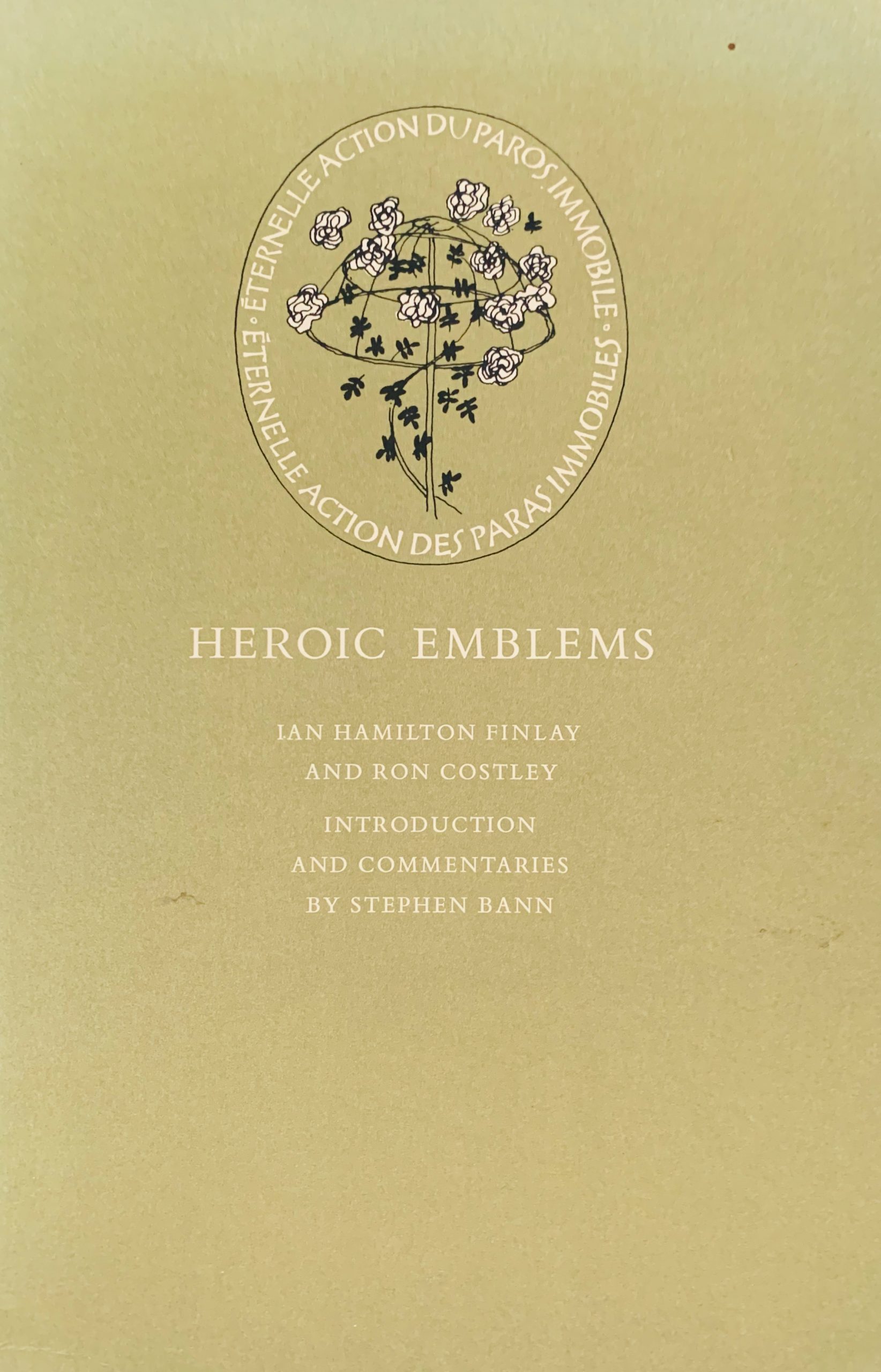
Calais, Vermont: Z Press, 1977 23 x 15cm, 54pp plus card covers. First edition of this artist's book designed by Ron Costley and with a commentary by Stephen Bann. The emblems are all drawings of military machines such as tanks or battle ships acting as metaphors associated with Greek mythology:

SEMPRE FESTINA LENTE
HASTEN SLOWLY

is associated with a Sherman tank with a flail which was used to clear minefields - hence moving slowly in order to later move quickly.
This is one of only 50 copies signed and numbered by Finlay in black ink aside from the larger edition of 750 copies. Rare deluxe copy. VG+.

...
Little Sparta: Wild Hawthorn Press, 1977
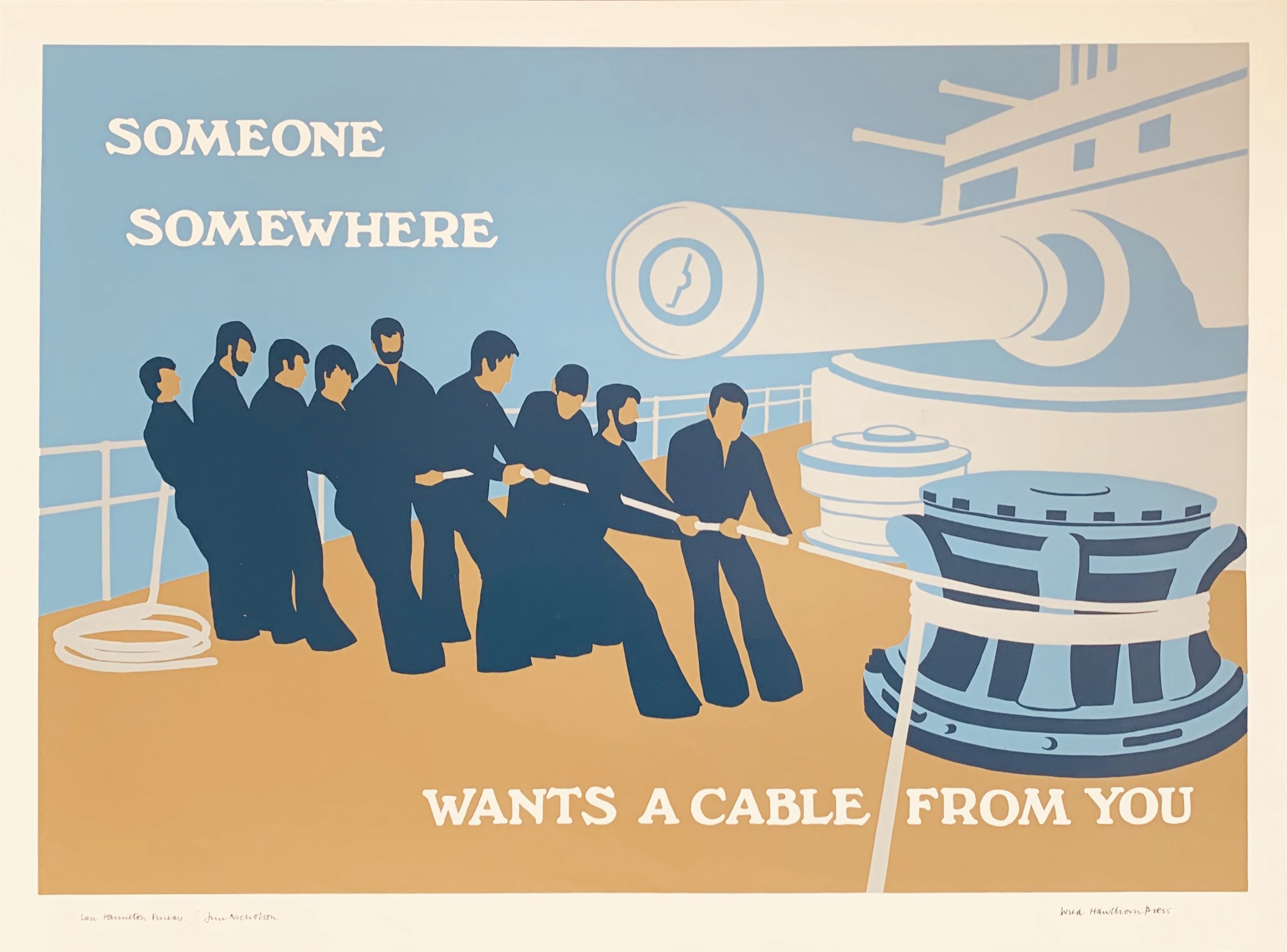
50 x 71cm, blue and light brown/orange silkscreen on white paper with a painting by Jim Nocholson of a group of sailors pulling a metal cable on the deck of a warship. The joke being the slogan having a double meaning - a campaign by the post office (then) for people to use the telegram service. This is one of a number of signed prints by Finlay. VG>

...

Vermont: Z Press, 1977
23 x 16cm, 152pp. Original card covers. Poetry anthology edited by Kenward Elmslie.
Finlay contributes Carrier Strike by Finlay and Carl Heideken. Twenty pages (all printed recto) of photographs of toys made by Finlay (mostly boats and military machines) and a title page.
This is a substantial work by Finlay and often forgotten in his milieu. The ironing board that the toy planes are arranged on is denoted as "an aircraft carrier". This example is signed in green ink by Finlay in full on the title page of his section. Murray 8.9

...

Little Sparta: Wild Hawthorn Press, 1977
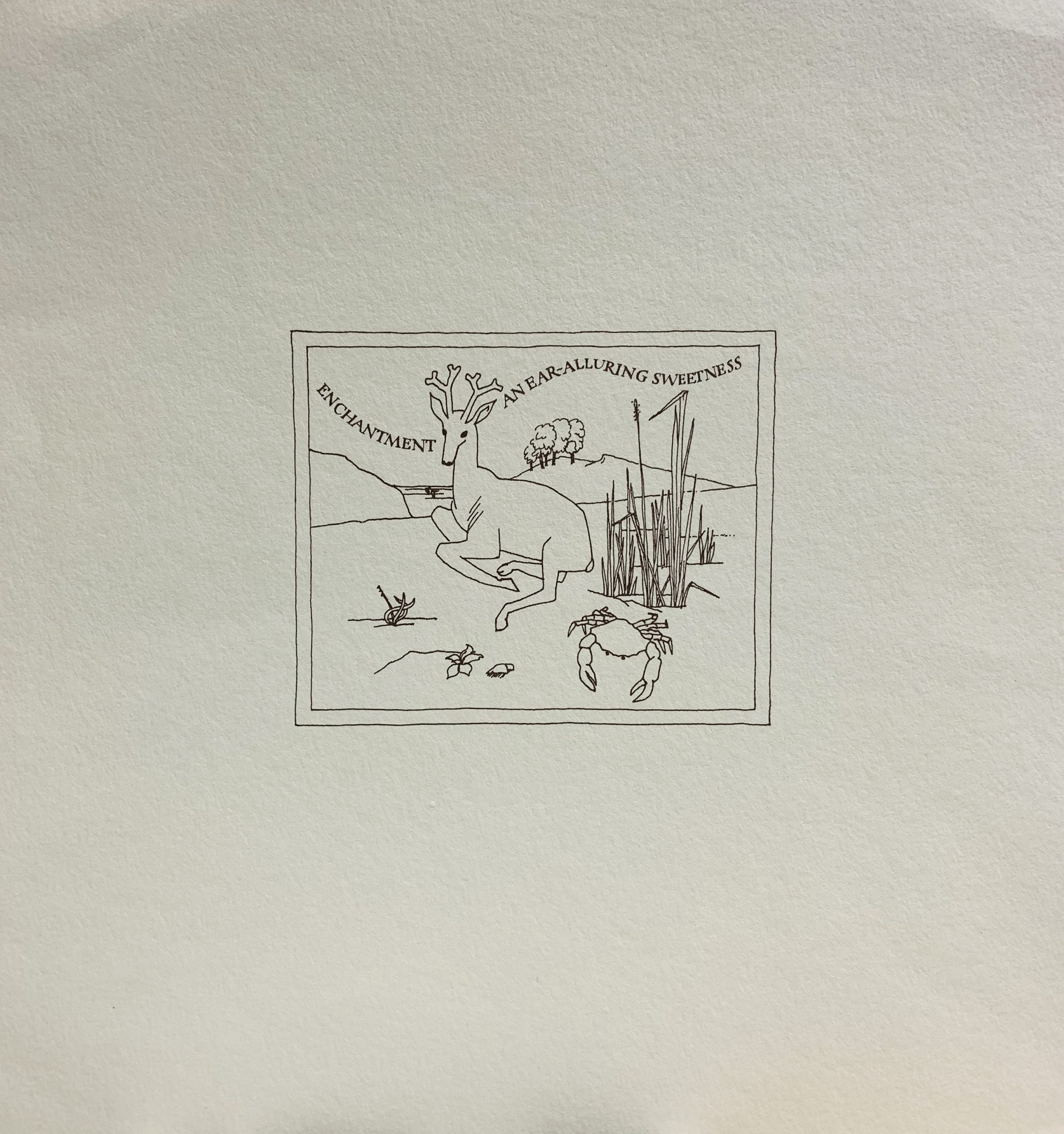
9.5 × 12.1Bm, brown on cream paper in folded 4pp light brown folder. The image by Ron Costley is of a stag, a crab together on a beach with the text "Enchantment An ear-alluring sweetness." a line from "On Abstinence from Animal Food" by Porphyry. a translation of part of the poem is printed on the inside of the cover - translated by Thomas Taylor. The section tells of how stags and horses and crabs can be charmed by music - the point being that the animals have more consciousness than usually ascribed to them in the days of the Romans. Porphyry was an early advocate of vegetarianism on spiritual and ethical grounds and this work reflects that philosophy.

...

Dunsyre: Wild Hawthorn Press, 1977
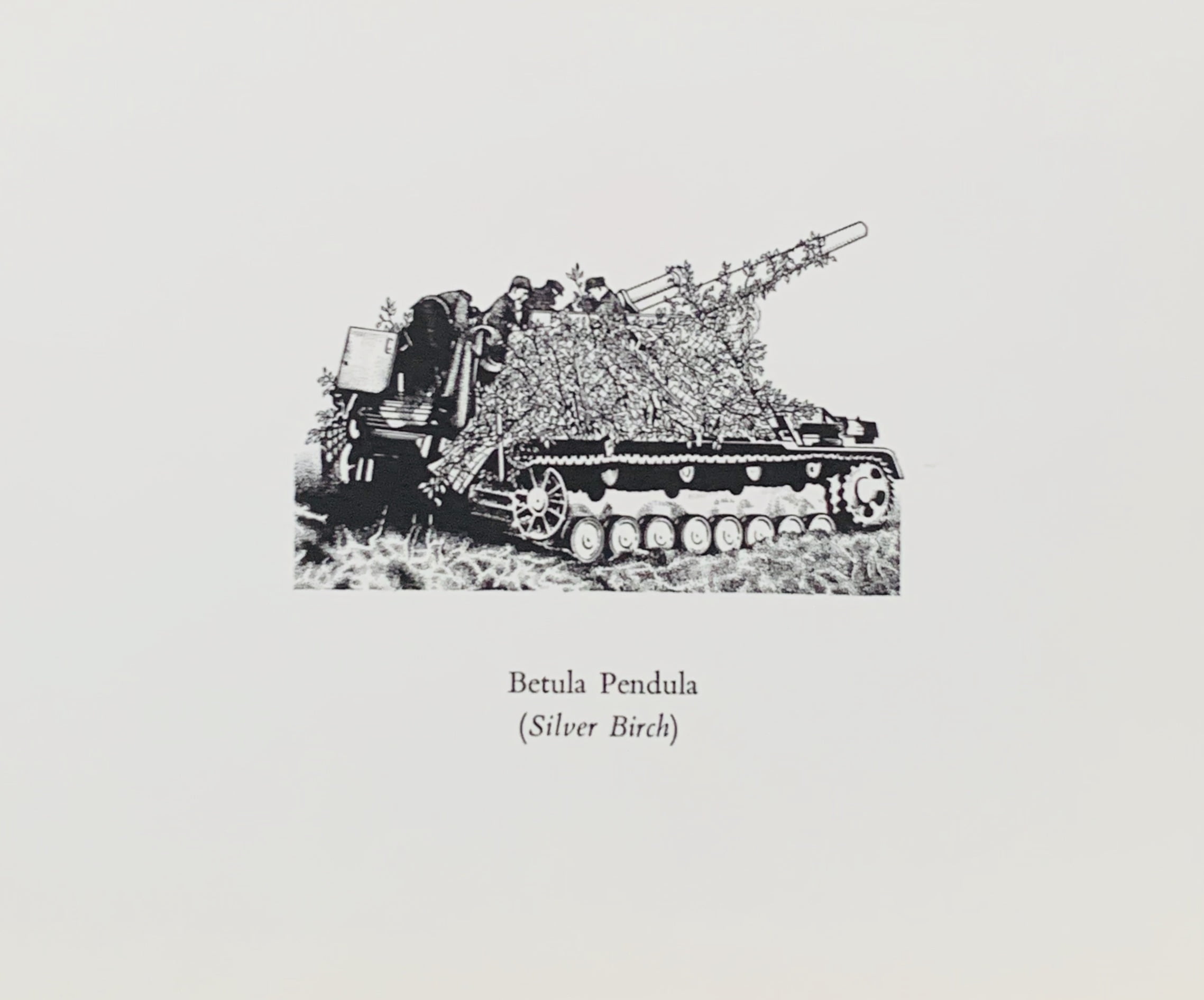
11.5 x 13.5cm, 2pp. The first of three cards which display a drawing (here by Gary Hincks) of an armoured tracked weapon from the second world war - this appears to be a US M7 Priest (from the double barrel) and it is camouflaged by the addition of tree branches on the sides (which one presumes are from birch trees). The birch is a tree that only grows from the East of Europe to the West but not South at all unless at high altitude (the tree does not like hot weather). This card reminds one - as with the other similar works - that even in the beauty of the countryside lurks death. As such it is a momento mori and not the first or last such work in Finlay's oeuvre. VG+.

...

Little Sparta: Wild Hawthorn Press, 1977
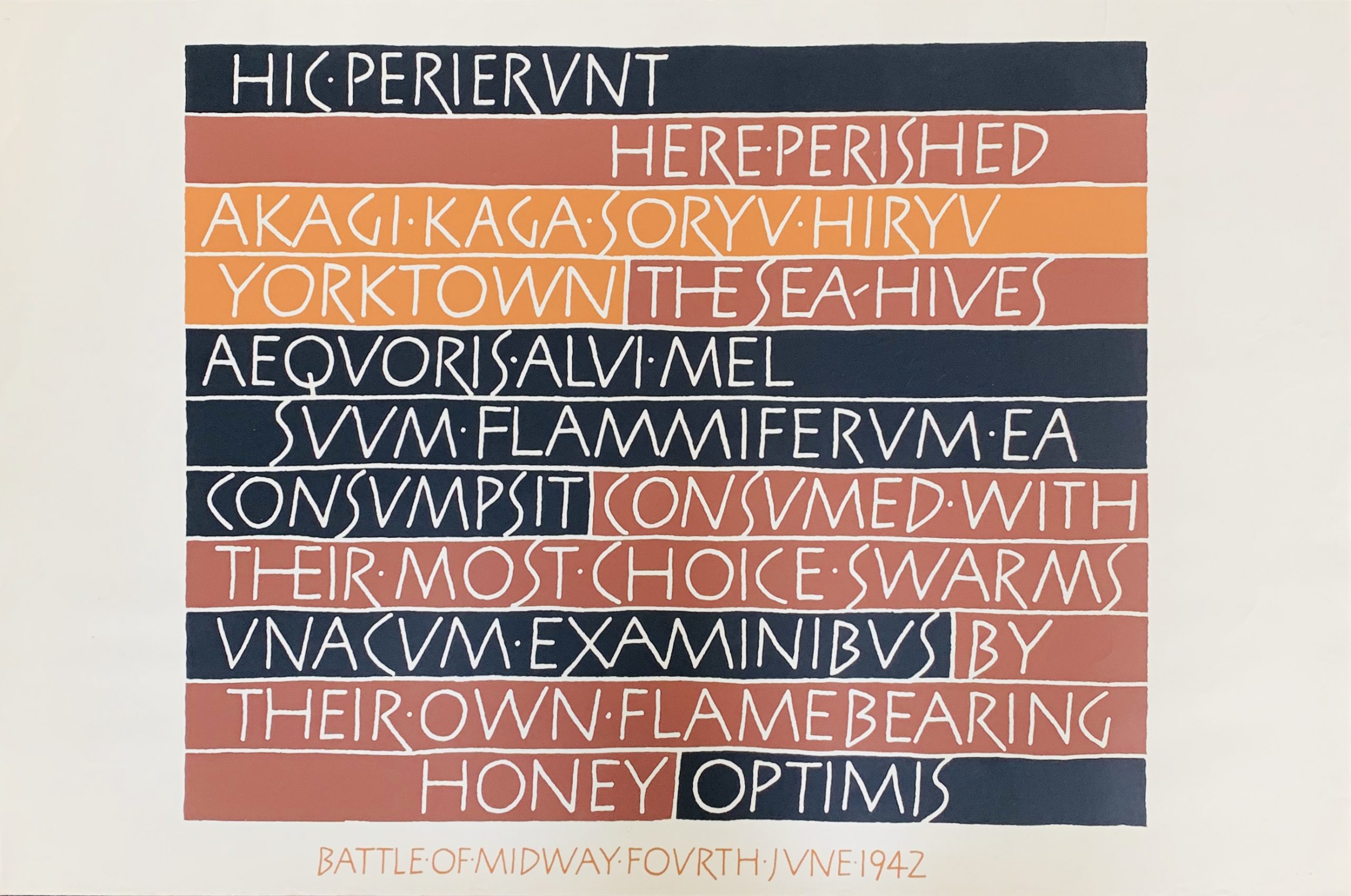
56.5 × 68.7cm, two colour silkscreen with typography by Ron Costley from Finlay's instruction. The text is in both English and Latin - and the former says "Here perished Akagi Kaga, Soryu, Hiryu, Yorktown. The seahives consumed with their most choice swarms by their own flame-bearing honey."
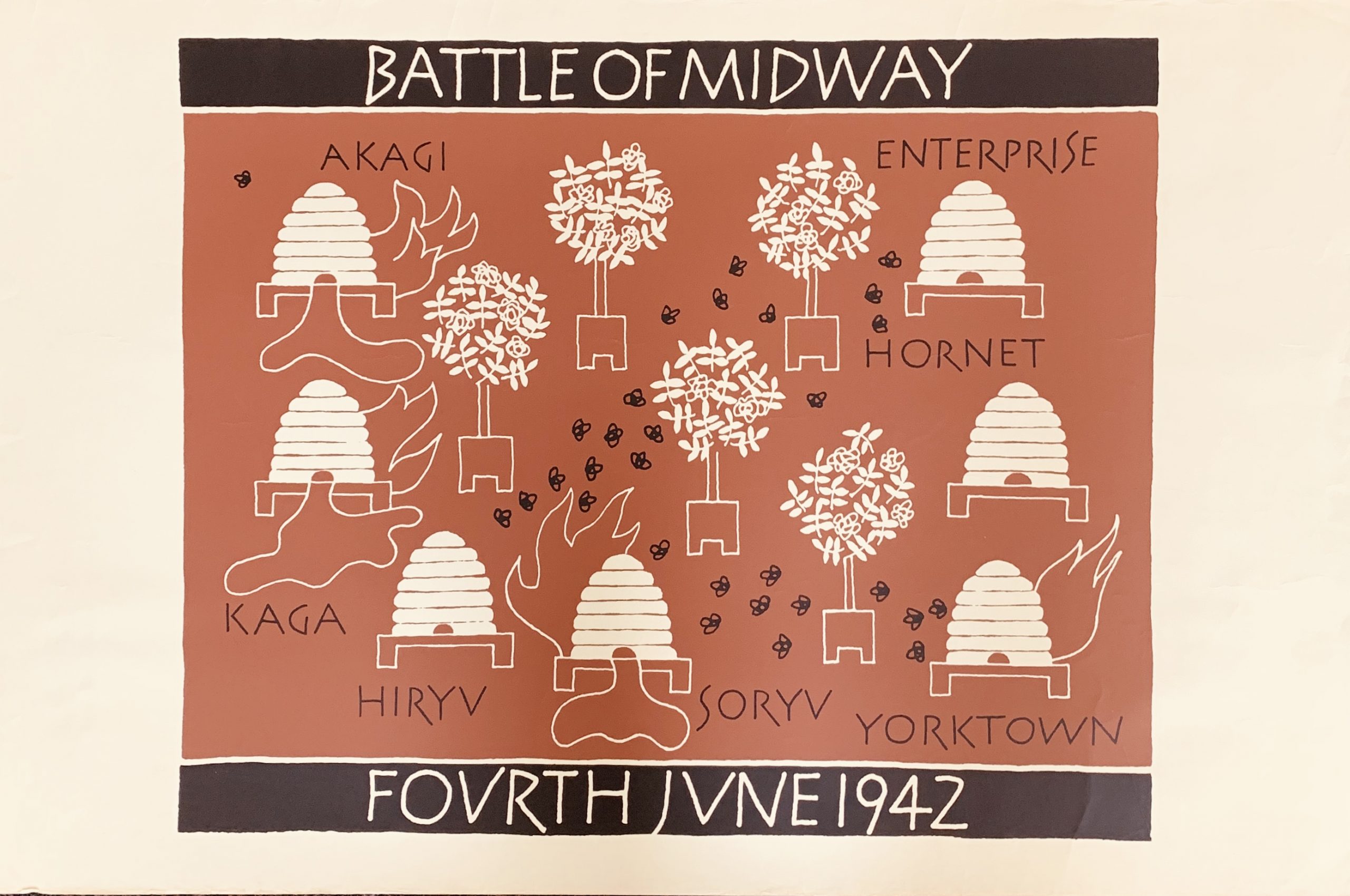
This is a second work of a pair of prints based on the American fleet's victory over the Japanese at the battle of Midway on the Fourth of June 1942. The victory left many of the Japanese aircraft with nowhere to land once their carriers were destroyed and they had to ditch in the water and most drowned. One of 300 copies made - this has a companion print Battle of Midway I (see separate listing) These are very large prints - possibly the largest Finlay had ever made. A bit worn at the edges but overall VG.

...

Little Sparta: Wild Hawthorn Press, 1977
56.5 × 68.7cm, two colour silkscreen with an image (by Ron Costley from Finlay's instruction) of beehives and trees some of which are aflame. The bees are flying between the hives some on the attack, others presumably in panic. A work based on the American fleet's victory over the Japanese at the battle of Midway on the Fourth of June 1942. The victory left many of the Japanese aircraft with nowhere to land once their carriers were destroyed and they had to ditch in the water and most drowned. One of 300 copies made - this has a companion print Battle of Midway II (see separate listing) These are very large prints - possibly the largest Finlay had ever made. A bit worn at the edges but overall VG.

...

Cambridge: Kettle's Yard, 1975
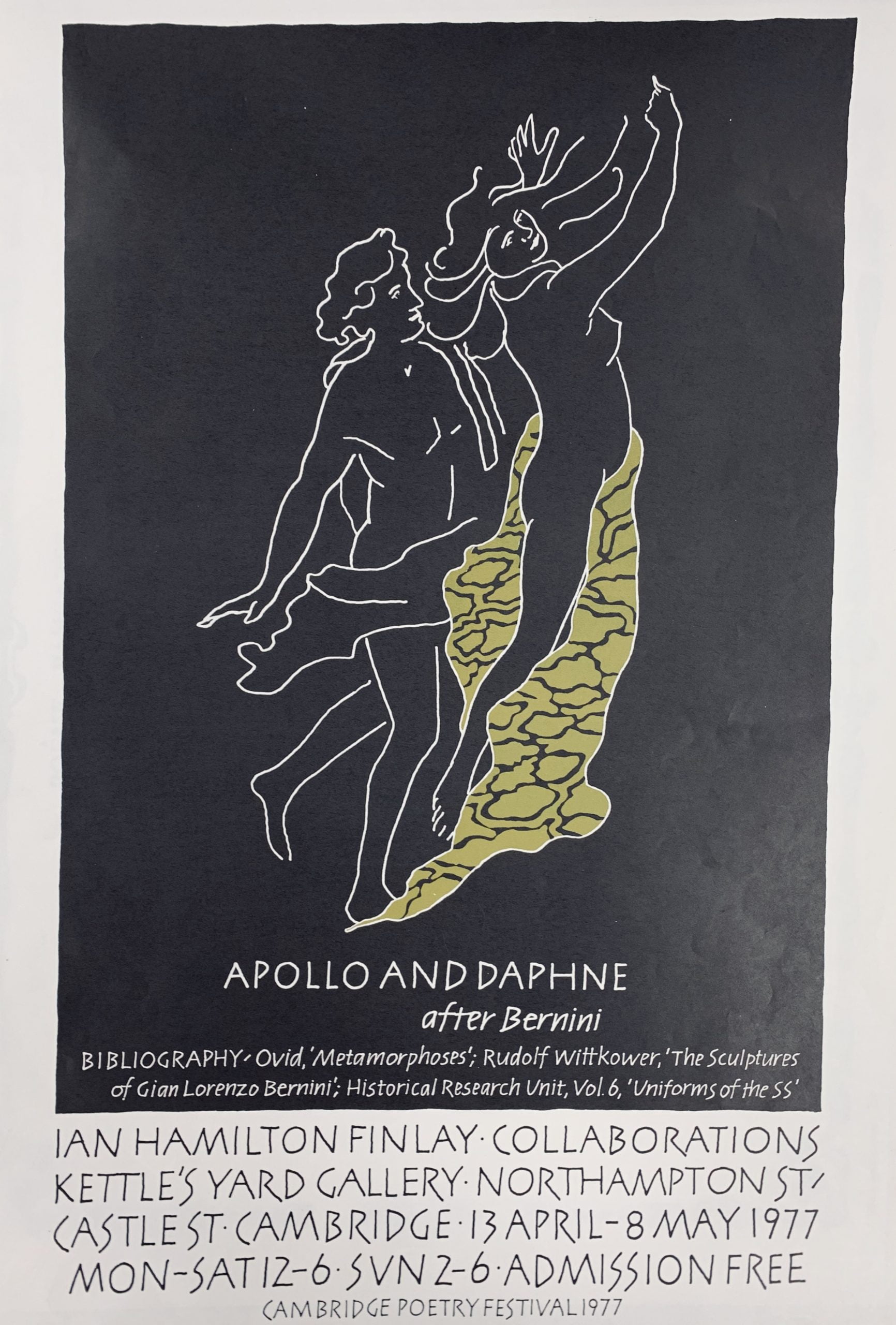
60 x 42cm, olive green and black on white offset lithograph. The line drawing by Ron Costley is a copy of the outline of the original Bernini sculpture of the gods.
There is a text beneath the image: ‘APOLLO AND DAPHNE/ after Bernini/BIBLIOGRAPHY - Ovid, “Metamorphoses”; Rudolf Wittkower, “The Sculptures of Gian Lorenzo Bernini”; Historical Research Unit, Vol. 6, “Uniforms of the SS”’.
The classical story of the pair is one of desire - Apollo being consumed by lust for Daphne (thanks to Eros messing with his motivation) and Daphne desiring to remain chaste (Again this is down to Eros). When Apollo did manage to catch Daphne (presumably with rape his intent) Daphne's father Peneus turned her into an laurel tree - hence saving her virginity.
The Tate Gallery website claims Finlay explained that "the gods and nature ‘were behaving not unlike the Waffen SS’ (who were the first to use a smock with a leaf camouflage pattern, hence its identification with them).
This poster, in which Daphne is wearing a camouflage smock which replaces ‘nature’, was the poster for the title exhibition at the Cambridge Poetry Festival in 1977. It is the same image as in the print APOLLO AND DAPHNE. AFTER BERNINI. 1975 but with exhibition details added at the bottom. Slight crease top right else VG.

...

Dunsyre: Wild Hawthorn Press, 1977
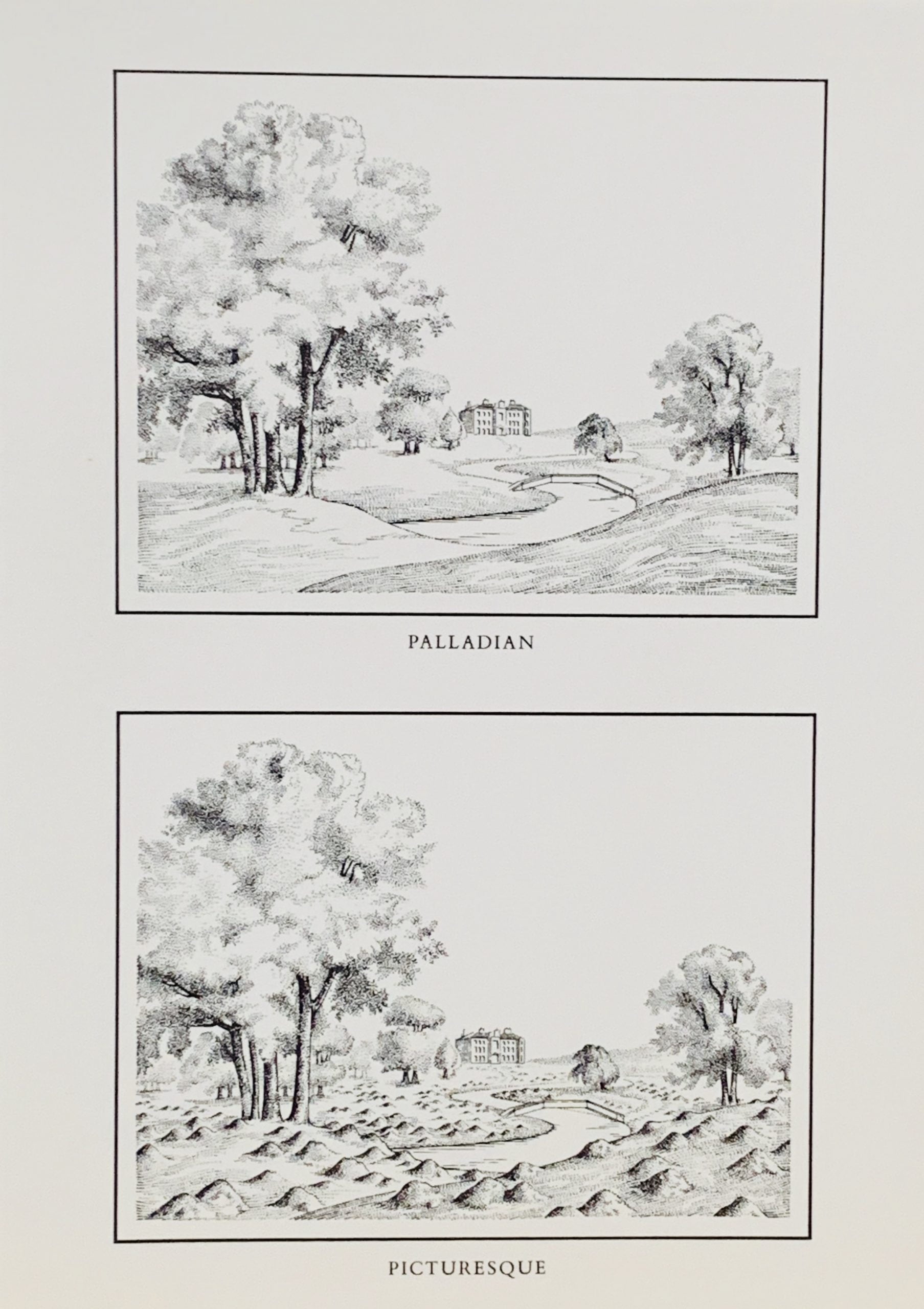
15 x 10.7cm, 2pp. Two drawings by Gary Hincks of the same landscape with a large stately home in the distance.
The first drawing is labelled Palladian and the second drawing, which shows molehills disturbing the scene everywhere, is labelled Picturesque.
Thomas Hearne was a 17th century diarist and engraver of landscapes - and they were often in the style of the Picturesque.
The two scenes here are a jokey method of commenting on conflicting styles of drawing/landscaping and architecture, Palladian stressed austerity, classicism and symmetry whereas the Picturesque style emphasised nature and the natural. By including the molehills in the second drawing, Finlay is criticising the style in favour of his neo-classical tastes by making the realities of the wild a destructive force to beauty.
This example was sent by Finlay to Dawn MacLeod has a handwritten note "A wee "get well" top the recalcitrant wrist. Warm wishes, Ian" in black ink. VG+.

...

Cambridge: Kettle"s Yard Gallery. 1977
21 x 13.2cm, 30pp plus card covers and printed typographic dust jacket. Design and typography by Ron Costley and essays by Stephen Bann, Douglas Hall, Miles Orvell and Stephen Scobie with a poem "Stonypath" by Kathleen Raine. An exhibition catalogue for a show of works which were "collaborations" with other artists (which is almost all of Finlay;'s works). VG+.

...

Shopping cart0
There are no products in the cart!
Continue shopping