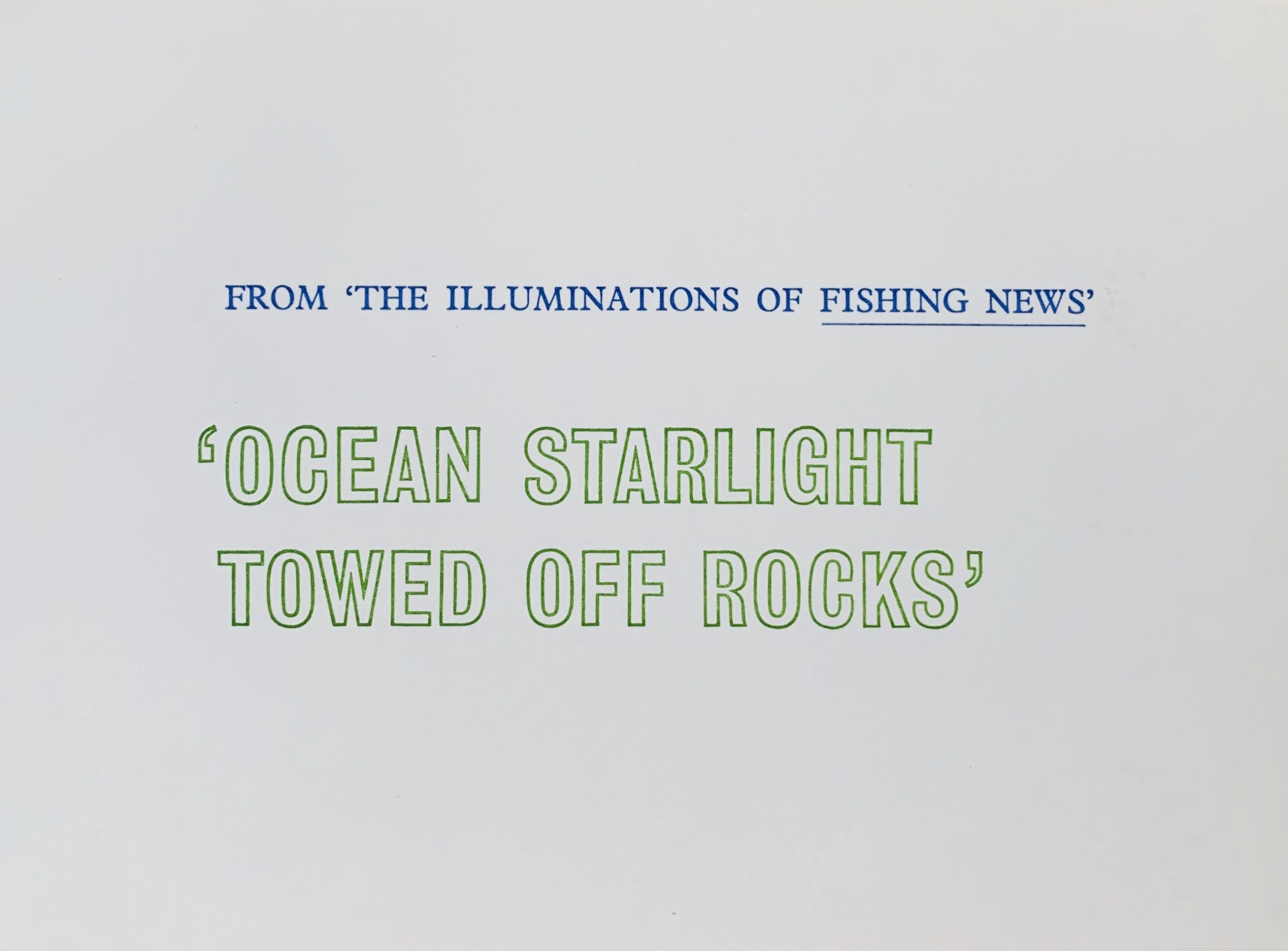
Dunsyre: Wild Hawthorn Press, 1968
12.5 x 6.8cm, 2pp. The card is the one of a series that reproduce phrases found in journals and newspapers together to tell a quasi-story or visual poem. Here Ocean Starlight (a boat's name) towed off rocks presumably is a story of a rescue but Finlay's appropriation turns this into a magical event involving light on water. The use of the word "illuminations" also reflects this meaning as well as amusingly suggesting that Fishing News is full of insights.
Murray has this as Card 4.13. Fine....
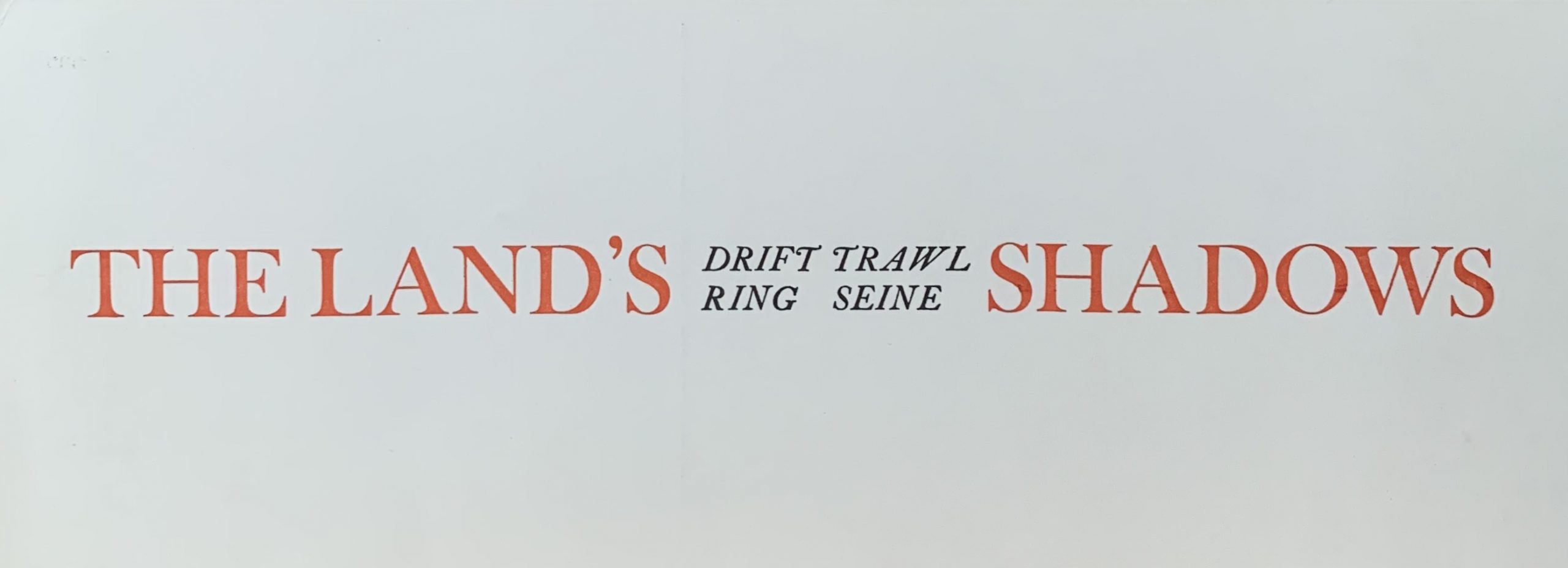
Dunsyre: Wild Hawthorn Press, 1968
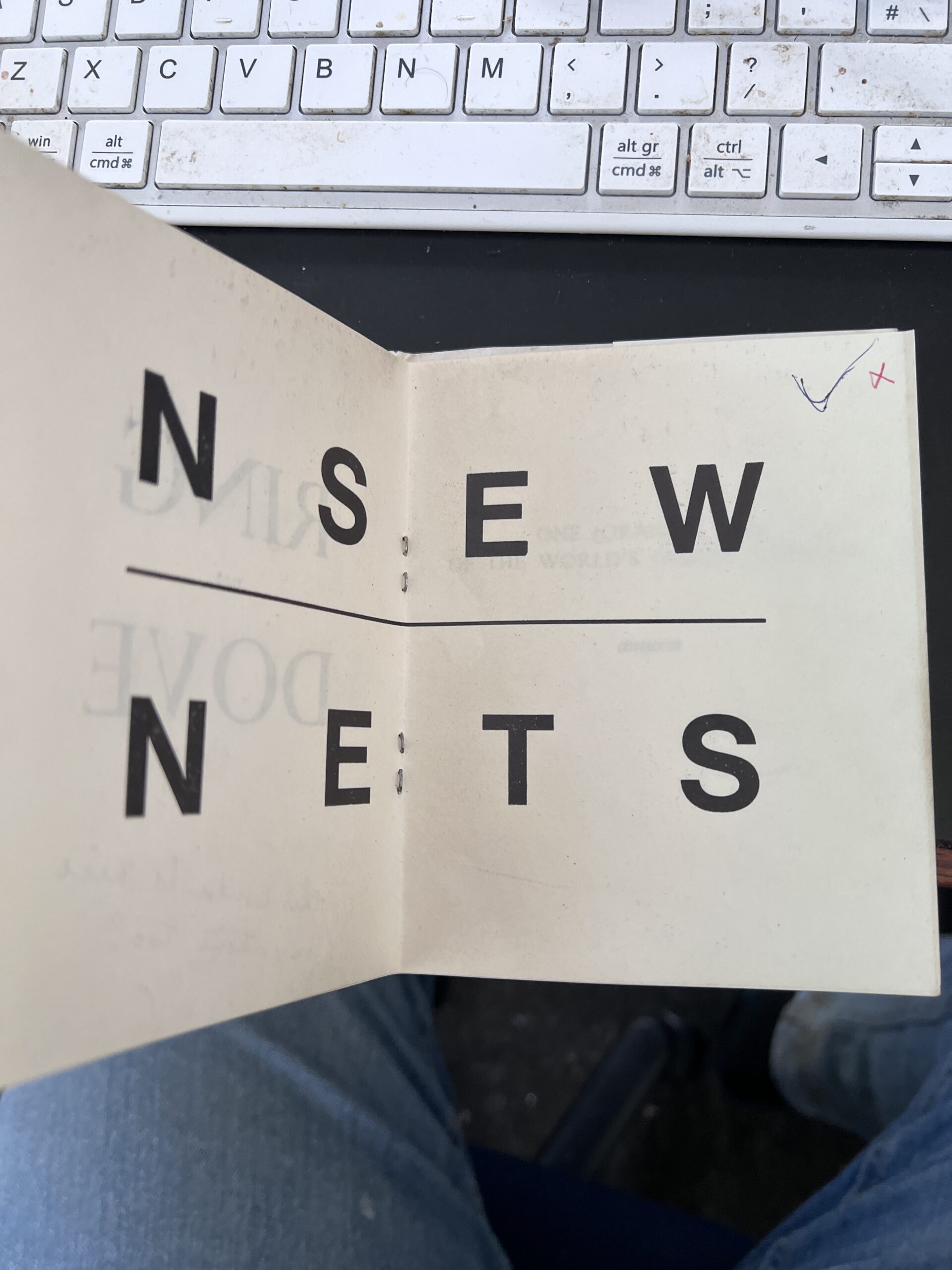
9.8 x 25cm, 2pp. Finlay in many of his early cards finds the spaces between banks of canals, or between features of the landscape irresistible. Here the words THE LAND'S SHADOWS in red are split with four others in a different colour which read Drift Trawl Ring Seine. Words associated with sailing are thus flanked by the dark areas of the landscape (from hills or banks - one does not know) hence painting a picture using words. VG. Murray 4.12. ...

Dunsyre: Wild Hawthorn Press, 1968
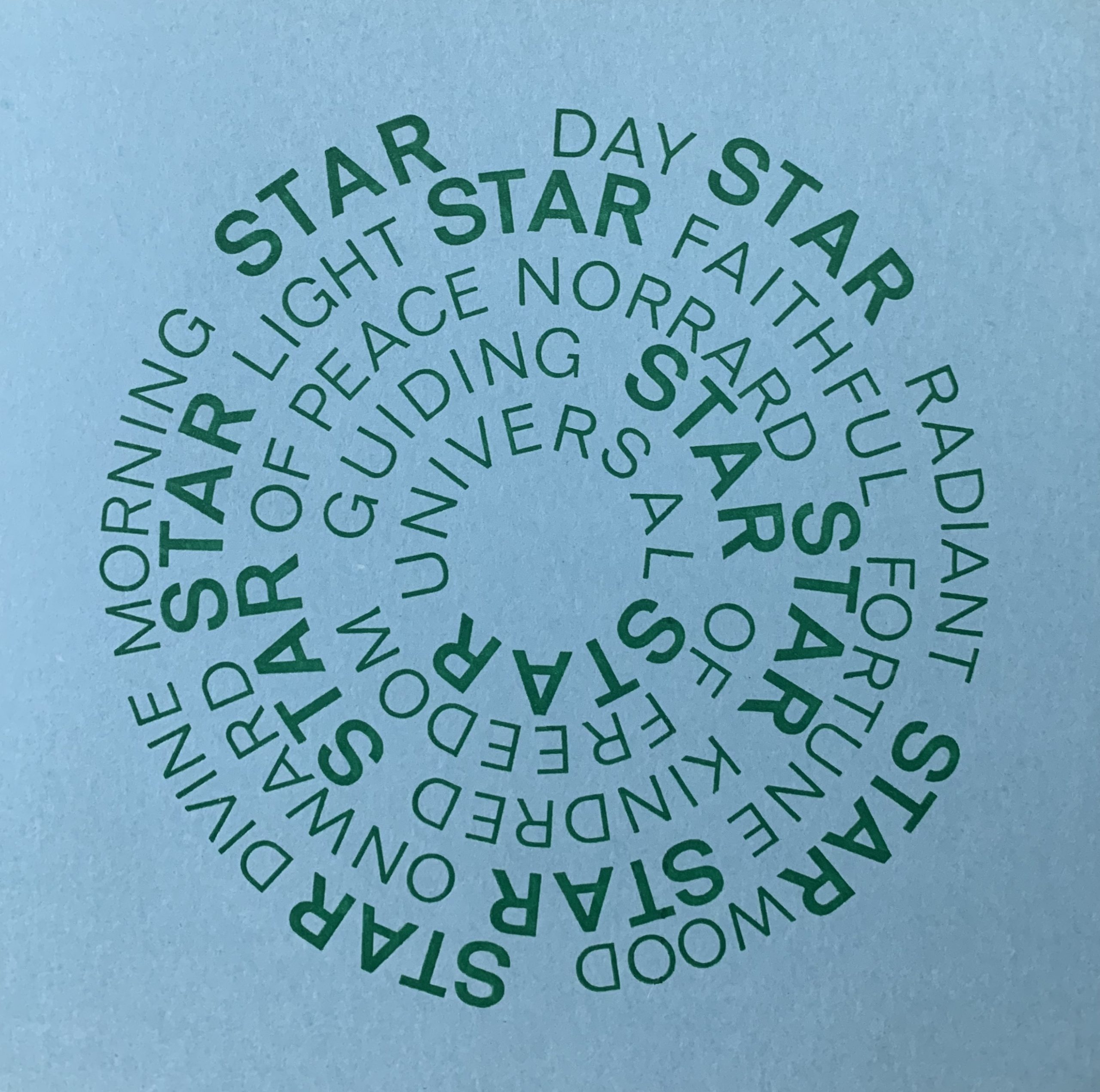
16 x 16cm, 2pp. Green on blue card - the front of the card has a circular design made up of fishing boat names typographically set by Alistair Cant on Finlay's instruction. The pattern creates both a planet or the movement in the stars as they appear to spin around the boat as night passes. Stars for boats are essential to allow passage - until modern methods of navigation they were the sailor's only orientation. The choice of the boat names chosen by Finlay reinforces that - all have the word STAR in them e.g. Morning Star, Day Star, Fortune Star and so on.
This is the second of two cards with a similar intent - the other uses the letters and numbers of the boats - here the attractive names people give their vessels are used instead.
The title Sea Poppy refers to the yellow hornpoppy which only grows on sea shores - again a clear nautical reference.
This design and others like it was used by Finlay in different formats including wall works, object multiples, printed posters and cards. ...

Munster: Anthologie zur Visuellen Poesie, n.d. (1968)
19,5 x 219cm, unpaginated ( c. 80pp plus card covers. Exhibition catalogue for an important early survey of concrete and visual poetry in Germany., Works shown by almost all the major figures in the movement. Finlay has two works - Village (where the v is inverted to create a hut) and Star Steer, Rare. VG+.

...

Dunsyre: Wild Hawthorn Press, 1968
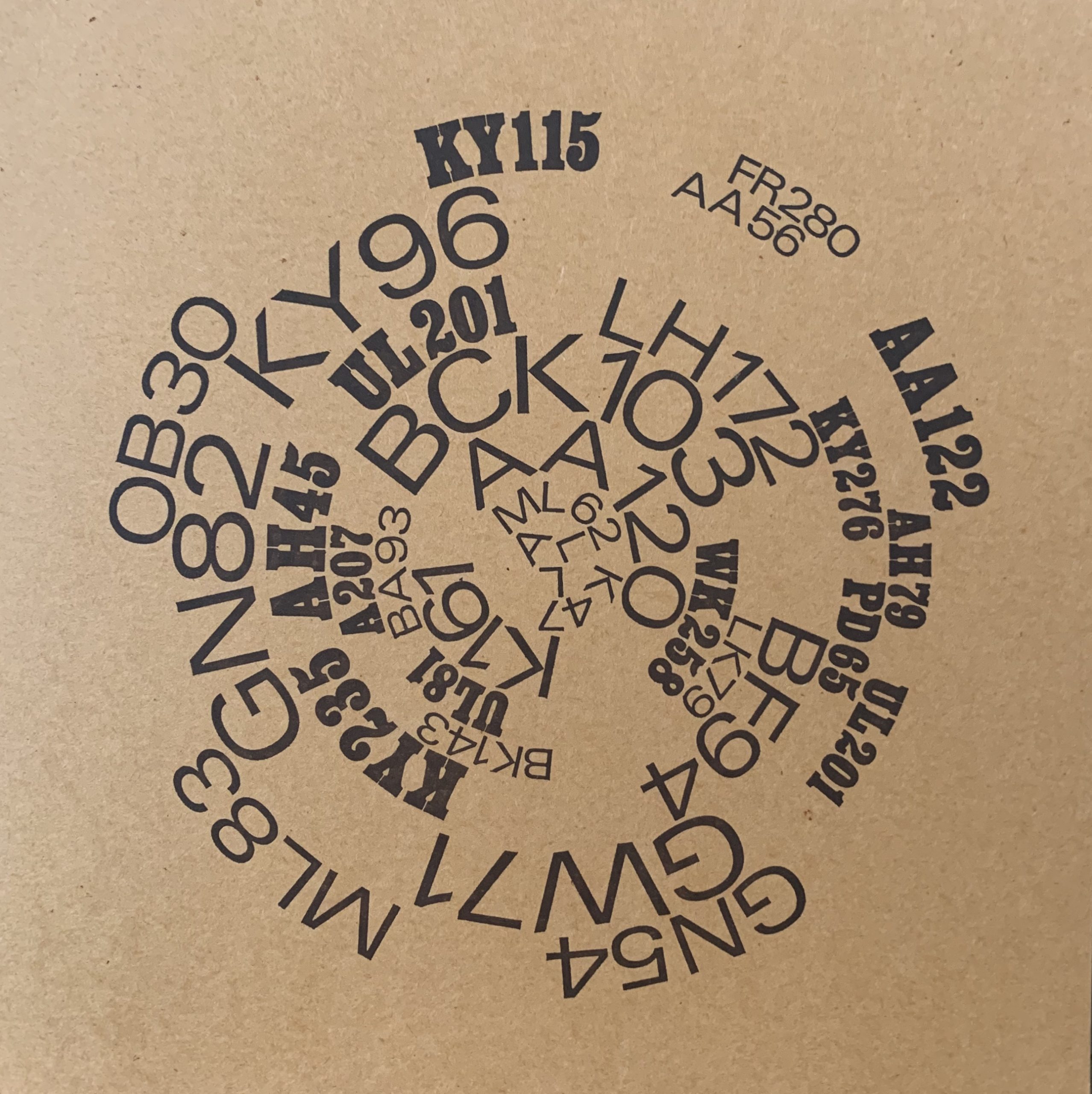
16 x 16cm, 2pp. Black on orange card - the front of the card has a circular design made up of fishing boat letters and numbers that allow unique identification of any particular vessel typographically set by Alistair Cant on Finlay's instruction. The pattern creates both a schematic planet or the perceived circular movement in the stars as they appear to spin around the boat as night passes. Stars for sailors are essential to life - until modern methods of navigation they were the only orientation available to the crew and captain of a ship.
The title Sea Poppy refers to the yellow hornpoppy which only grows on sea shores - again a clear nautical reference.
This design and others like it was used by Finlay in different formats including wall works, object multiples, printed posters and cards....

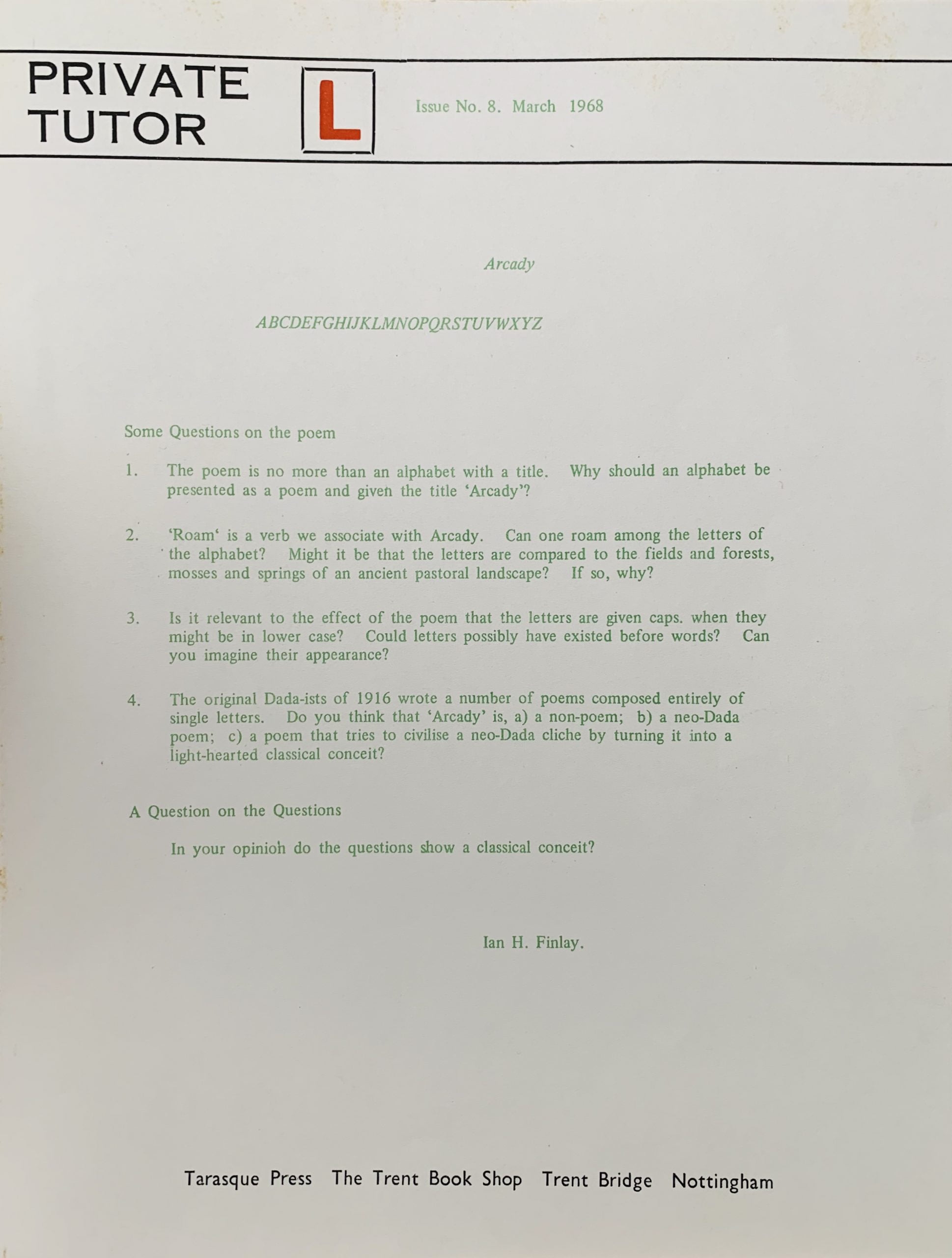
Nottingham: Tarasque Press, 1968
26 x 20cm, 1pp. Small broadside issued by The Trent Bookshop/Tarasque Press (formed by Stuart Mills and Martin Parnel in 1964) which had a different poet in each issue. This number has "Ian H. Finlay"'s Arcady poem and "Some Questions on the poem". We have written extensively on this work as a stand alone book elsewhere on this site. What is worth noting is that this is an extremely rare item in VG+ condition.

...

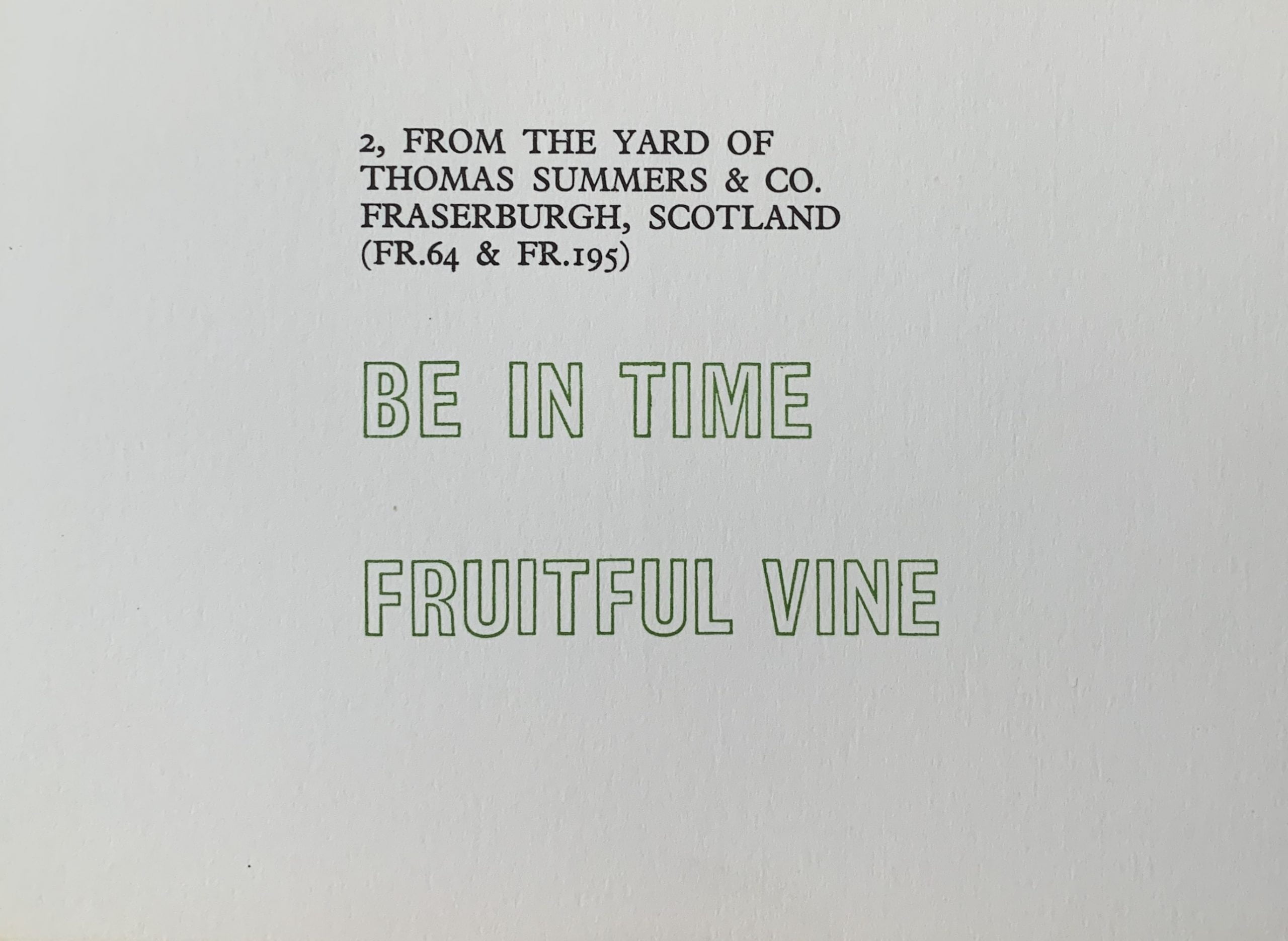
Dunsyre: Wild Hawthorn Press, 1968
17 x 12.5cm, 2pp. The card is one of a series that joins boat names together to tell a quasi-story or visual poem. Here Be in Time leads onto Fruitful Vine. The rhyme is by luck but together it creates an optimistic epigram and metaphor. Fine example. Murray has this as Card 4.9. Murray mis-identifies (not unusual) the date here - on the back it is clearly 1968 but the Catalogue Raisonne has it as 1967. ...

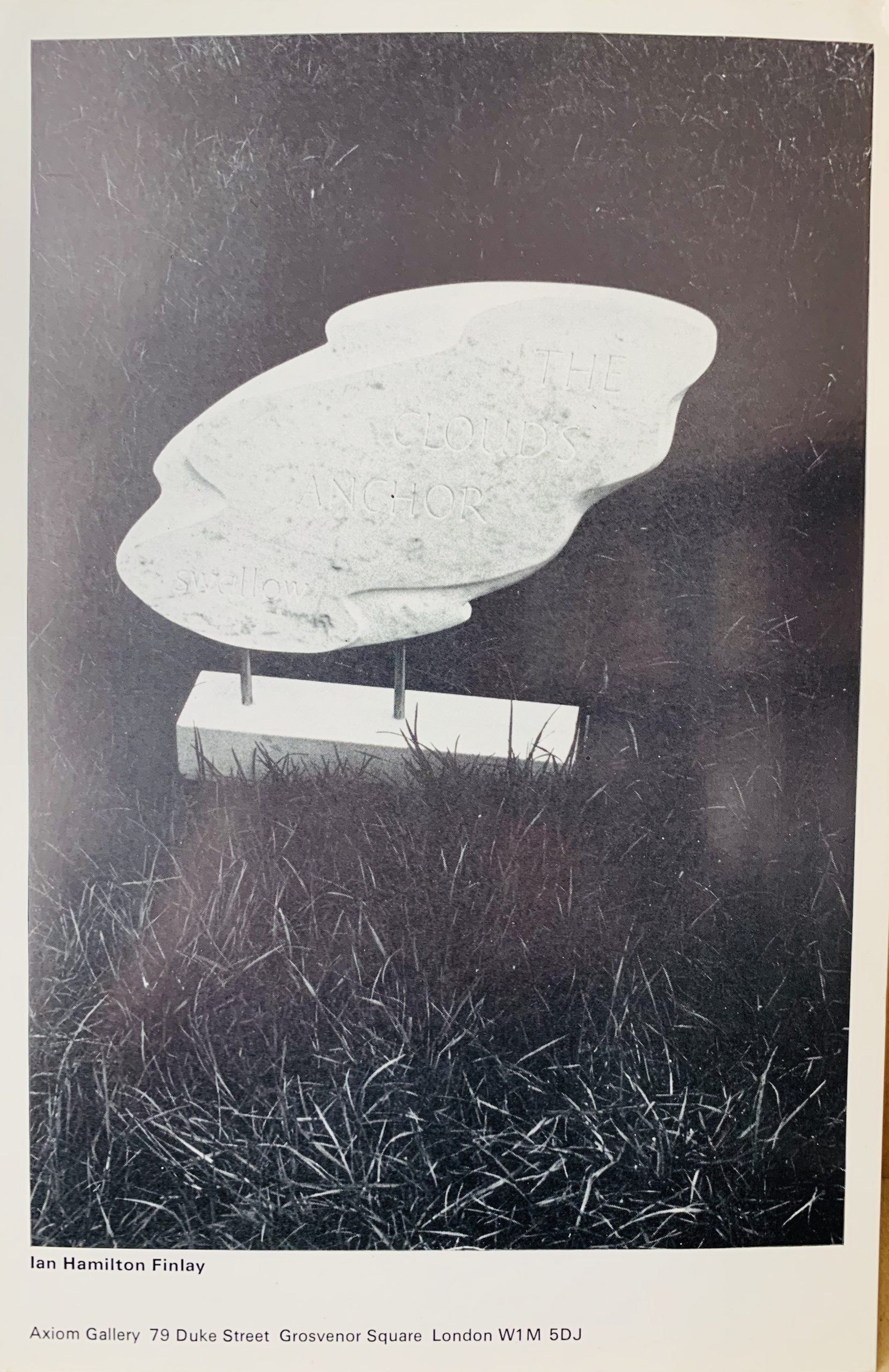
London: Axiom Gallery n.d (1968)
22.5 x 13cm, printed brown paper folder content of three large 22 x 12.7cm, 2pp announcement cards each with an image of a work in b/w on the front and on the back gallery details. The three artists are Keith Milow, Ian Hamilton Finlay and John Walker.
This was Finlay's first ever solo show and his announcement card has an image of a sculptural work "The Clouds Anchor " with recto a short biography.
A rare item indeed.

...

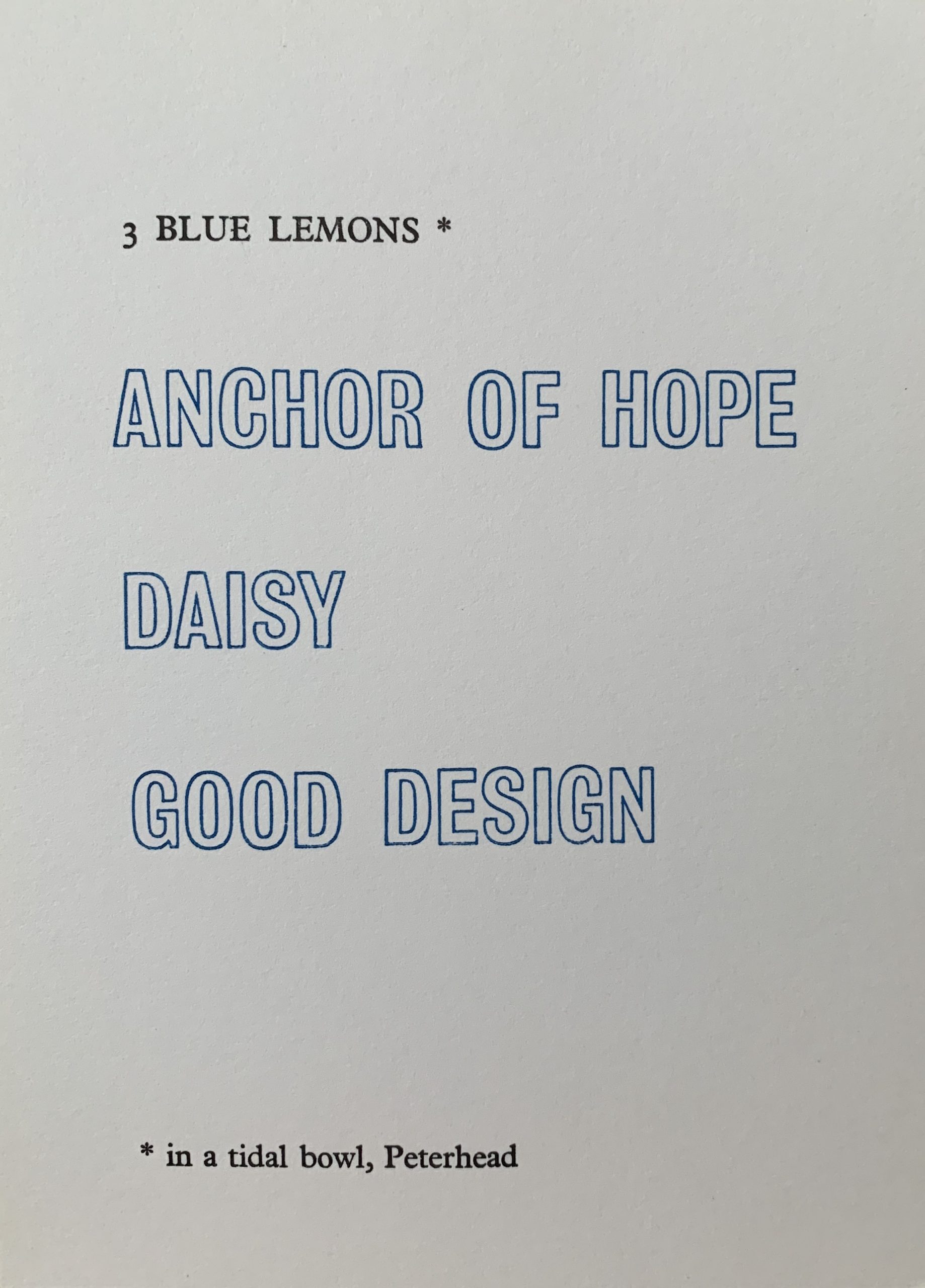
Dunsyre: Wild Hawthorn Press, 1968
17 x 12.5cm, 2pp. The card is the first of a few that join boat names together to tell a quasi-story or visual poem. Here Anchor of Hope/ Daisy/ Good Design indicates a daisy in the ground that is well rooted - hence a "good design" and is in some way a metaphysical comment on evolution's creation. The card's title has an Asterix which leads to the note "in a tidal bowl, Peterhead" - a clarification that these are boats. Fine example.
Murray has this as Card 4.8. Murray mis-identifies (not unusual) the date here - on the back it is clearly 1968 but his Catalogue Raisonne has it as 1967. ...

Stoneypath; Wild Hawthorne Press, 1967
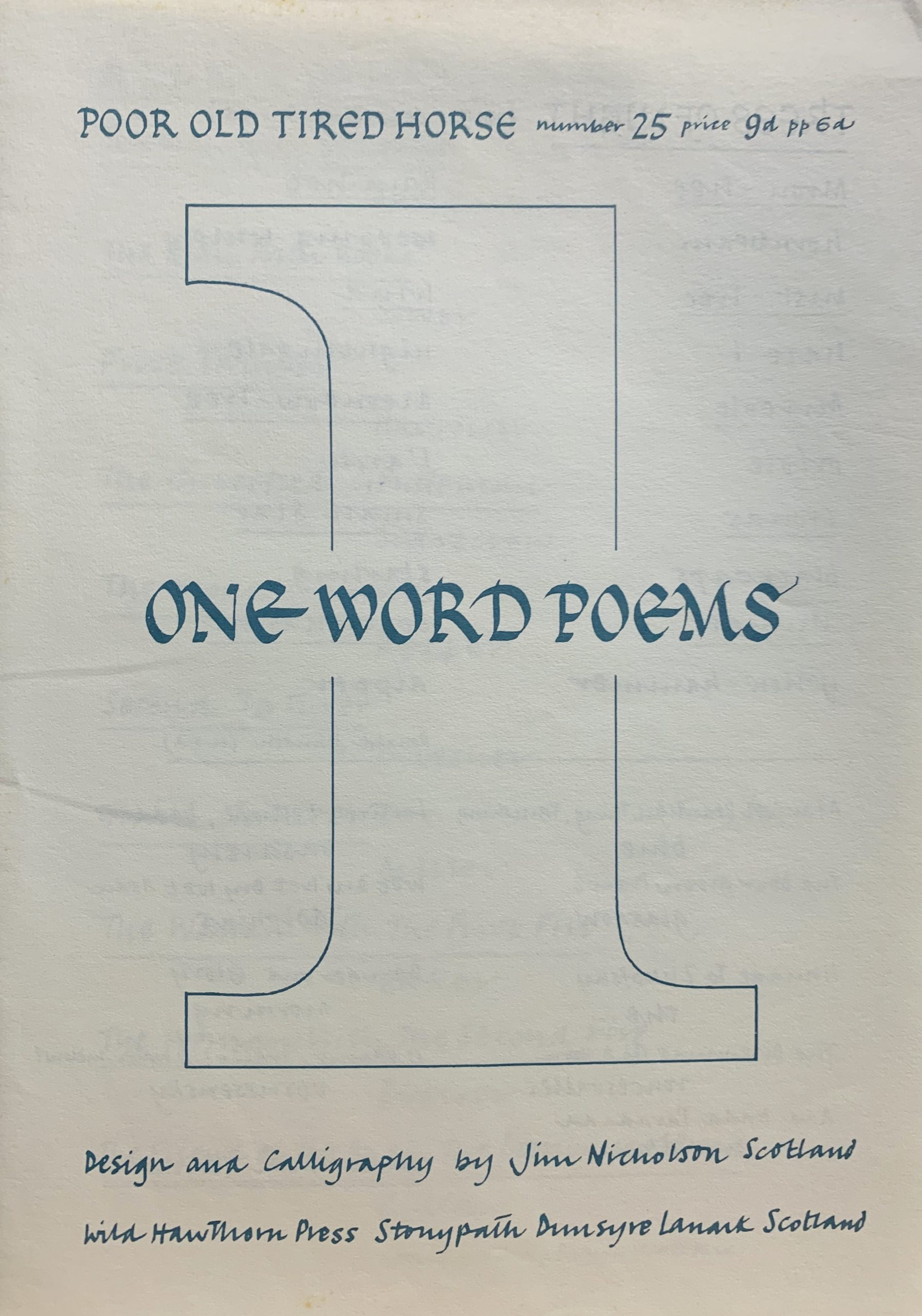
26 x 21cm, 8pp. The final number of Finlay’s poetry publication. Design and calligraphy by Jim Nicholson. Contributions from Ronald Johnson, Edwin Morgan, George Mackay Brown, Eli Siegel, Jerome Rothenberg, Alkman (translated by Guy Davenport), Hugh Creighton Hill, Stuart Mills, Pedro Xista, Alan Riddell, Martin Seymour-Smith, Kenelm Cox, Giles Gordon, Douglas Young, Edward Lucie-Smith, Stephen Bann, Dick Sheeler, Astrid Gillis, Oswald de Andrade, Ernst Jandl, Gael Turnbull, Aram Saroyan, Jonathan Williams and Ian Hamilton Finlay. VG+.
Finlay whilst not inventing the One Word Poem format certainly helped popularise it - he uses the format in a number of his artist's books. The last poems in this publication are by Finlay and include some of his best known works reformatted in to such a form.

A SEE-SAW
_________
SEA

...

Dunsyre: Wild Hawthorn Press, 1967 12.8 x 10.5cm, 32pp. Card covers with printed dust jacket. An artist's book the title of which refers to a wild bird - interestingly not found in Scotland - which had a loud piercing song which is often claimed to be like two stones being hit off each other. The book consists of a number of concrete and experimental poems using different forms different forms.

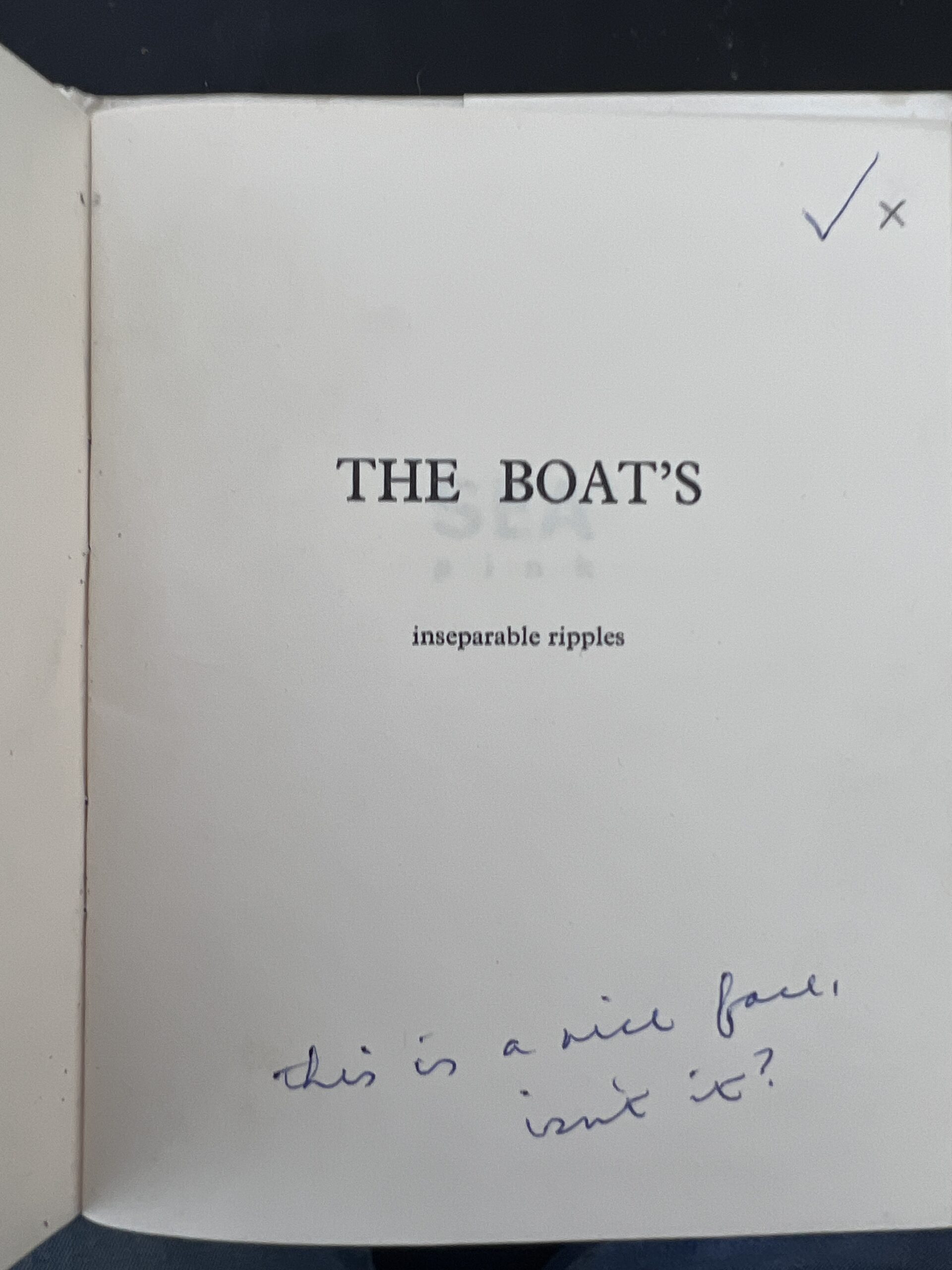
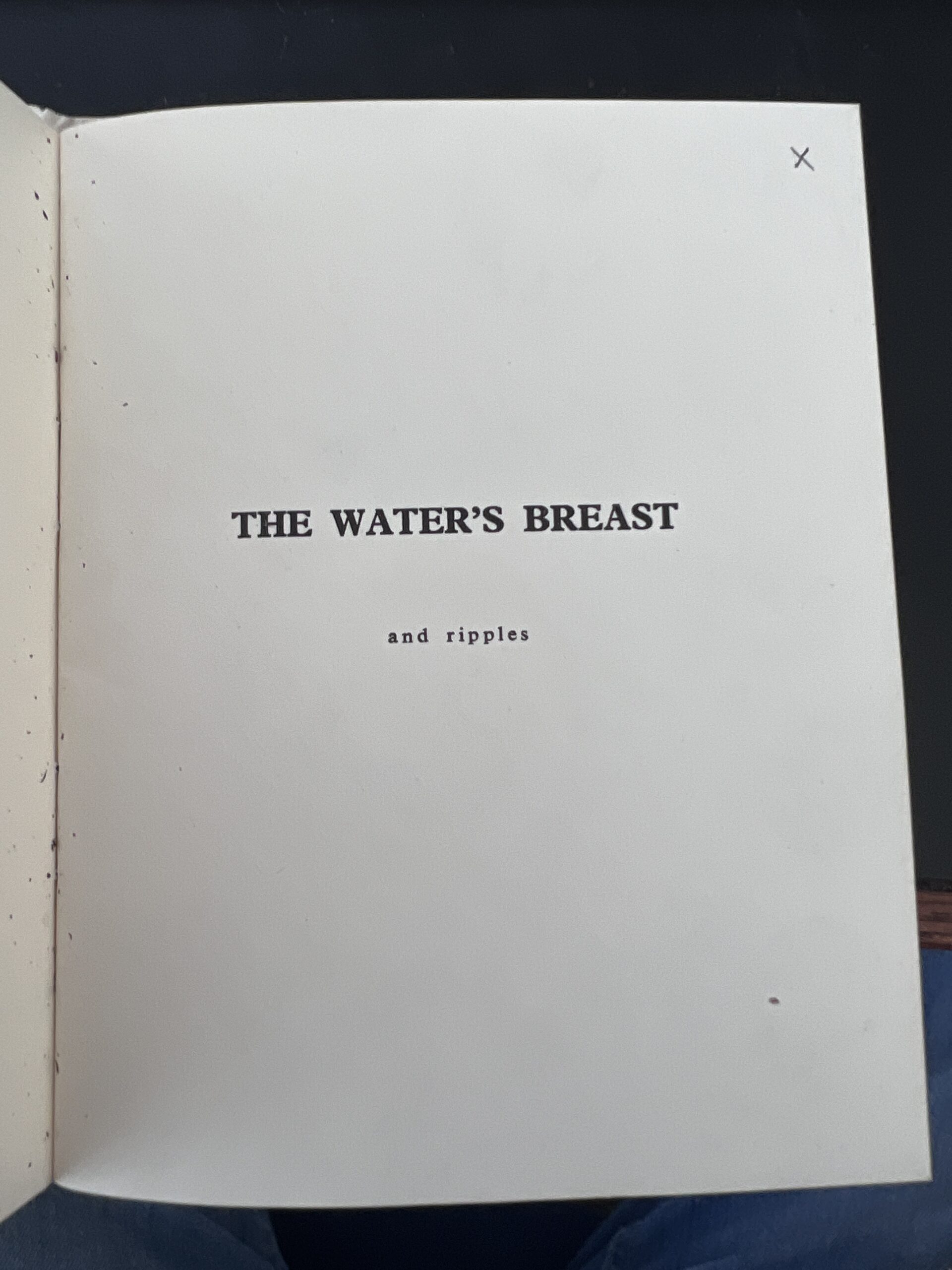
This copy is unique in that it was send by Finlay to Maxwell Allan (a sculptor and collaborator) and has been annotated with crosses and ticks on most pages (perhaps indicating approval for further works based on them) and on one page an ink text in Finlay's cursive hand: "this is a nice font isn't it?" referring to the typography of the words in "THE BOAT"S/inseparable ripples". An unusual find in an already somewhat scarce book. VG although the cover is slightly grubby through being handled. ...

Shopping cart0
There are no products in the cart!
Continue shopping