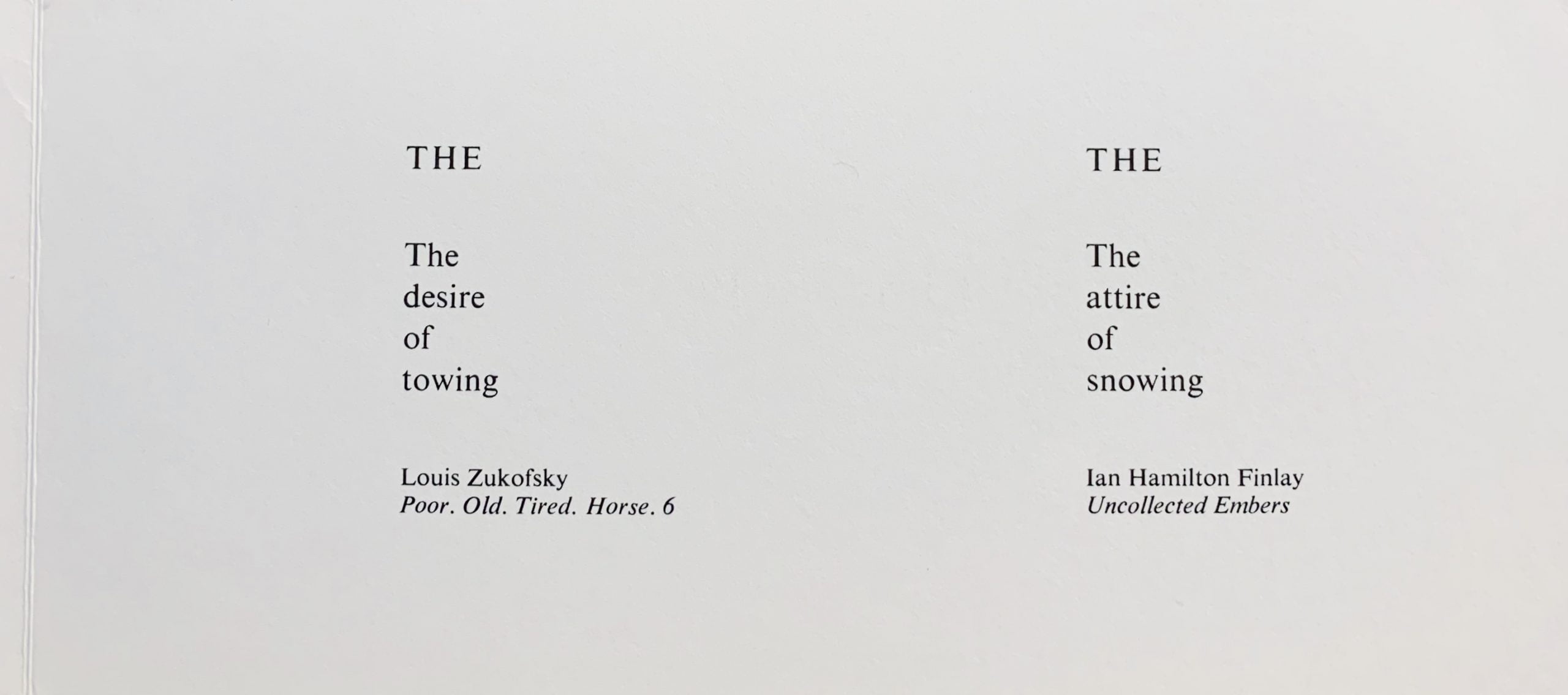
Little Sparta: Wild Hawthorn Press, 1985
9.4 x 20.4cm, 4pp card with two poems - one by Luois Zukofsky which was printed in POTH 6:
The
desire
of
towing
Conjoined with Finlay's
The
attire
of
snowing

The first refers to a barge being pulled along and the forces creating a desire to be somewhere else, the latter is a description of snow covering everything after a fall.
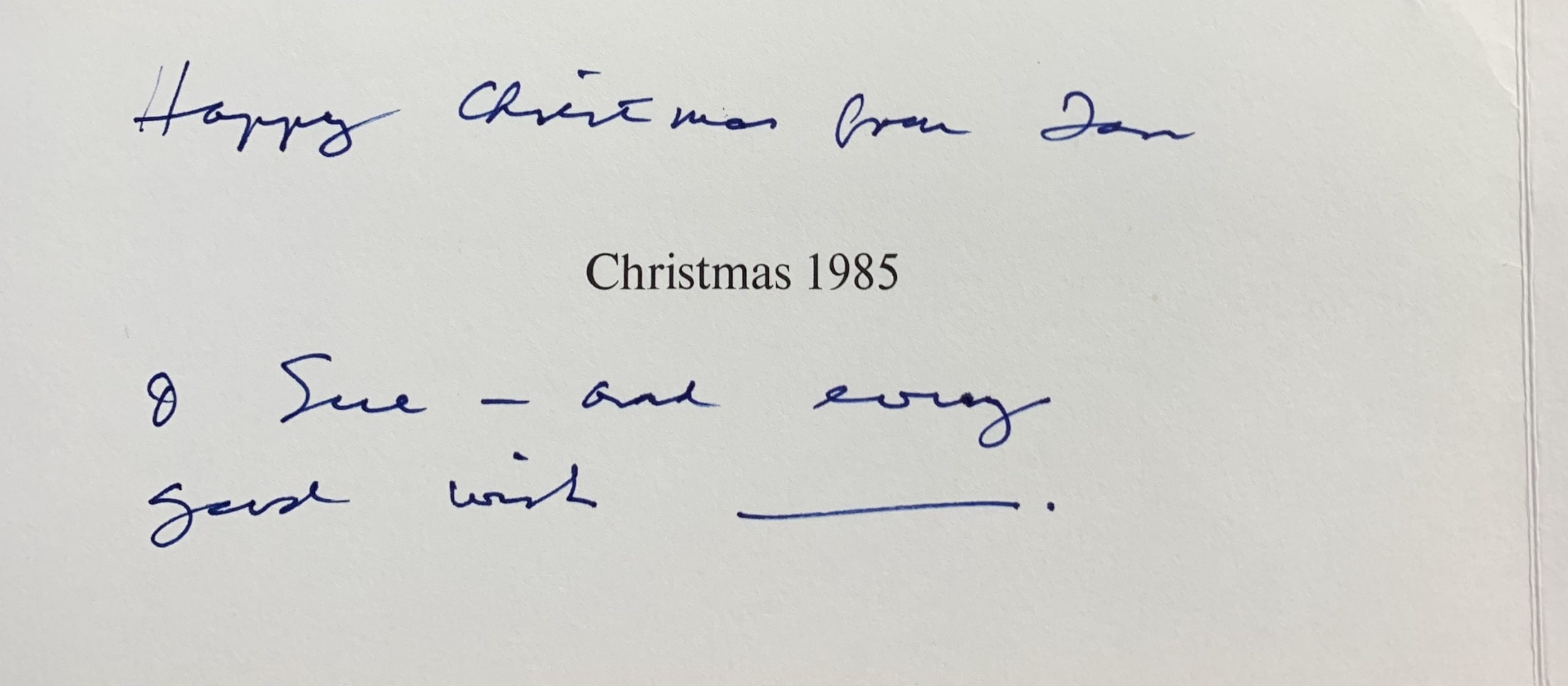
This example has a hand written Christmas greeting from Finlay on the left side of the inner card. VG+.

...
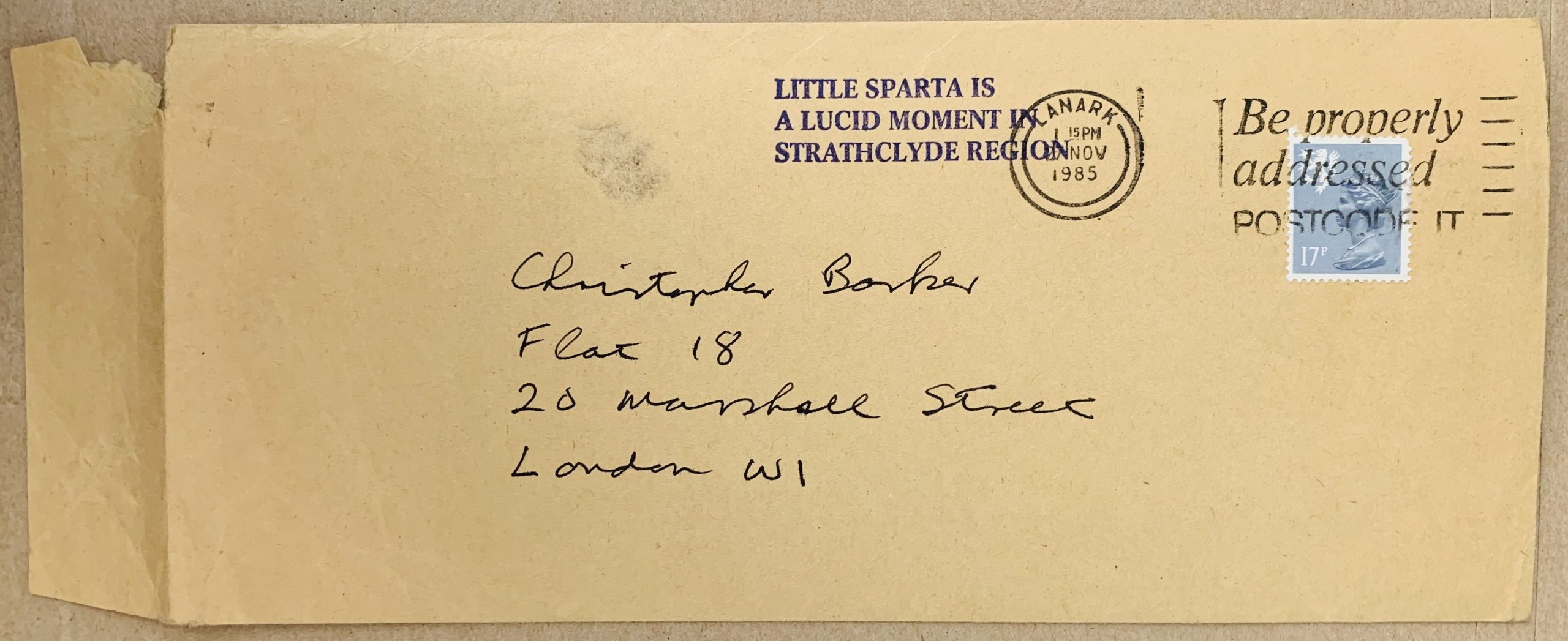
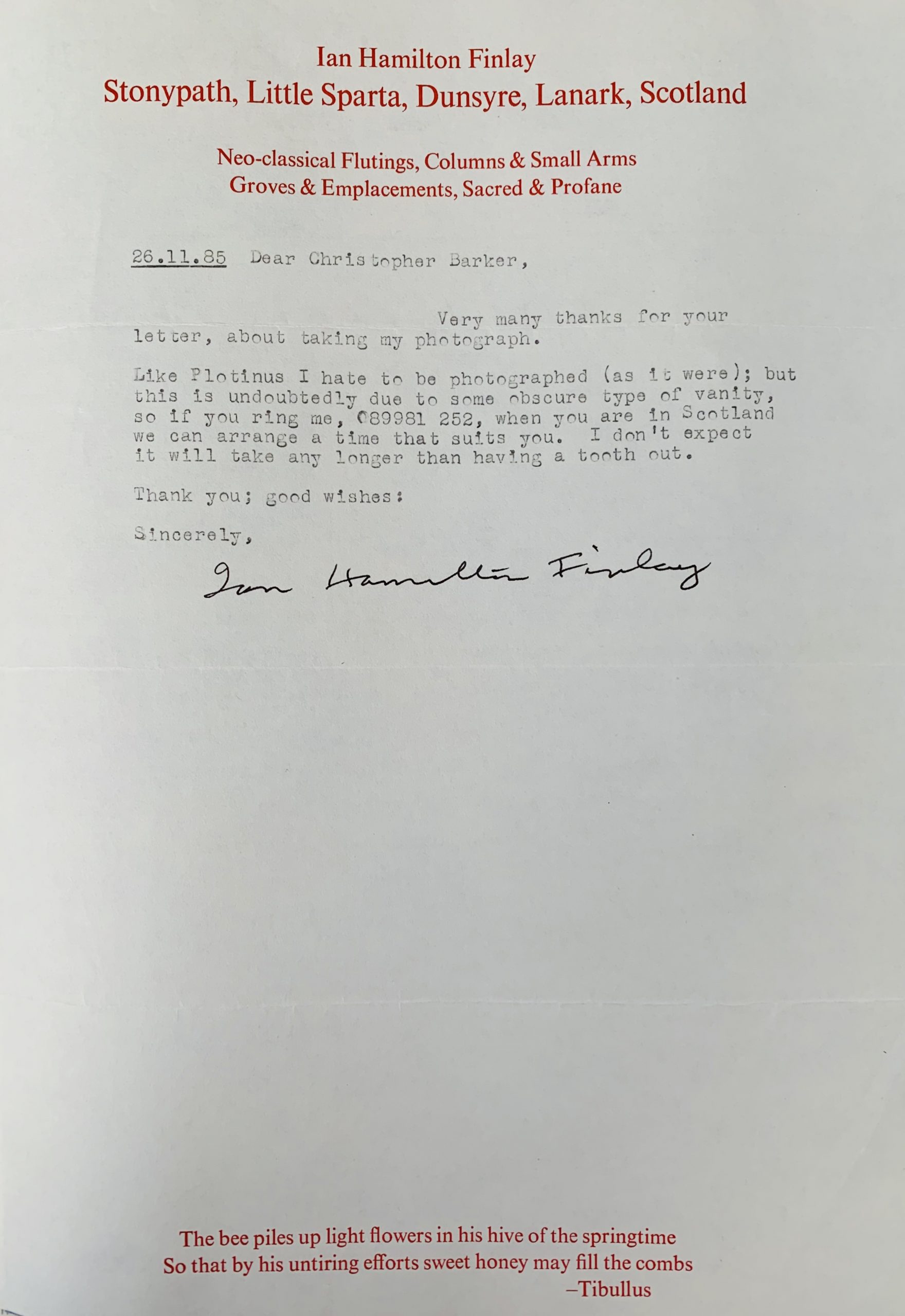
30 x 21cm, hand typed letter on printed letterhead paper.
A letter sent by Finlay to Christopher Barker dated 26.11.85
The letter agrees to the poet's photograph to be taken by Barker for a book in response to the latter's letter (see below) asking for a session. Finlay as ever is funny - he claims that "Like Plotinus I hate to be photographed" and that "I don't expect it will take any longer than having a tooth pulled."
Signed in full in black ink by Finlay at the end.

JOINT WITH:
Original typed letter (unsigned) from Christopher Barker to Finlay dated 6.11.85 requesting to be allowed to visit Little Sparta and so to include Finlay in a book of photographs of British poets planned for publication and asking for one poem to also be included in the book. Blue printed stationery.

...

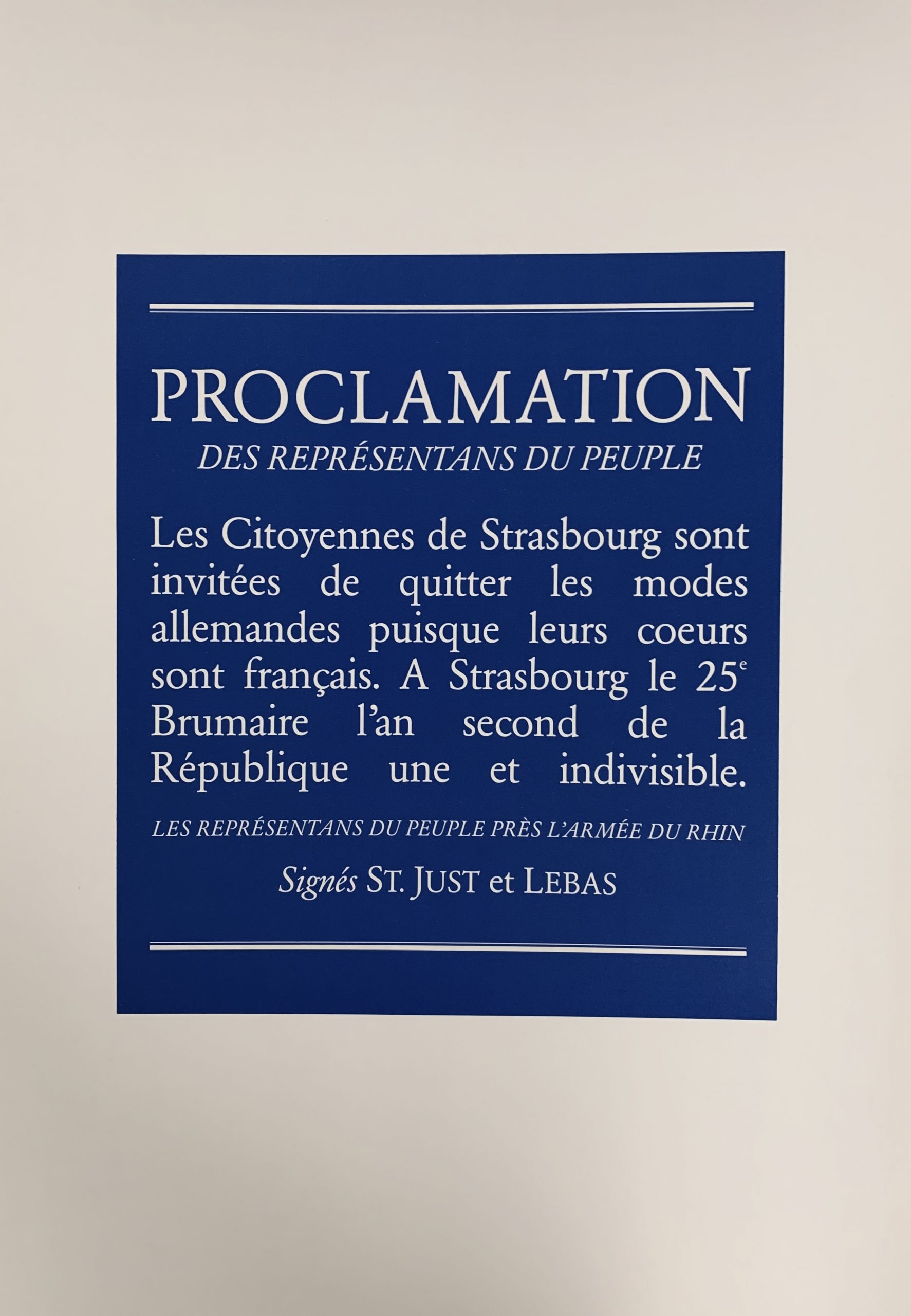
Little Sparta: Wild Hawthorn Press, 1985
42 x 29.5cm, red on white satin paper offset lithograph with a text in French after Saint-Just and his comrade in arms Lebas who had been sent to Stranbourg in 1794 by Robesprierre to end local disputes in the city that had come to violence. This was part of a general move on the Committe for Public Safety to rein in the actions of the many Representatives on Mission who had overstepped their perceived powers and gain central control of the country. The proclamation (on 25 Brumaire, 1794) tells citizens of Strasbourg to stop acting like Germans as their hearts are French. By accounts Saint-Just and Labas took the side of the city merchants over that of agitators from outside (presumably regarded as more "German") and capturing the latter's leader Euloge Schneider sent him back to Paris to meet the guillotine (again: as they had publicly displayed him tied up in front of a the local version for a day) but now for the last time .Brumaire was the second month of the revolutionary calendar and its symbol was fog. Ultimately the Coup of 18 Brumaire brought General Napoleon Bonaparte to power as First Consul of France and in the view of most historians ended the French Revolution.
There were two colour variants of this print - this is the blue one, the red is also in this collection.

...

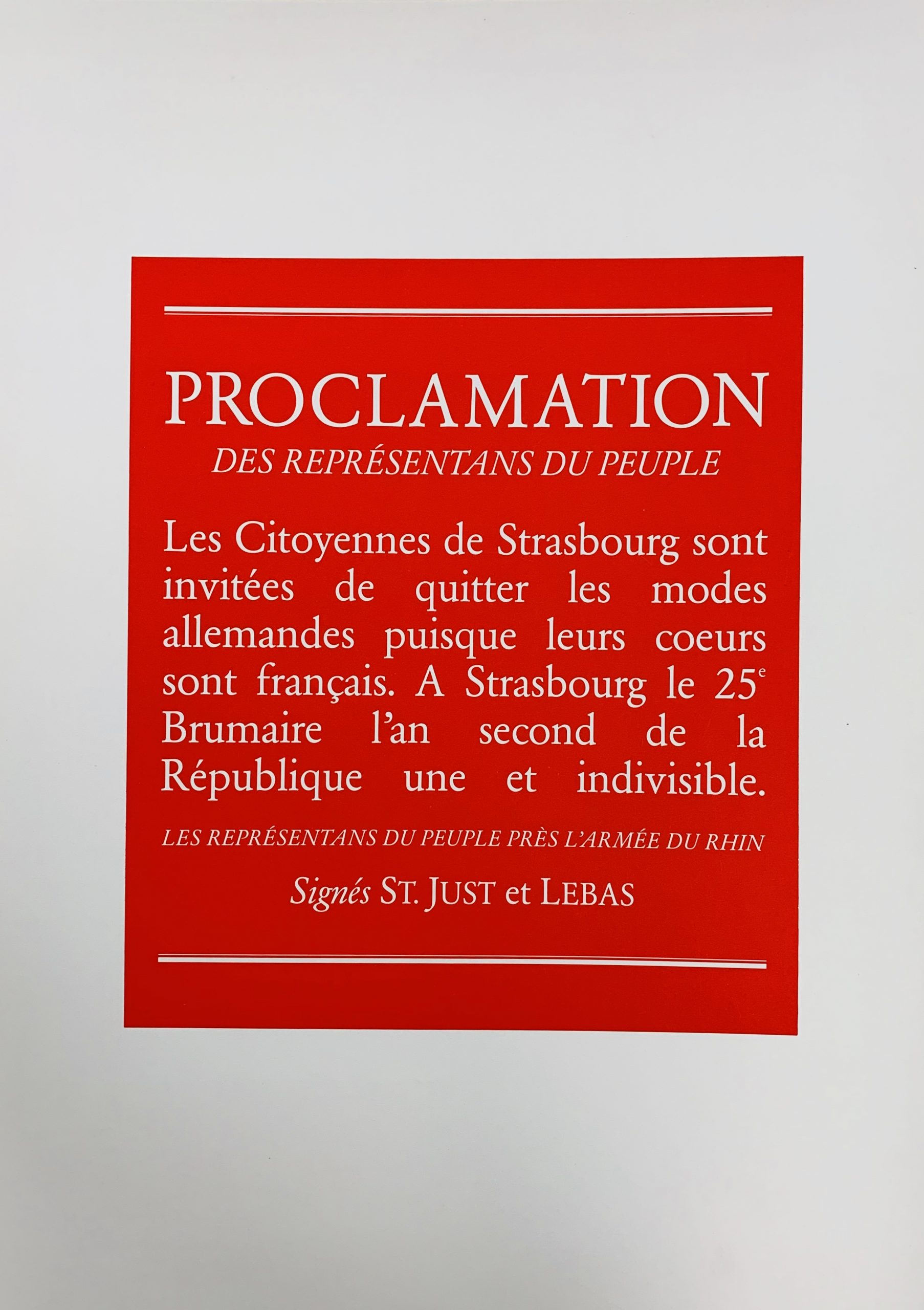
Little Sparta: Wild Hawthorn Press, 1985
42 x 29.5cm, red on white satin paper offset lithograph with a text in French after Saint-Just and his comrade in arms Lebas who had been sent to Stranbourg in 1794 by Robesprierre to end local disputes in the city that had come to violence. This was part of a general move on the Committe for Public Safety to rein in the actions of the many Representatives on Mission who had overstepped their perceived powers and gain central control of the country. The proclamation (on 25 Brumaire, 1794) tells citizens of Strasbourg to stop acting like Germans as their hearts are French. By accounts Saint-Just and Labas took the side of the city merchants over that of agitators from outside (presumably regarded as more "German") and capturing the latter's leader Euloge Schneider sent him back to Paris to meet the guillotine (again: as they had publicly displayed him tied up in front of a the local version for a day) but now for the last time .Brumaire was the second month of the revolutionary calendar and its symbol was fog. Ultimately the Coup of 18 Brumaire brought General Napoleon Bonaparte to power as First Consul of France and in the view of most historians ended the French Revolution.
There were two colour variants of this print - this is the red one, the blue is also in this collection.

...

Little Sparta: Wild Hawthorn Press, 1985
5.1 x 7.2 cm, 8pp concertina card printed red on white and on both sides of the card. On both sides is the same line: "WINDMILLS WINDING WATERS" one word per section, clearly one is to read the lines as having two different meanings.
The first is a description of the landscape the windmill is set in, the second is the wind caused by the rotating (winding) sails. VG+.

...

Firenze: Exempla/Exit Lugo 1985
8.9 x 31.7cm, 28pp (printed recto only) and printed white wrappers with printed dustjacket.
Artist's book with 8 colour typographic works by Finlay and Ron Costley. The texts are word combinations such as SEAPINK or STRAWBERRYCAMOUFLAGE- which have multiple meanings in part because of the lack of any spaces between the words. The works reproduced here were all released as much larger edition prints by the Wild Hawthorn Press but this book was an edition with Maurizio Nannuci in Italy himself a well known concrete and experimental poet (and artist). This is one of the deluxe copies - 150 signed and numbered by Finlay by hand in greem ink. VG+.

...

Little Sparta: Wild Hawthorn Press, 1985
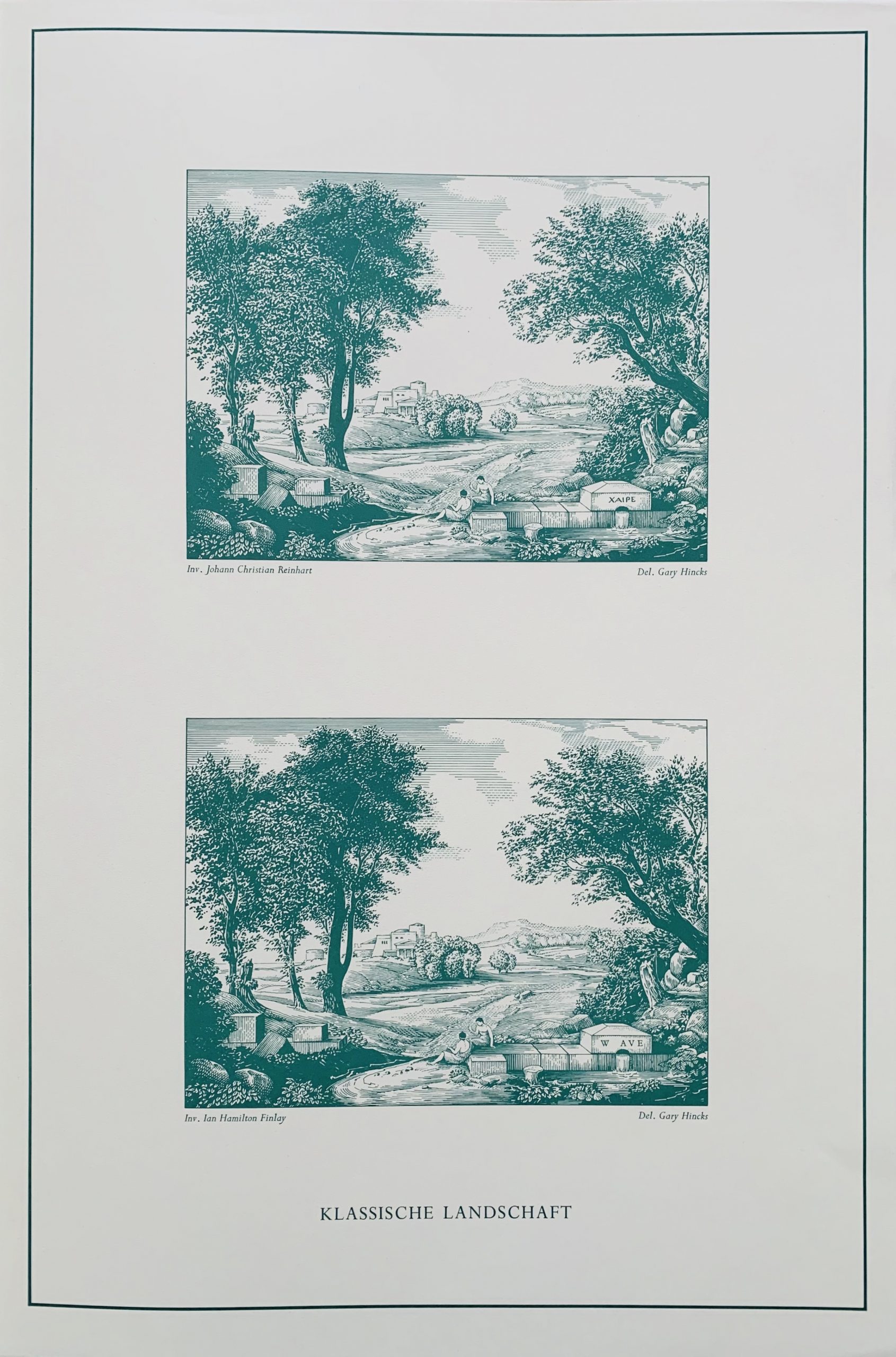
48.5 x 32.5cm, green on cream paper offset lithograph with two drawings by Hincks one above each other. The first is after a landscape Johan Christian Reinhart etched in Rome in 1811. The second is with Finlay's addition of the word "W AVE" on the stone opening for the spring. In the Reinhart original the word in Greek `"XAIPE " means Hail or Farewell and Finlay notes that as being in relation to death. The AVE part of Finlay's text is the Latin equivalent to XAIPE but with the addition of the W (a little distance from the rest of the lettering) then the meaning is altered to that of water.
This was one of only 250 such prints made. In VG condition in like folder.

...

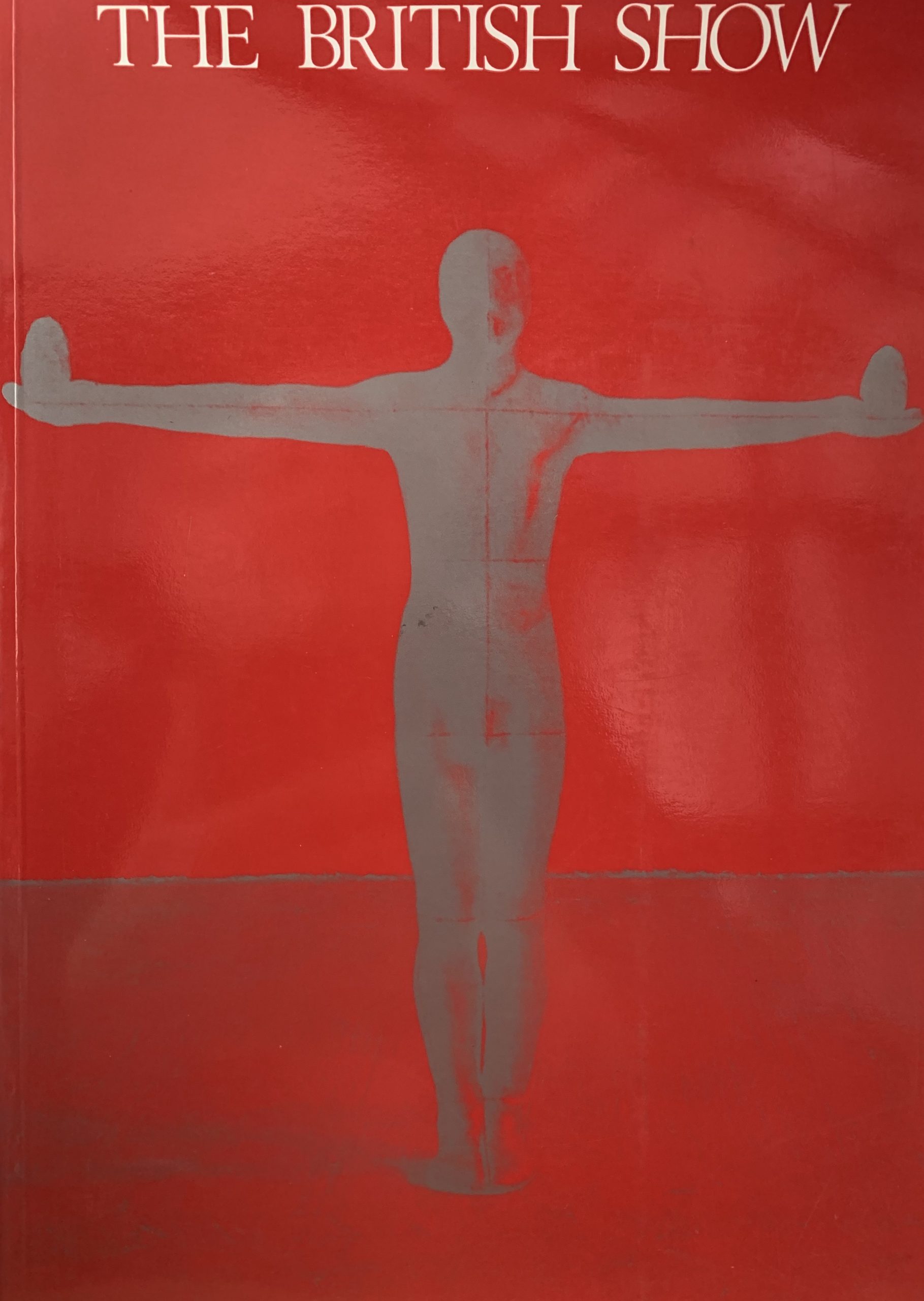
Sydney: Art Gallery of New South Wales, 1985)
30 x 21cm, 160pp plus card covers. Exhibition catalogue for an Australian travelling exhibition of British art. Finlay has 4pp of text and works as well as one of his sundials as frontispiece. VG+.

...

Little Sparta: Wild Hawthorn Press, 1985
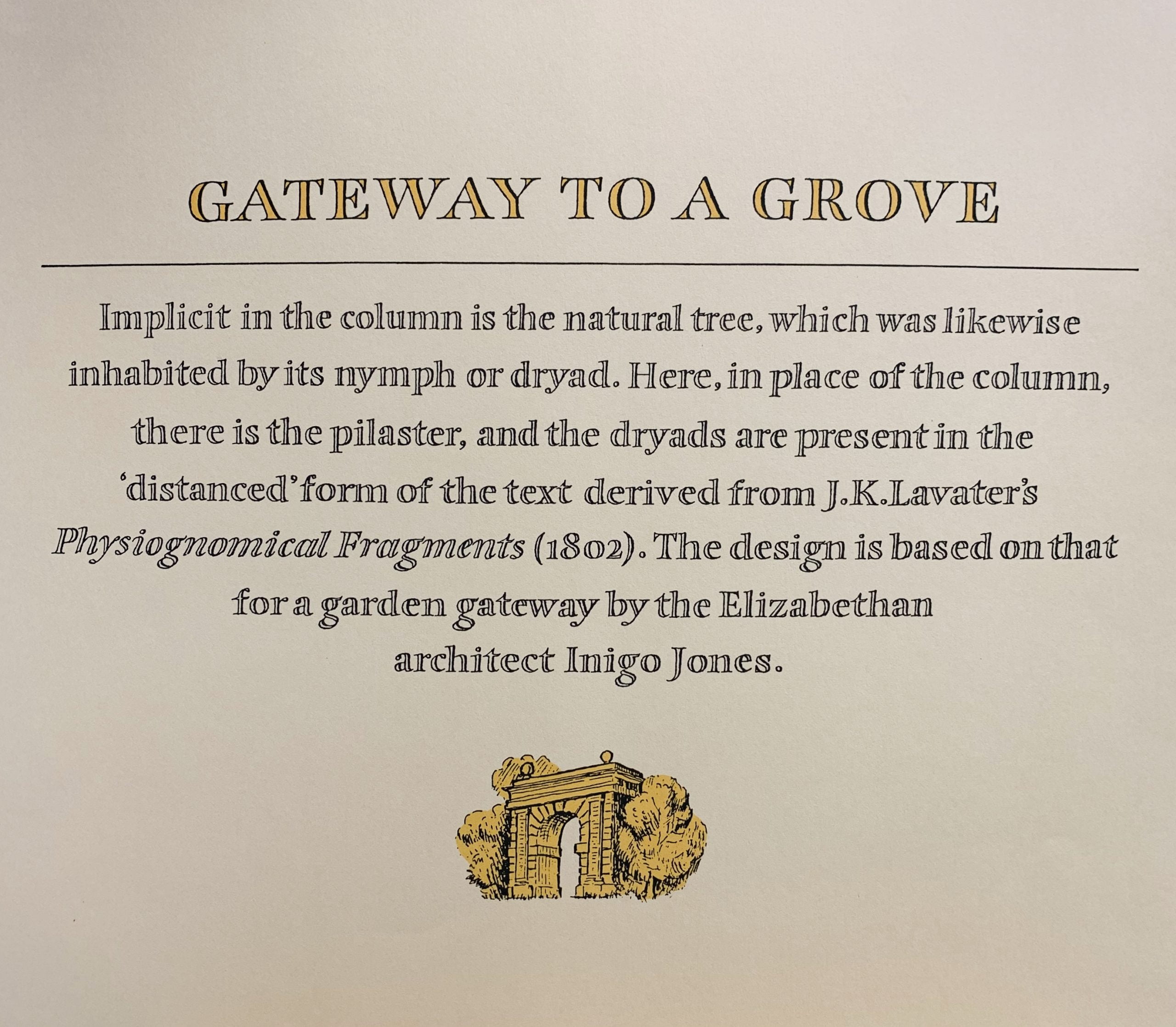
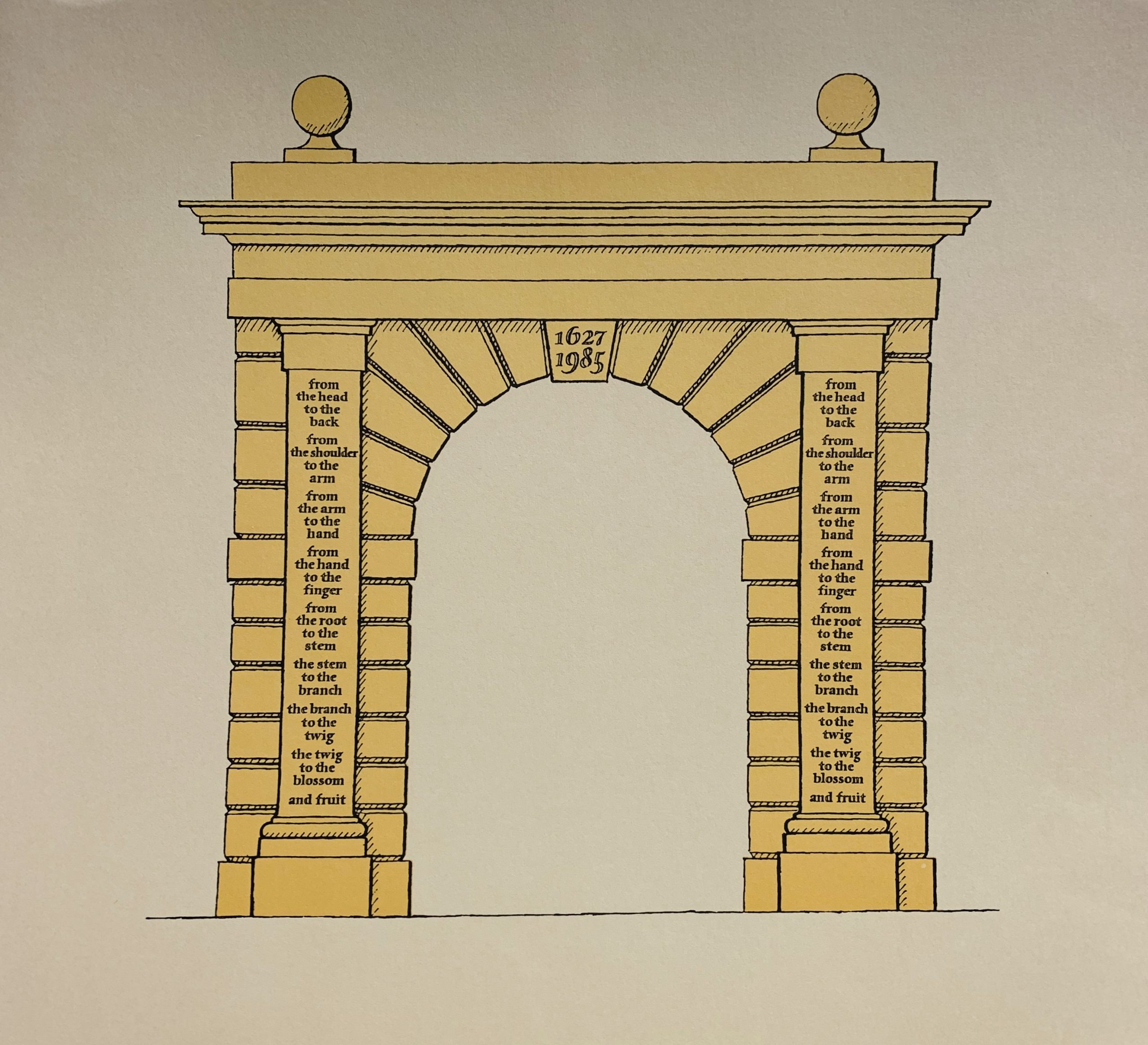
25 x 29cm, black on green folder lithograph in folder content of two lithographs after drawings by Michael Harvey of the proposed stone gateway and a textual explanation thus: 'Implicit in the column is the natural tree, which was likewise inhabited by its nymph or dryad. Here, in place of the column, there is the pilaster, and the dryads are present in the 'distanced' form of the text derived from J.K.Lavater's 'Physiognomical Fragments' (1802). The design is based on that for a garden gateway by the Elizabethan architect Indigo Jones."

...

Peninsula: Wild Hawthorn Press, 1985
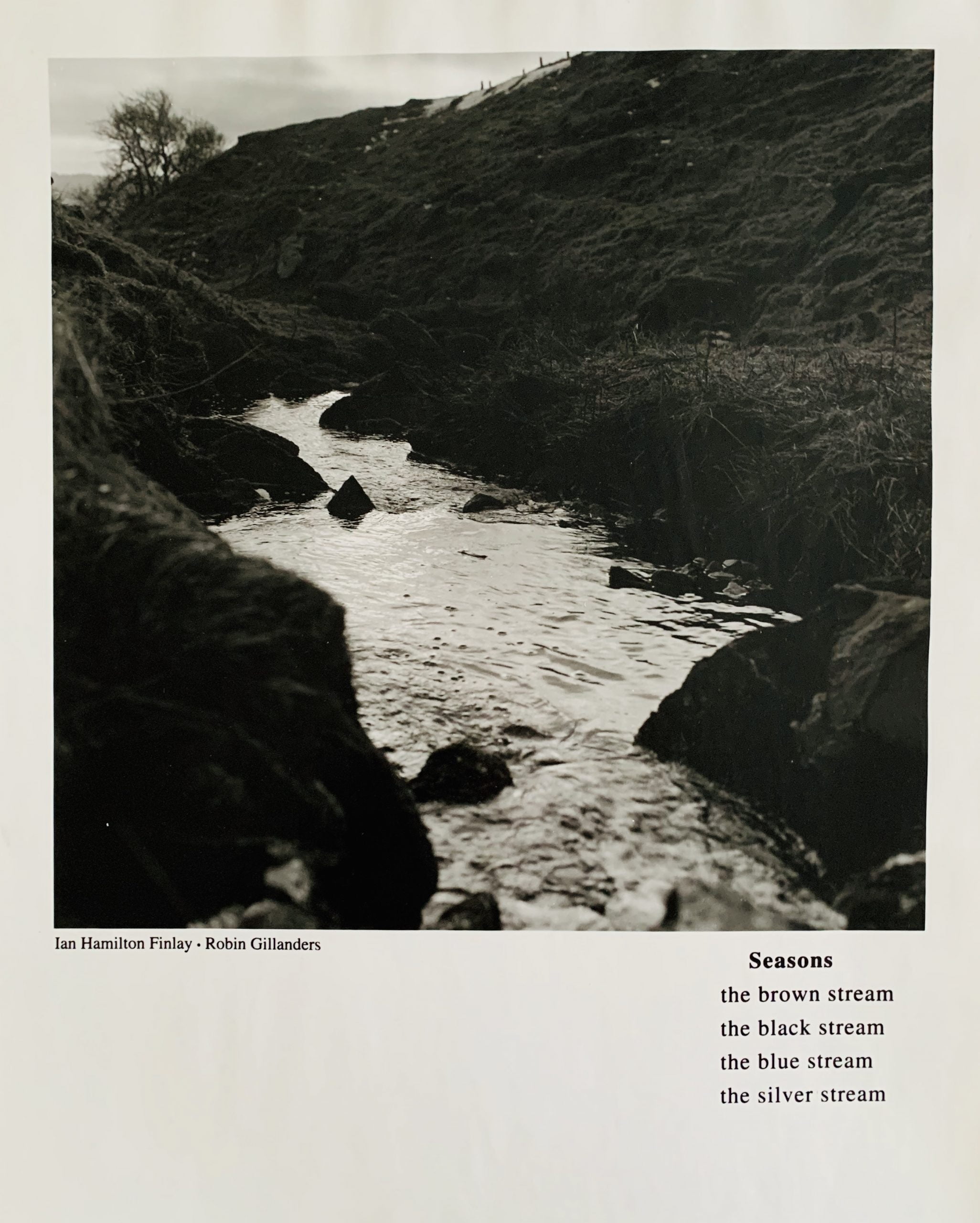
50 x 40cm, silver gelatine print. The photograph of the stream by Robin Gillanders is combined with a short poem by Finlay.

the brown stream
the black stream
the blue stream
the silver stream

The same phrase is repeated with only the colour changing each time. Gillander's photograph is in b/w so one might imagine it in different colours as per the poem - and the water having a different history each time - silver being related to fish or speed, blue in reflections or the sea, black from coal or dirt or darkness and brown from pollution or soil.
This edition is from a portfolio called ‘Dear Stieglitz,’ named in homage to Alfred Stieglitz, the photographer and gallery owner who published the art-photography journal ‘Camera Work’ in the early Twentieth century.
On the reverse is a label with details of the portfolio and image and it is signed by Finlay and numbered in pencil from the edition of only 35 copies. VG+.

...

Shopping cart0
There are no products in the cart!
Continue shopping