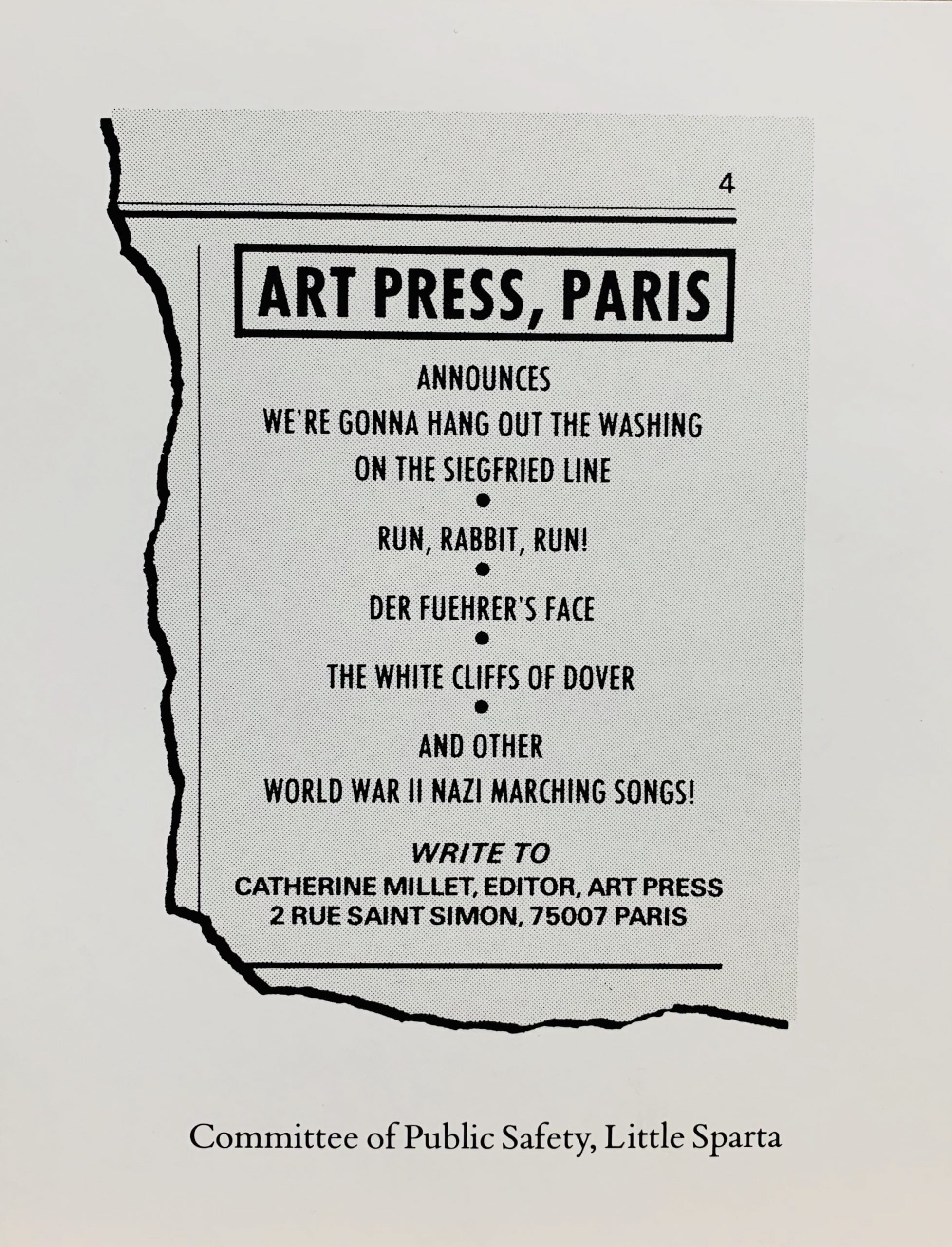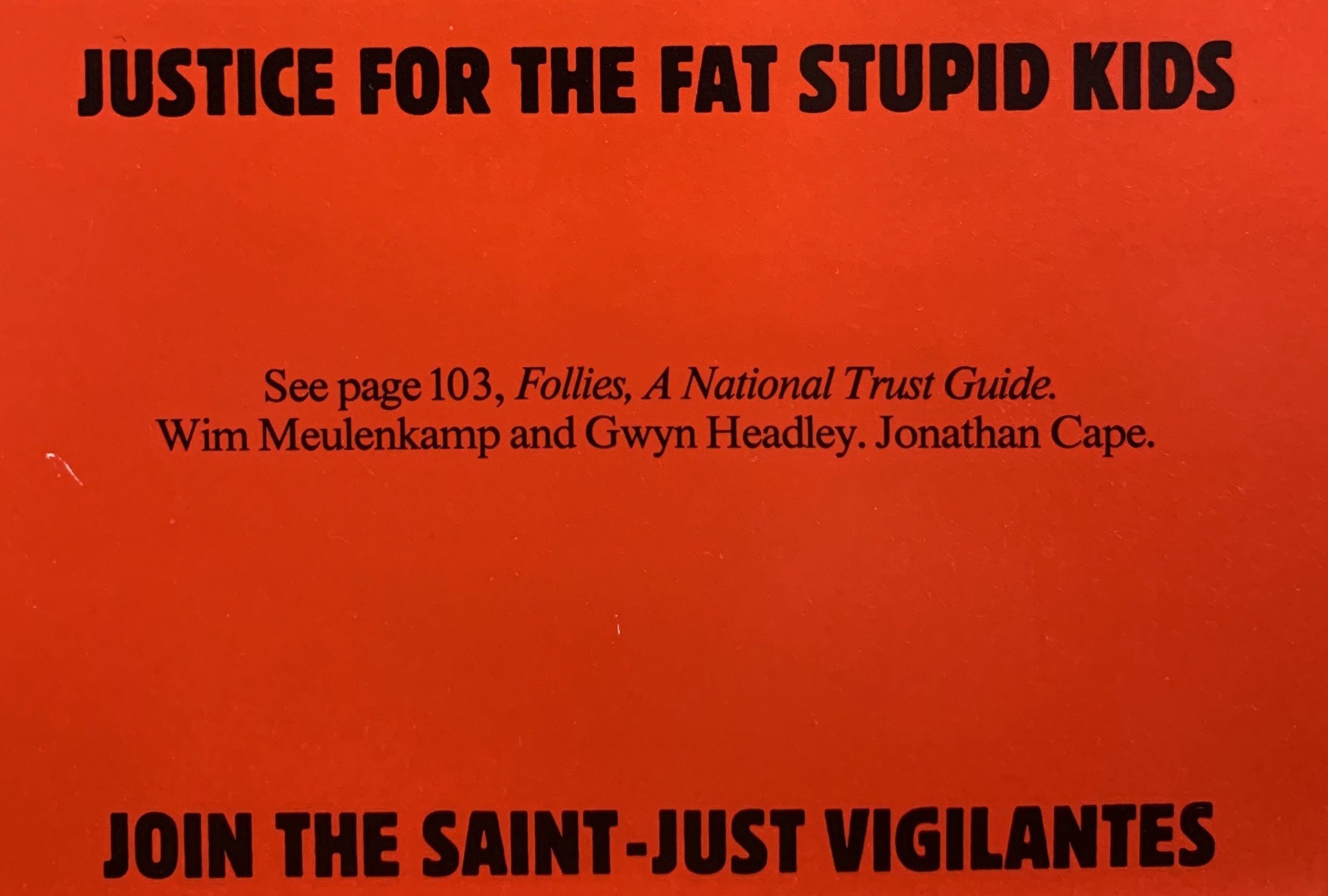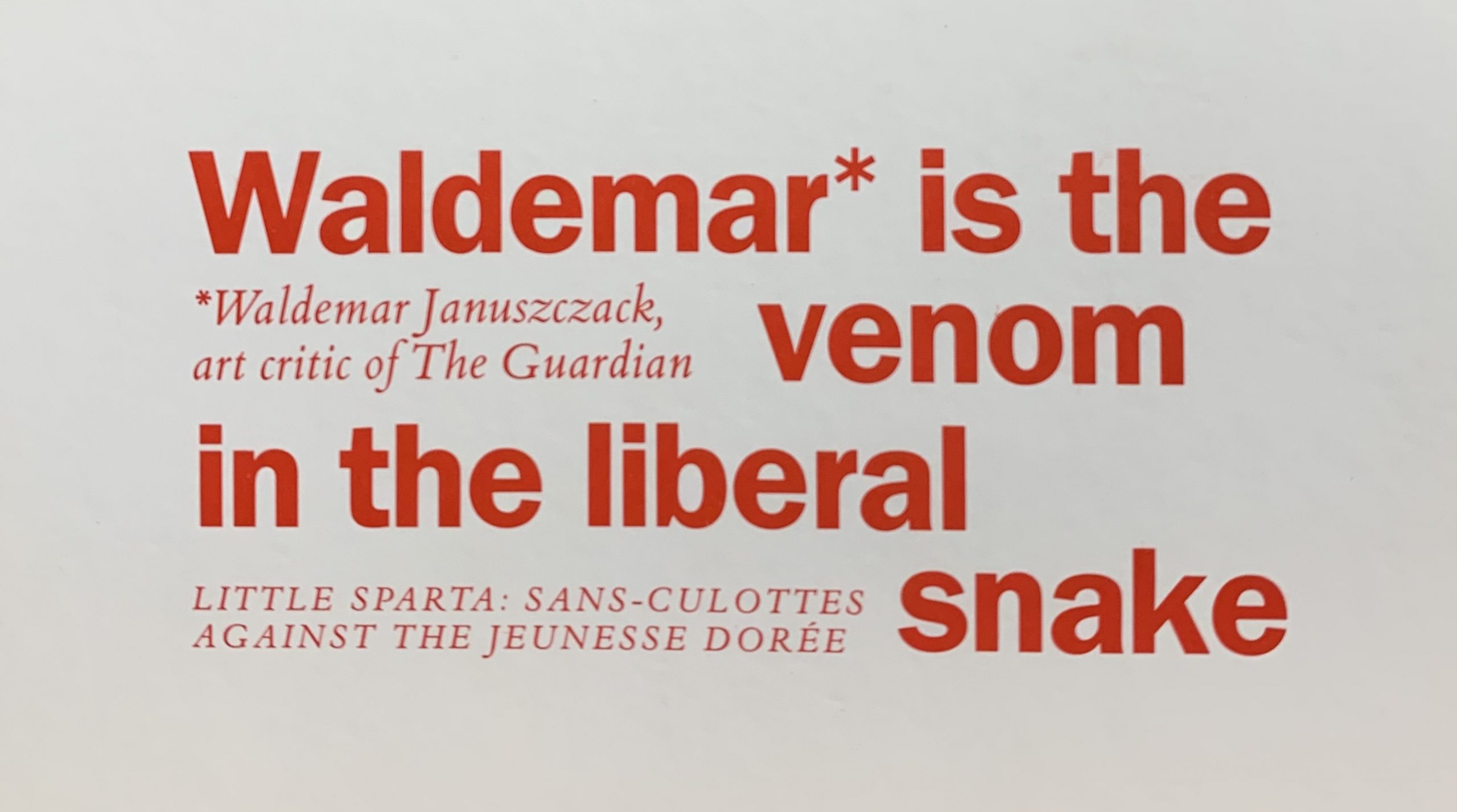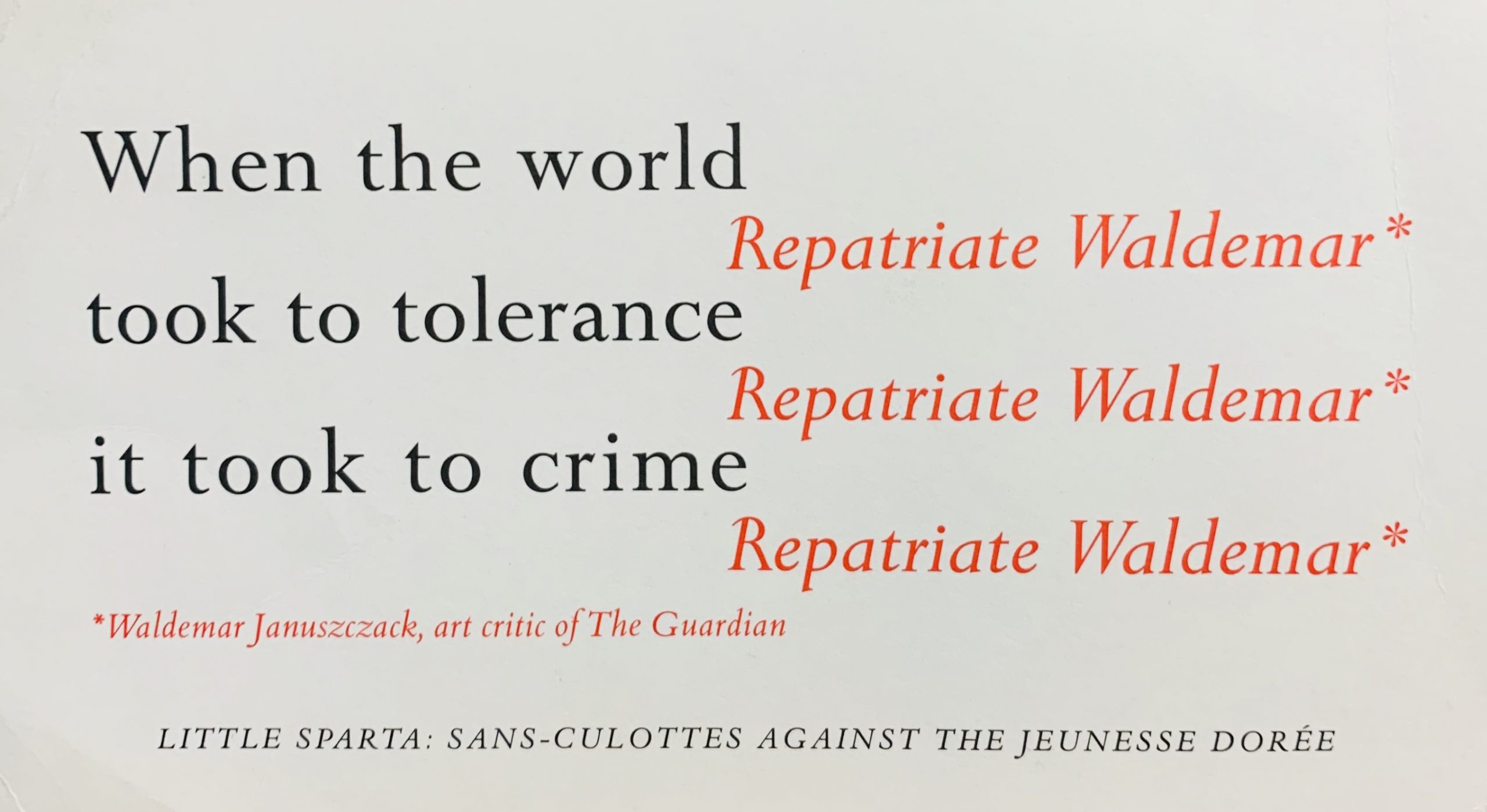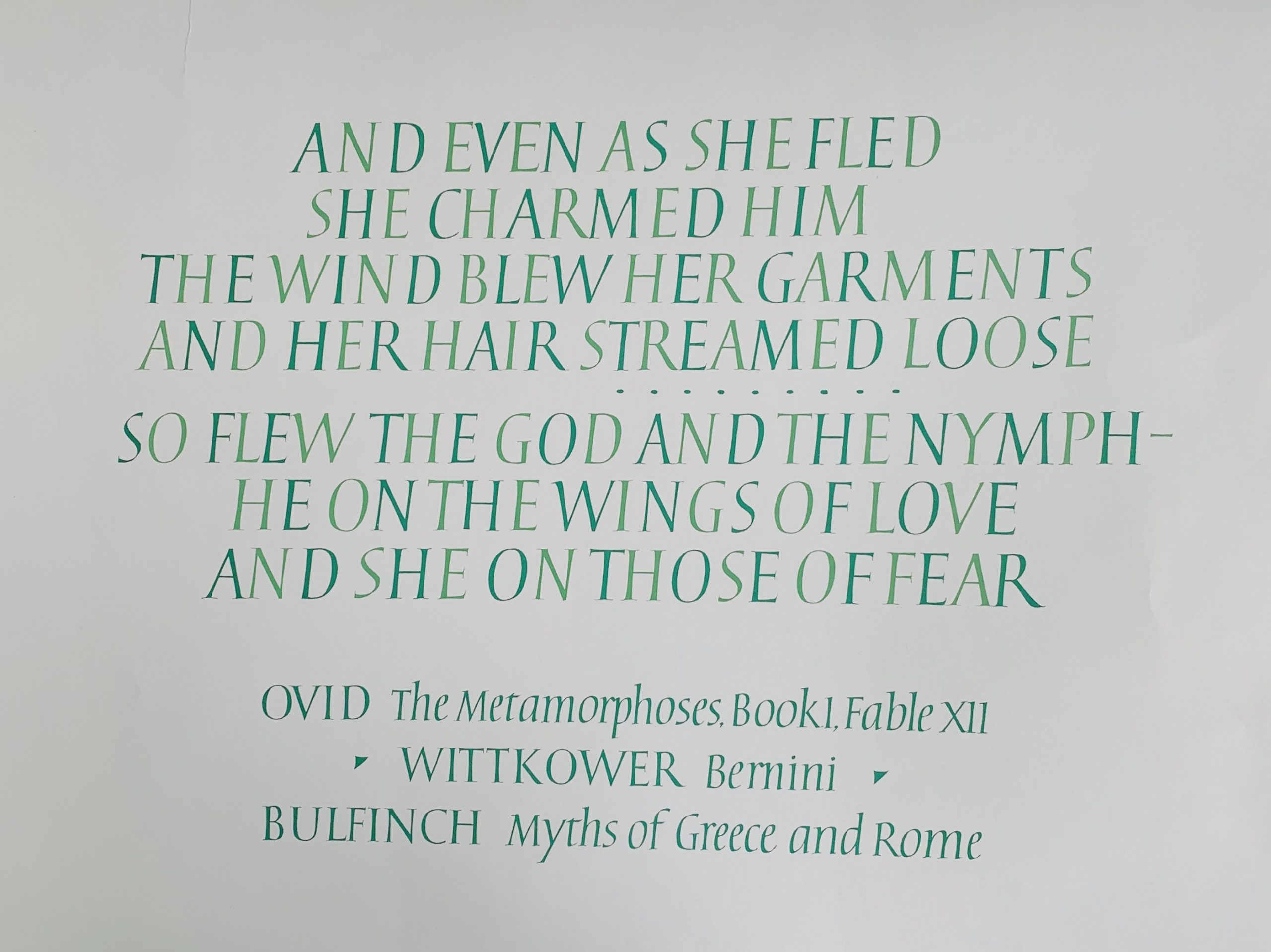
Little Sparta: Wild Hawthorn Press, 1987
11 x 8cm, 1pp Artist's card attacking the Follies book published by the National Trust:

ACCORDING TO THE NATIONAL TRUST
The certifiable build the abbeys The sane build the tearooms.

National Trust supported buildings in the UK almost always have a tea-room added to them. On the reverse there is a post-it note on which Finlay has written "A Follies War Card". VG+.

...

Little Sparta: Wild Hawthorn Press, 1987
14 x 12.5cm, 2pp artist's card released on the fourth anniversary of the First Battle of Little Sparta. The card quotes Jules Claretie reporting on Louis XVI writing "Nothing" in his diary on the night of the storming of the Bastille (this is unfair on Louis as the reference to "nothing" was actually his recording of a failure to catch anything while hunting but the story is usually told as to prove he was out of touch). Louis was indeed out of touch (he went hunting on that day after all) but that diary entry was not evidence of it but Finlay uses the quote to taunt his enemies' failure to storm the Temple Gallery on that day four years earlier thanks to the actions of the Saint-Just Vigilantes. This card is hand address to Peter Townsend, Editor of Art Monthly by Finlay. VG+

...

Little Sparta: Wild Hawthorn Press, n.d.. (1987)
17 x 13cm, 1pp artist's card with a photograph of a sticker having been stuck to the outside spine of the Follies A National Trust Guide by Gwyn Headley and Wim Meulenkamp which Finlay had condemned for misrepresenting Little Sparta as a "folly". The sticker reads "Censored by the Saint-Just Vigilantes". ...

Little Sparta: Wild Hawthorn Press, 1987
11.8 x 14.1cm, 2pp card. An appropriated drawing of a guillotine is matched with a text which shows only part of the name Headley (---LEY) as if the name of the main author of the National Trust publication "Follies" has been decapitated (the additional joke being that the part removed is the HEAD). Underneath the first there is the French text - "Je perds une tete" and under the guillotine "J'en trouve une" - I have lost a head/I find one. VG+

...

Little Sparta: Wild Hawthorn Press, 1987
13.6 x 8.2cm, 1pp Artist's card presenting a faux menu of Danton, followed by Hebert then Clooz followed by Meulenkamp and Headley. The first three names in order were guillotined under the orders of the Committee for Public Safety, the last two only in Finlay's revengeful fantasies.VG+.

...

21 x 26.5cm, b/w silver gelatine photographic print of an unique sculptural work created under Finlay's instruction by John Andrew. The image is of a boat anchored to the beach - a reference to Ullysses. The texts from Virgil is "Sterns stood along the beach". VG+.

...

21 x 26.5cm, b/w silver gelatine photographic print of an unique sculptural work created under Finlay's instruction by John Andrew. The image is of an anchor which has been sunk into foliage - bringing Finlay's oft comparison of fruit with boats to life or at least stone. The texts from Virgil is "Anchors were cast from prows" which is also a pun. VG+.

...

Little Sparta: Wild Hawthorn Press, 1987
18 x 13cm, 1pp Artist's card with an appropriated etching from 1793 - "Louis le Traître lis ta Sentence" which translates to "Louis the Traitor, read your sentence" below the image Finlay quotes Ian Barr, the Chairman of the Saltire Society as "He thought Follies an entertaining guide and enjoyed it". Clearly Finlay had added Barr to his enemies list. On the reverse there is a post-it note on which Finlay has written "A Follies War Card". VG+.

...

Little Sparta: Wild Hawthorn Press, 1987
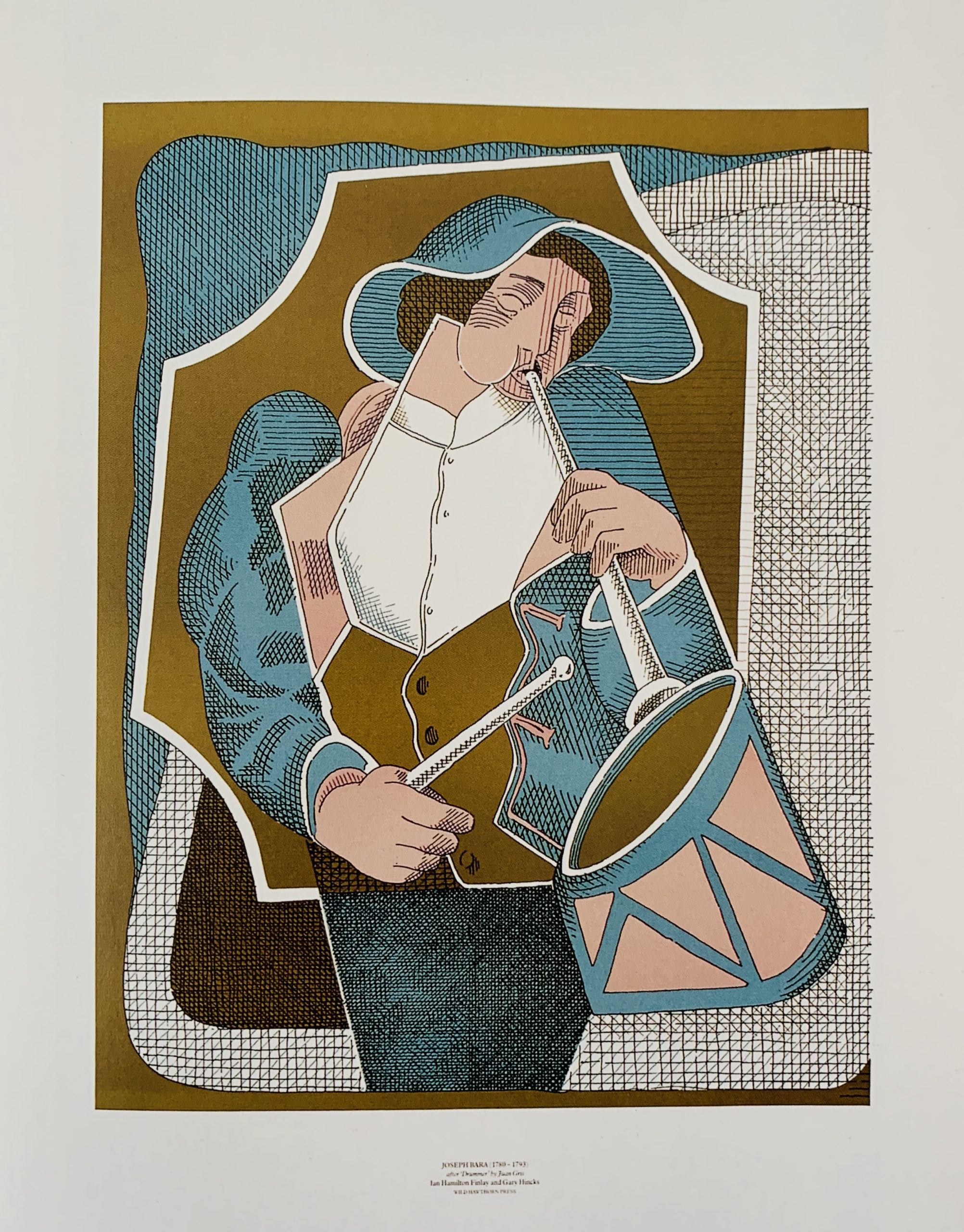
54.5 x 49.5cm, full colour offset lithograph on paper. The reproduced painting by Hincks is of Saint-Juste supposedly replacing Tatlin in his cubist self-portrait The Sailor from 1911. The text: "SAILORS! REVOLUTIONAIRES! LEARN FROM YOUR BOLDNESs" is from the French revolution but could equally be from the Russian overthrow of the Tzar. Whereas in the original painting the cap has the word GUARDIAN on it, the Finlay version says REPUBLIQUE.
The image we have used here is from a publication - the print we hold is framed in wood and glass and hard to image without reflections - but the work is in VG+ condition.

...

Little Sparta: Wild Hawthorn Press, 1987
7.1 x 10.5cm, 8pp and card covers along with printed brown dust jacket. The artist's book has a visual poem:

cottage
loaves

loaf
cottages

and there is a drawing by Howard Eaglestone and a photo-montage by Antonia Reeve.
The texts by reversing the words create first an image of squat country houses (brown and russet red as when painted by Paul Cezzane) and then a loaf with the shape of a solid loaf. The illustrations reflect those two poetic images. VG+.

...

Little Sparta: Wild Hawthorn Press, 1986
18.3 x 12cm, 20pp and card covers along with flower pattern dust jacket and printed tipped on label. The full title of the book is "Detached Sentences on Weather In The Manner of William Shenstone".
Shenstone was not only an 18th century poet but also an influential early estate gardener. The texts are a series of aphorisms by Finlay which are presumably in the style of the earlier poet and all consider the importance of the weather - a subject very important to both gardeners and British people. Two examples of these sayings are:

"The Late Night Shipping Forecast is a kind of High Church Weather Service for radio listeners."
Or
"The Greeks before Troy feared hostile weather as much as hostile Trojans."

One of only 200 such books printed at Christmas as presents to friends and colleagues. Two small vignettes by Jo Hincks. VG+.

...

Little Sparta: Finlay, 22nd December 1986
An original vintage xerox 30 x 21cm, 1pp with a round robin letter from Finlay to all of the Saint-Just Vigilantes explaining the the Consumer Protection Department has begun an investigation of "Follies: a National Trust Guide" by Headley and Meulenkamp and published by Jonathan Cape. Finlay asks if his supporters can write to the CPD with letters explaining why Little Sparta is not a Folly and why it should not be included in such a guide. Finlay hopes the investigation may lead to the withdrawal of the Follies book. The letter ends with one of Finlay's "detached sentences on the National Trust":
"One cannot preserve the meaning of a building by preserving the building alone."

...

Shopping cart0
There are no products in the cart!
Continue shopping