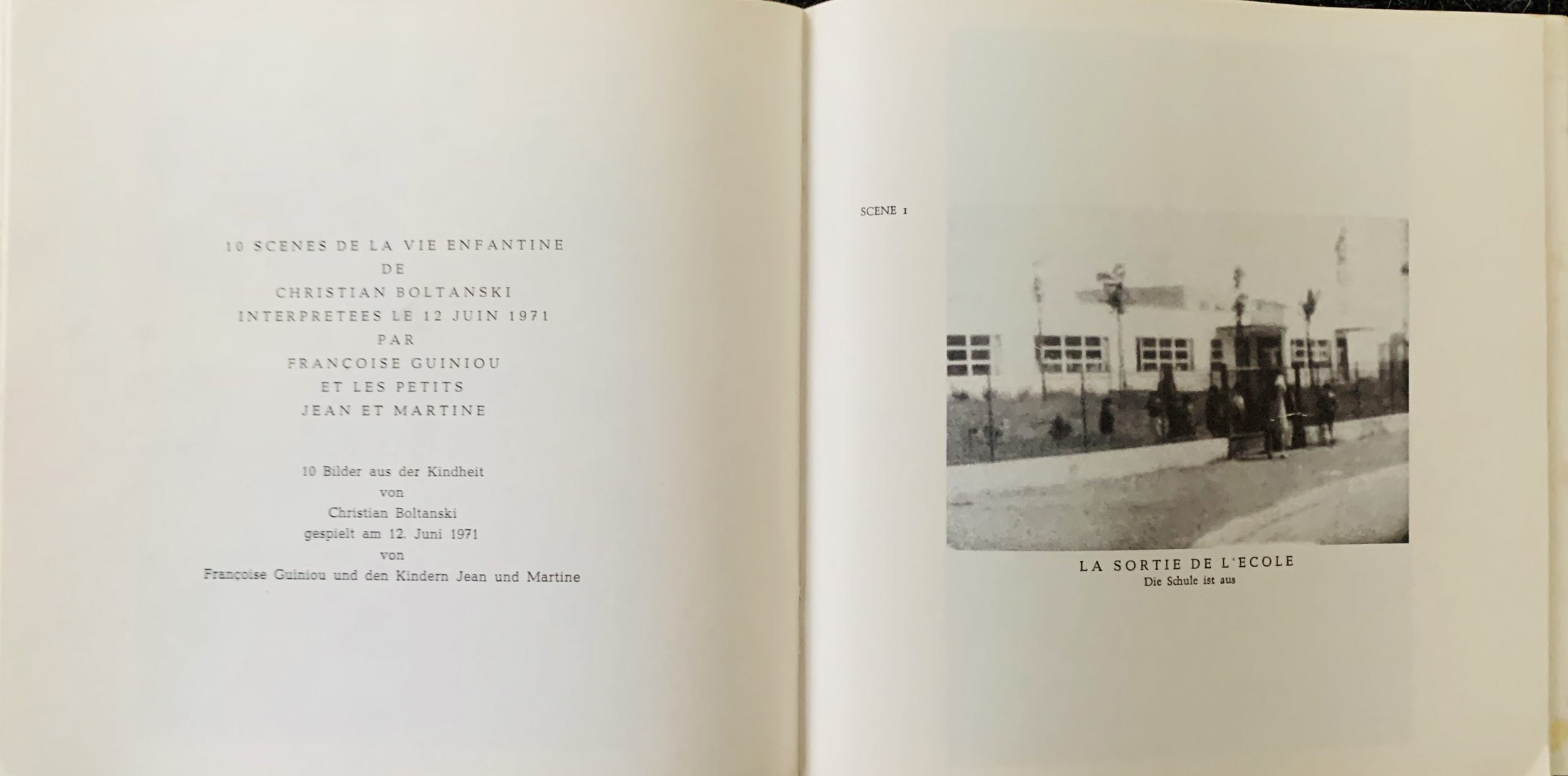
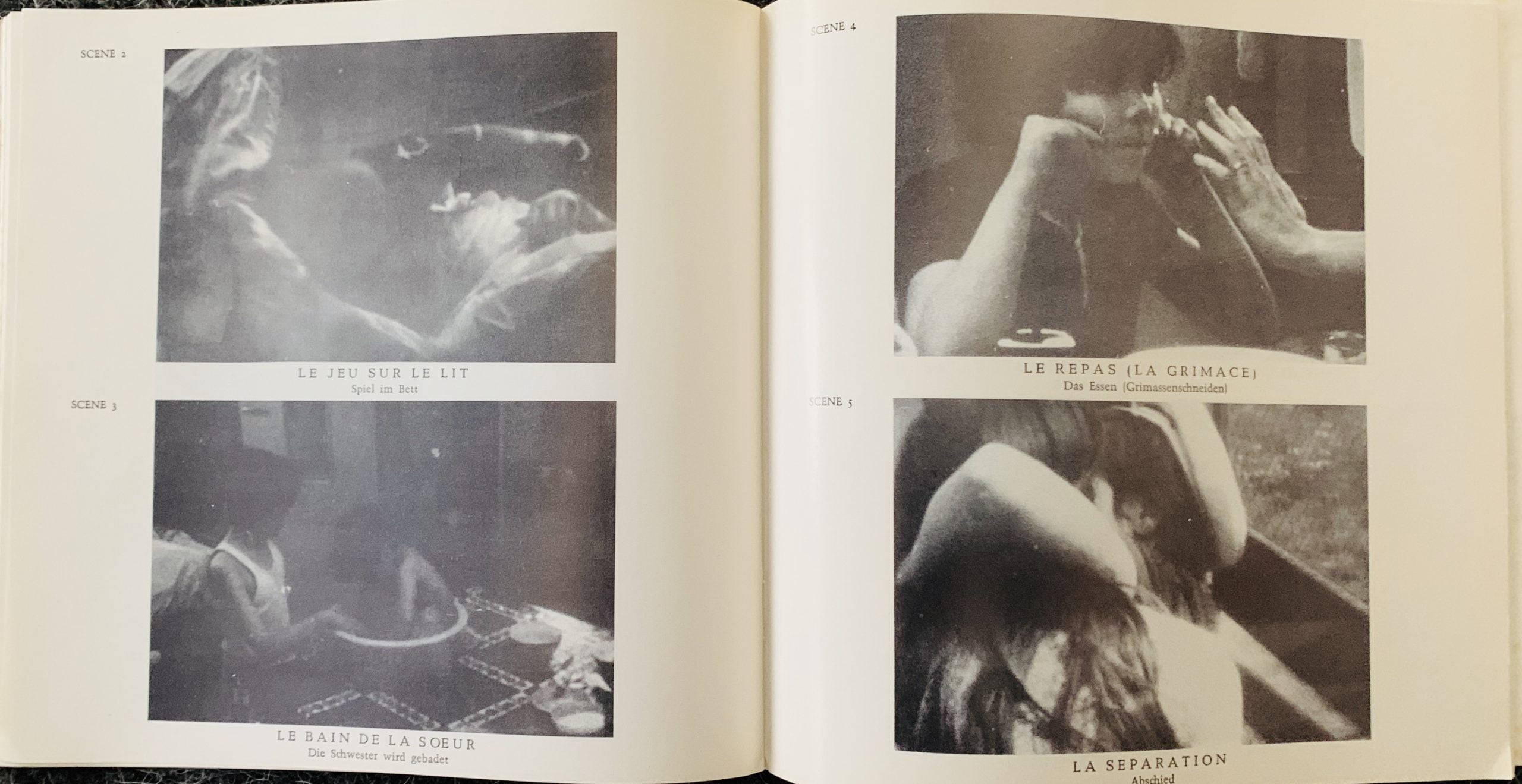
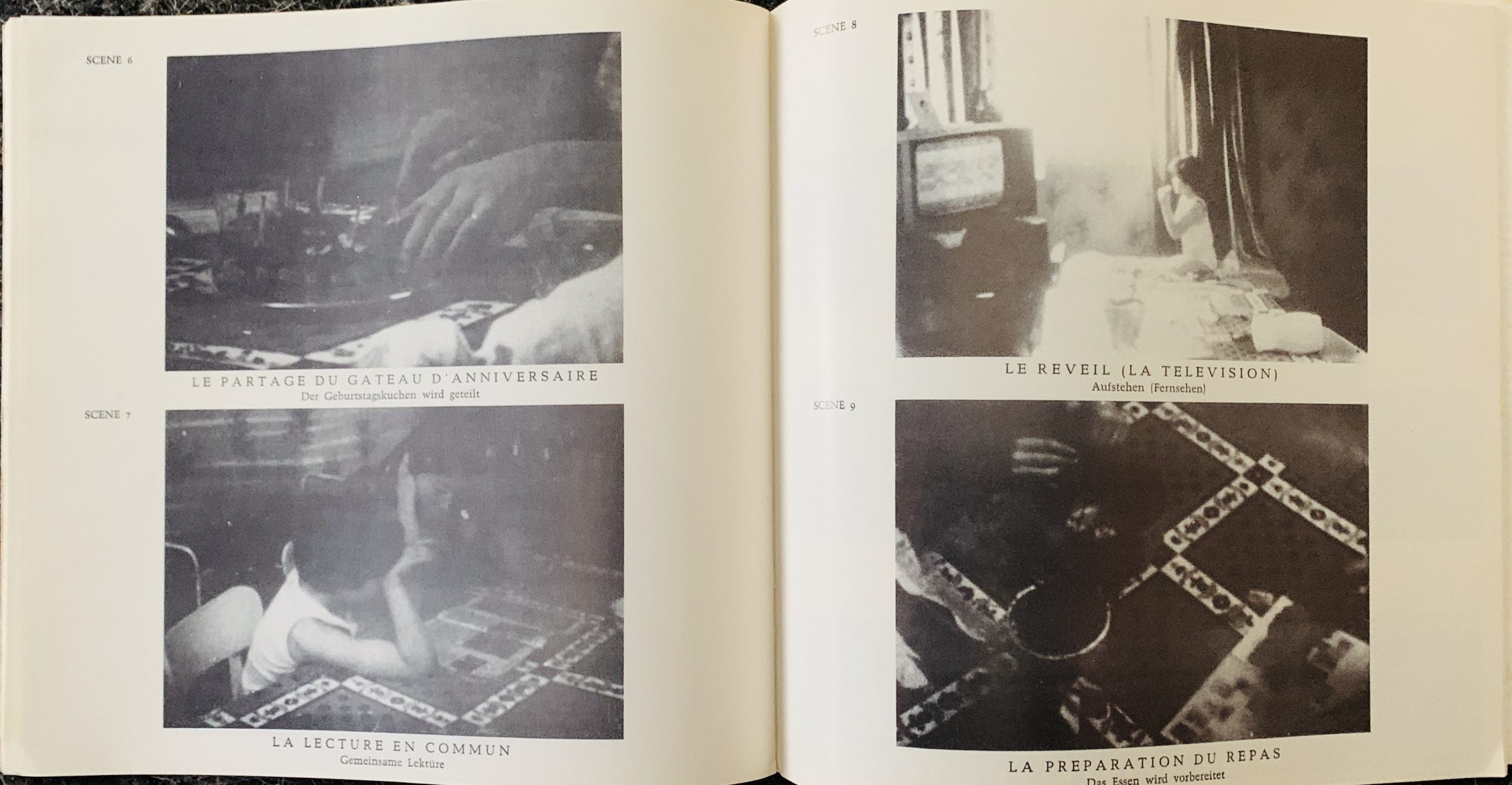
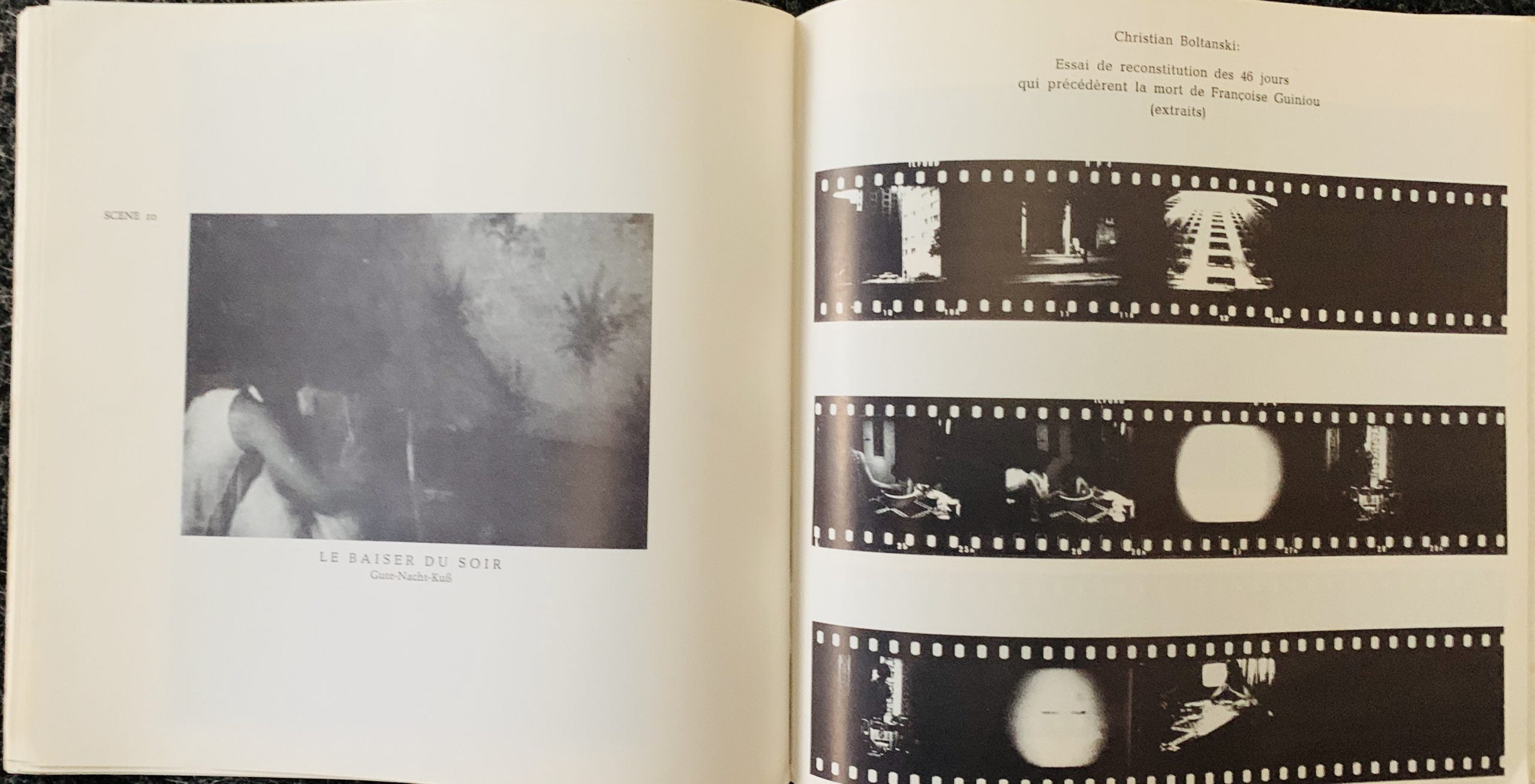
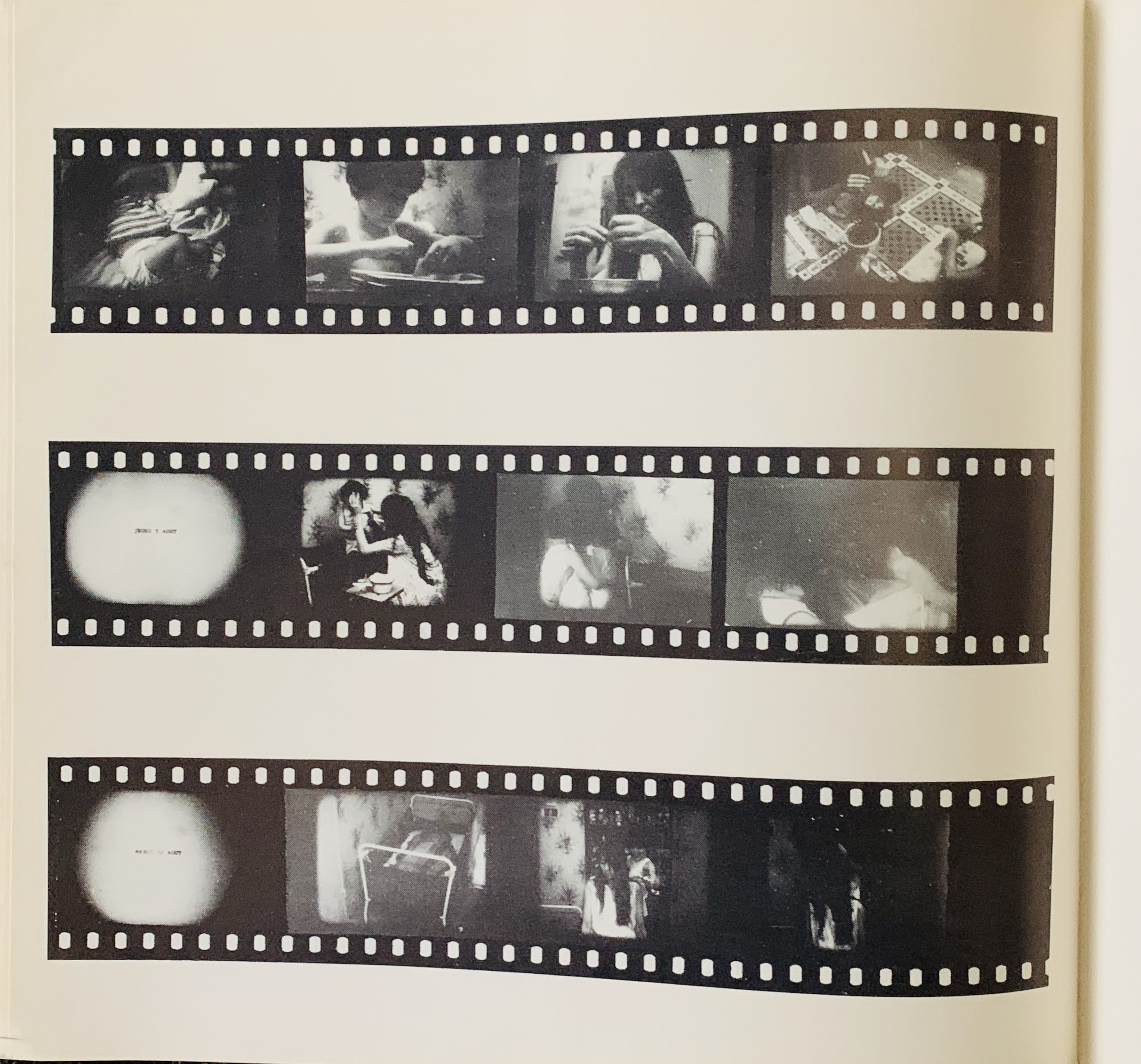
Berlin: AQ Verlag, n.d (1972)
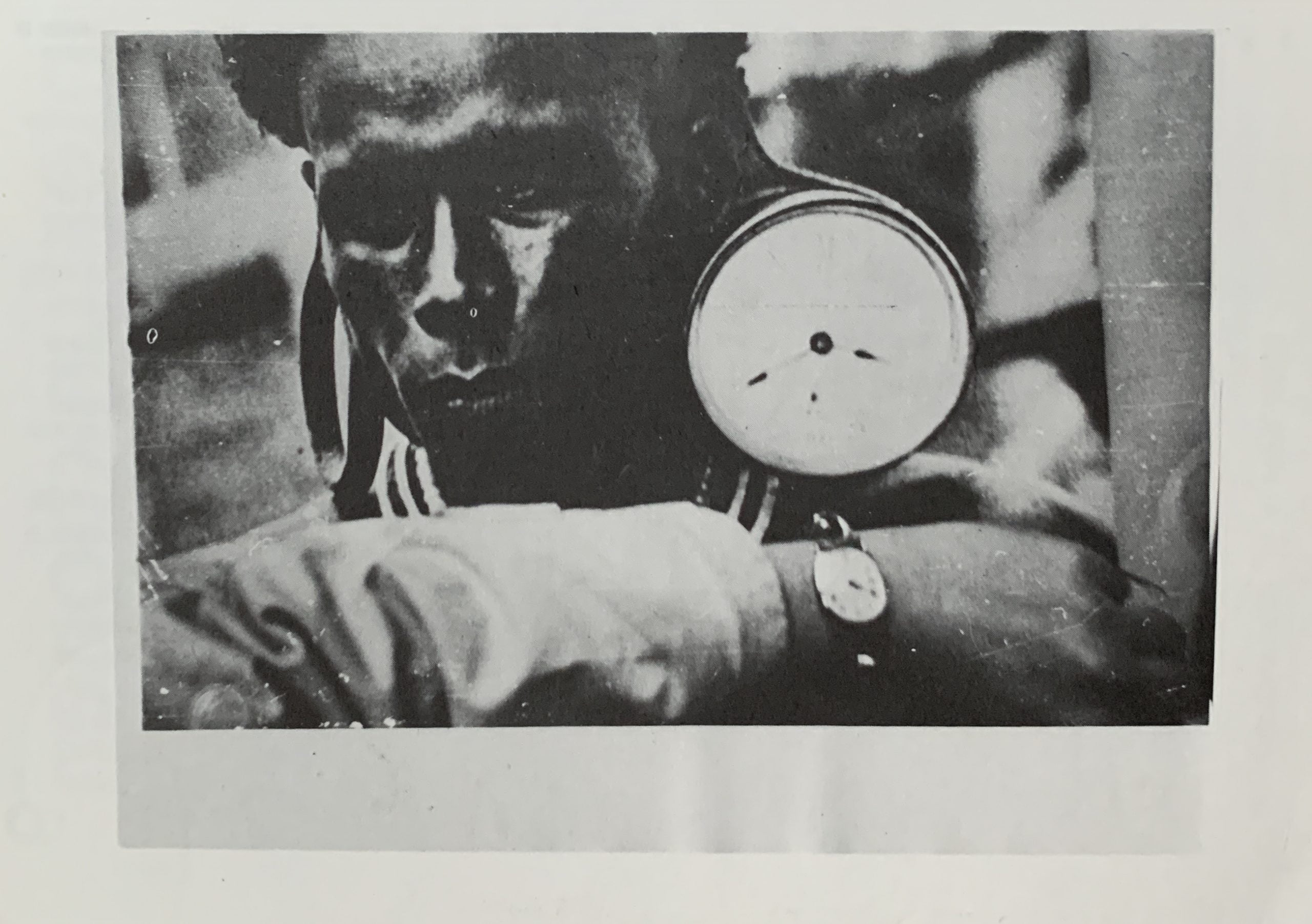
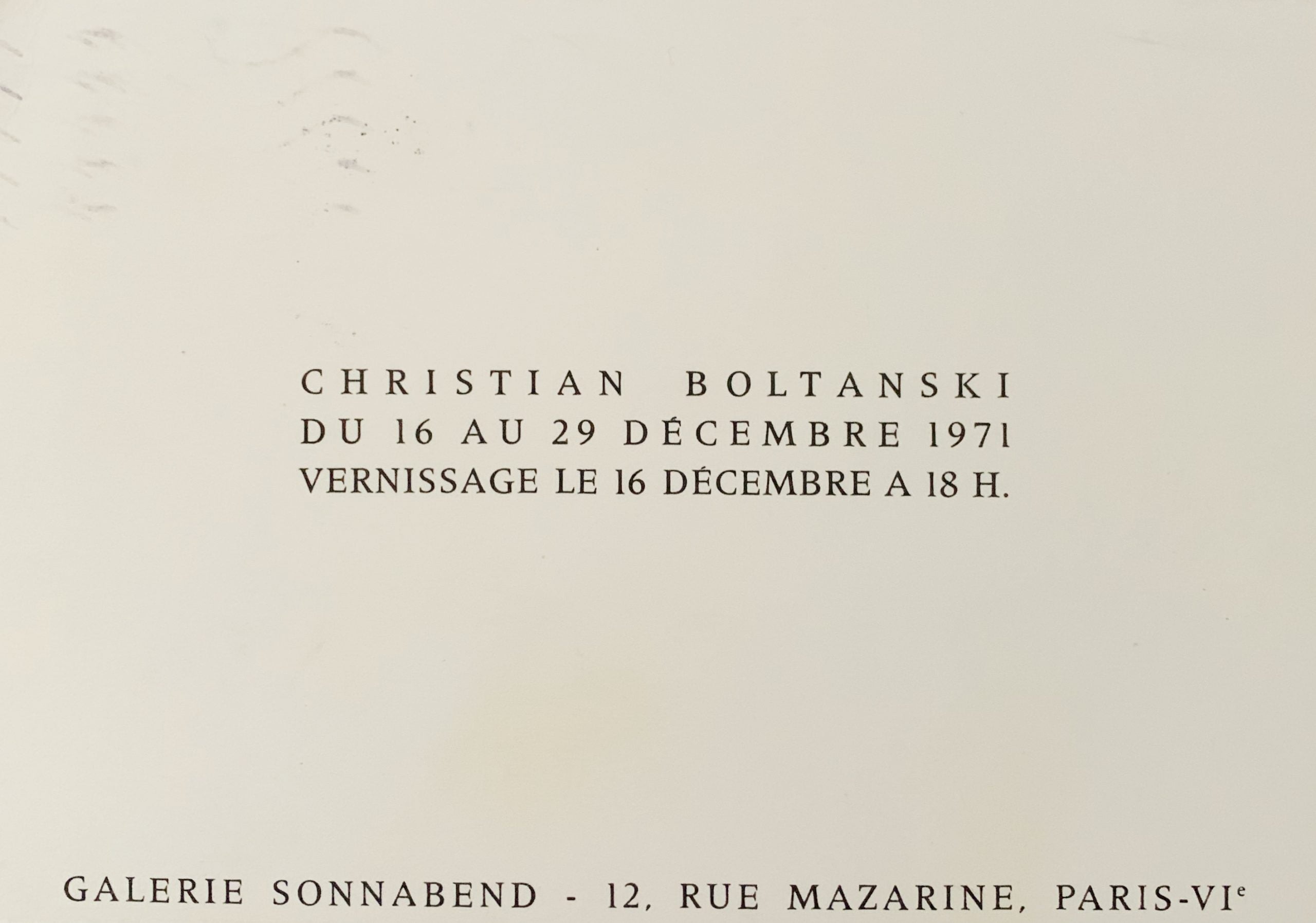
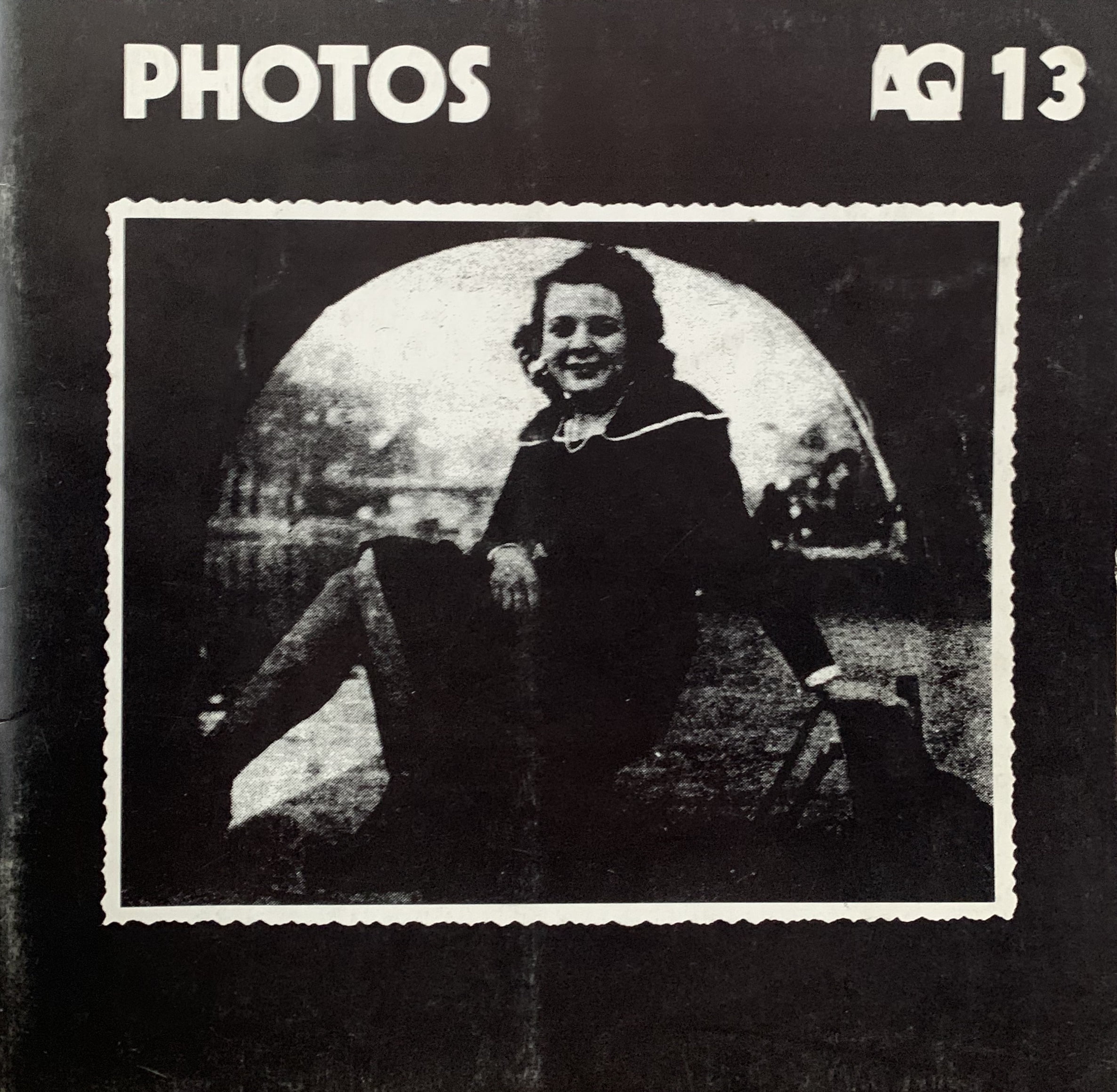
20 x 20.7cm, unpaginated (c. 112pp) plus pictorial wrappers. A single number of this photographic and art journal - here Boltanski has two original contributions - 10 SCENES DE LA VIE ENFANTINE DE CHRISTIAN BOLTANSKI INTERPRETEE LE 12 JUIN 1971 PAR FRANCOISE GUINIOU ET LET PETITS JEAN ET MARTINE and ESSAI DE RECONSTITUTION DES 46 JOURS QUE PRECEDERENT LA MORT DE FRANCOISE GUINIOU (EXTRAITS). Neither to our knowledge is reproduced elsewhere. The former being six b/w images of children acting out scenes from Boltanski's supposed memories. The second the same photographs and more displayed as contact prints from a film role. One is expected (one presumes) to see the latter as the documentation of the previous project and that Francoise Guiniou somehow died soon after the photoshoot.
There are other original pageworks by Paul-Armand Gette, Jean Le Gac, Hans-Peter Feldmann, Jochen Gerz and Anthony McCall.
Not in any catalogue raisonne.

...
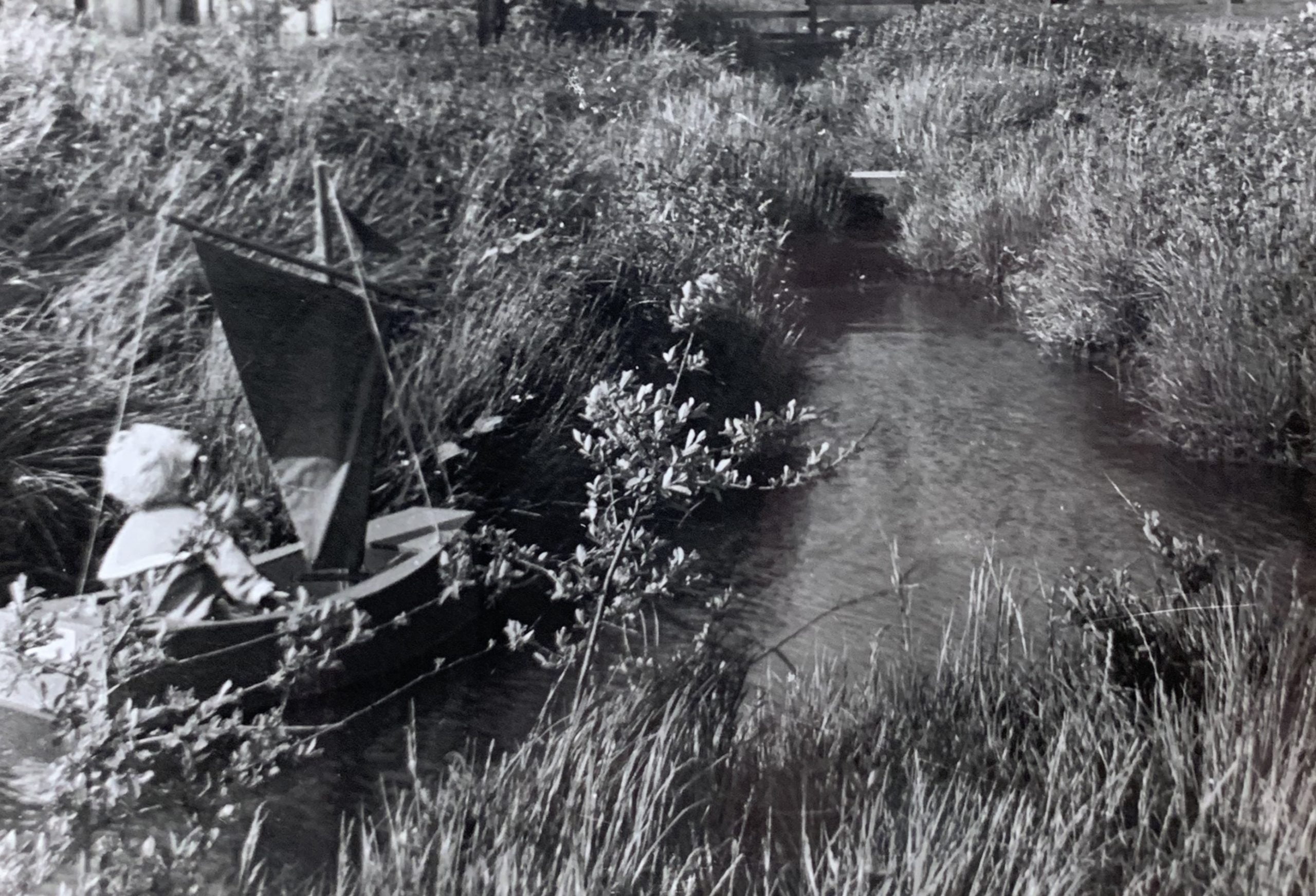
Dunsyre: Wild Hawthorn Press, 1972
10.5 x 15.2cm, 1pp. A photograph by Finlay of his son Eck (later Alex) Finlay as a young child in a small boat on the lake (named after Eck) on the Finlay farm. It is a charming picture. Edward Atkinson Hornel was a Scottish painter who specialised in paintings of landscapes and nature within which children were often seen playing - a successful strategy for sales.

...

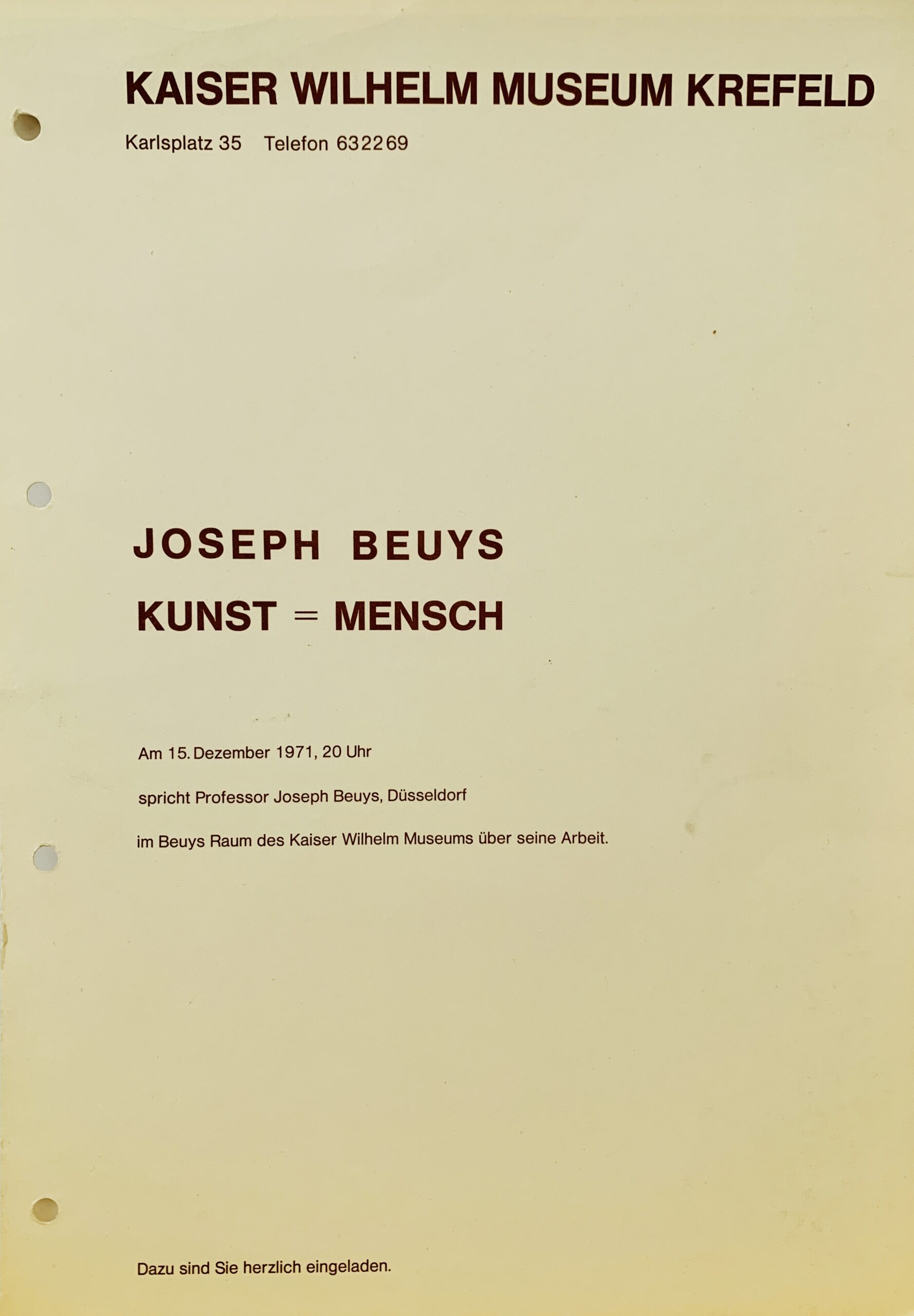
Koln: Interfunktionen, n.d. (1972) 15 x 10.5cm, 2pp subscription card promoting the ninth number of the conceptual art journal. Lists contributions from Beldessari, Baumgarten, Beuys, Didier Bay, Terry Fox, Dan Graham, Hans Haacke, Friedrich Heubach, Will Insley, Jurgen Kramer, Dennis Oppenheim, Steve Reich, William Wegman and Signmar Polke. The front of the card reproduces a poster designed by Polke for the magazine. VG+. Scarce. ...

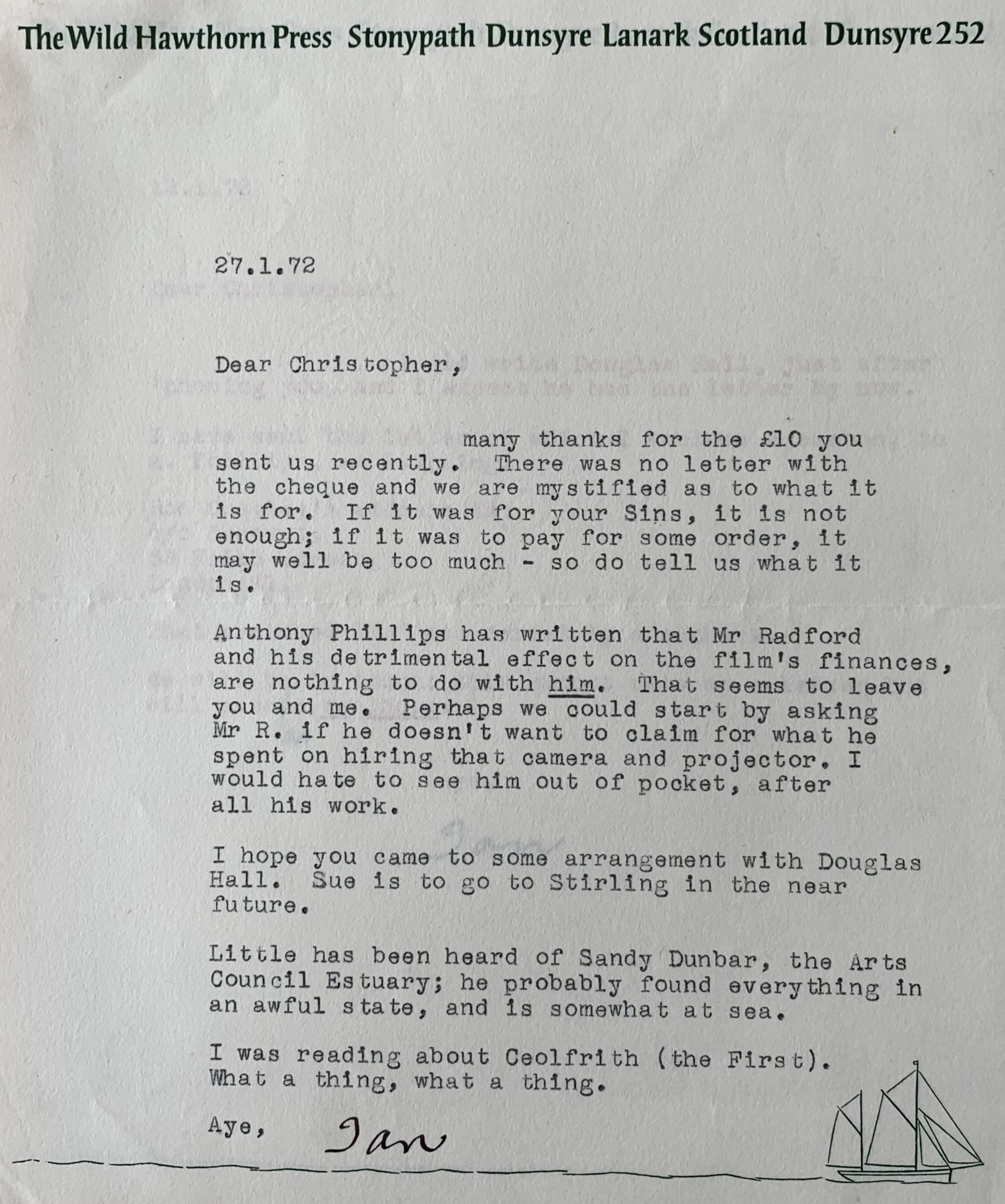
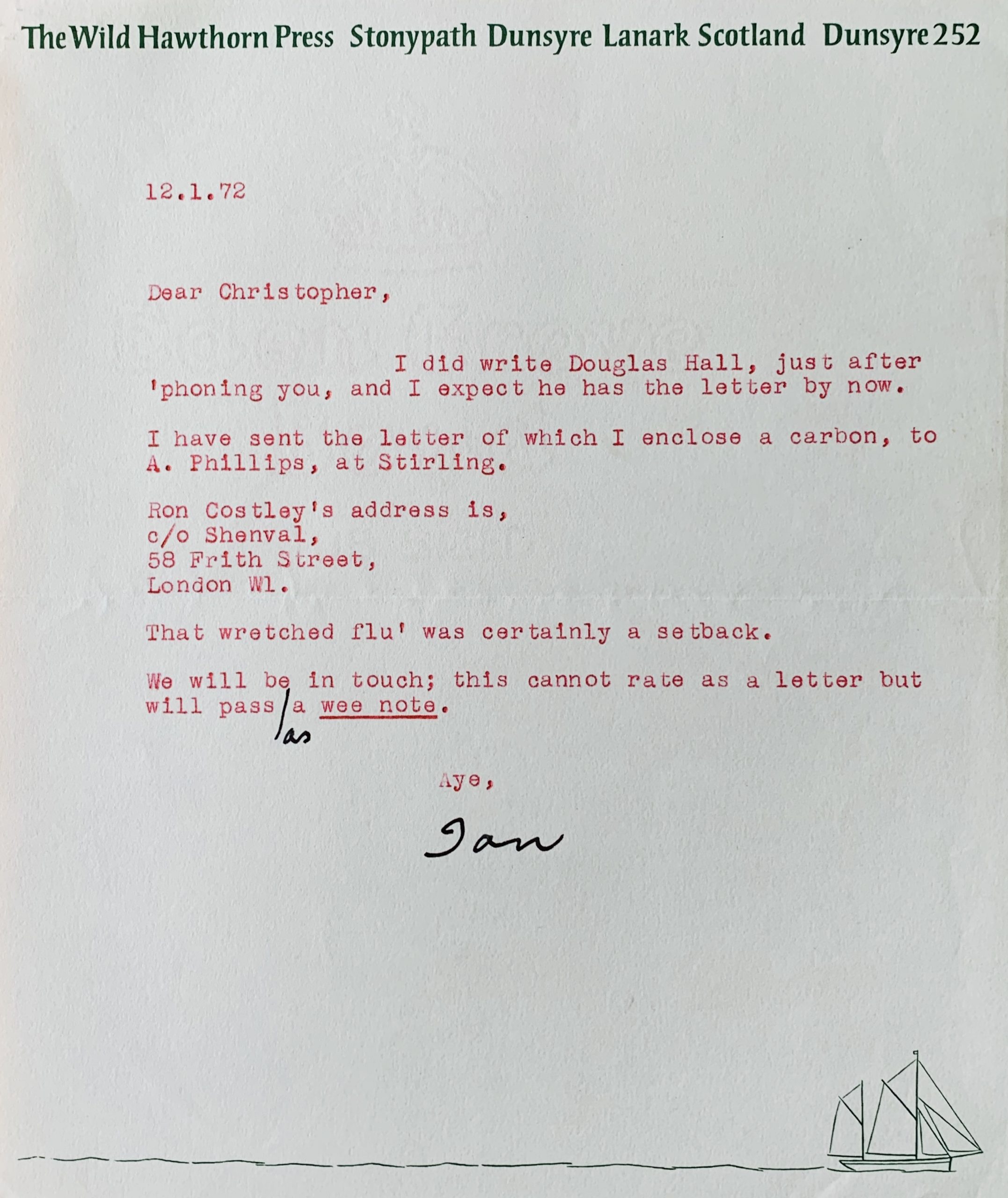
21 x 17.8, 1pp. Original typed letter on green Wild Hawthorn Press stationery to Christopher Carrell continuing the discussion about invoices received from Michael Radford for travel and other expenses during a film-making session at Stoneypath. Finlay says that Anthony Phillips states he has nothing to do with him Finlay amusingly asks Carrell why he sent a£10 cheque - "if it was for your SIns, it is not enough; if it was to pay for some order , it may well be too much...

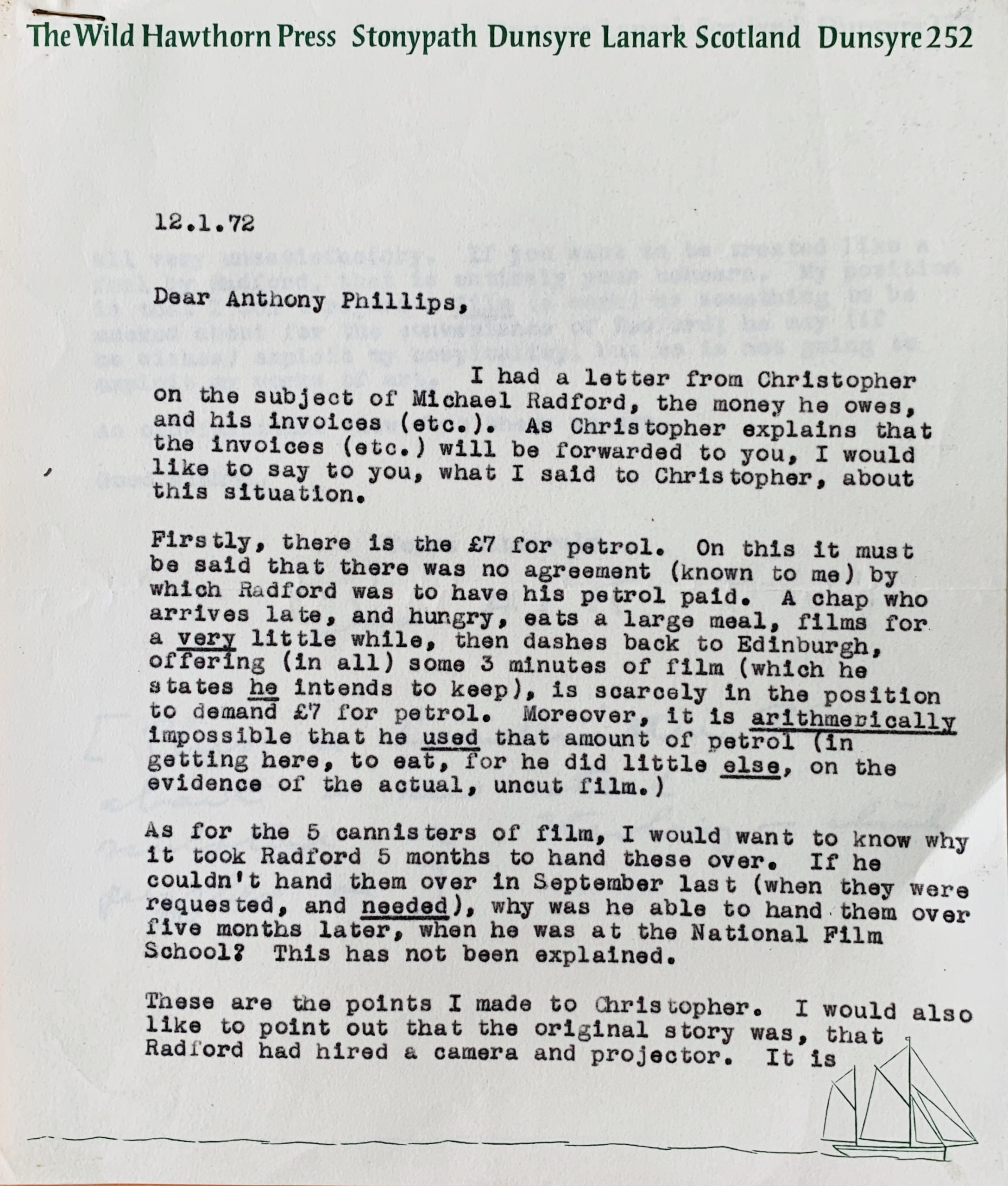
21 x 17.8, 2pp (stapled together). Original typed letter on green Wild Hawthorn Press stationery to Anthony Phillips complaining about invoices received from Michael Radford for travel and other expenses during a film-making session at Stoneypath. Finlay points out that the bill for £7 seems excessive from Edinburgh and that he had fed Radford who then made a very short period of filming before returning home. The signed letter has a PS at the end moaning about some steel sculpture in Stirling . It is not clear if the film was ever completed or released but Finlay clearly felt aggrieved about it all. We do not know Phillips' relationship to this dispute. VG+.

...

Dunsyre: Wild Hawthorn Press, 1972
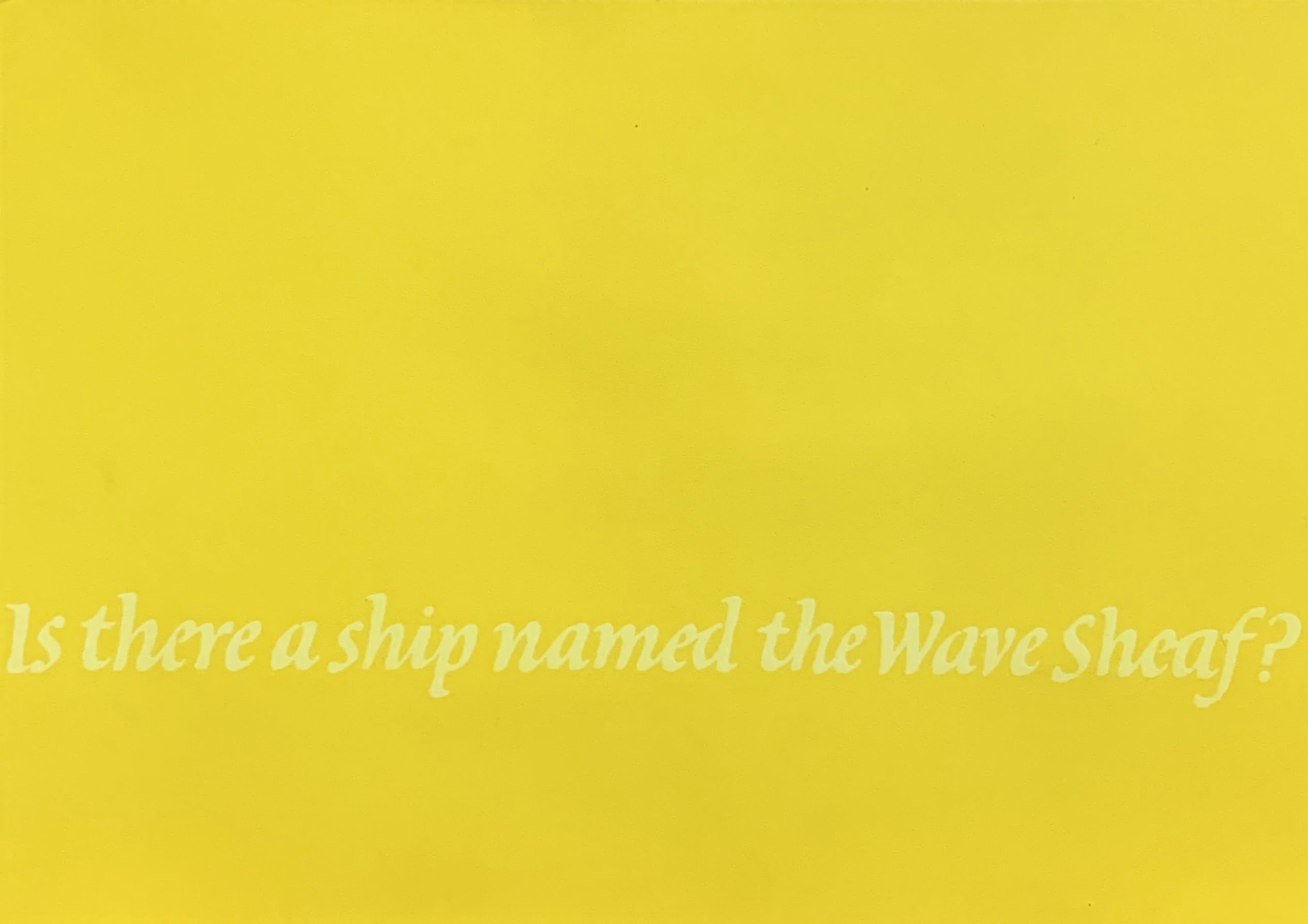
10.5 x 14.9cm, 4pp. Christmas card with typography by Michael Harvey with the title text across the card printed light yellow on yellow. The colour is meant to be reminiscent of wheat - and the boat name "Wave Sheaf" references the way the wind makes the stalks billow as if they are waves. The way the text is placed also implies a voyage across the horizon by a boat and simultaneously the ascenders of the letters might be regarded as masts or the sheaves. Additionally a wave-sheave was a traditional offering given by Jewish priests to their god and preceded the harvesting of the corn.
Leviticus 23:10-14 says "Speak to the children of Israel, and say to them, When you be come into the land which I give to you, and shall reap the harvest thereof, then you shall bring a sheaf of the first fruits of your harvest to the priest: And he shall wave the sheaf before the LORD, to be accepted for you: on the morrow after the sabbath the priest shall wave it."

...

Dunsyre: Wild Hawthorn Press, 1971
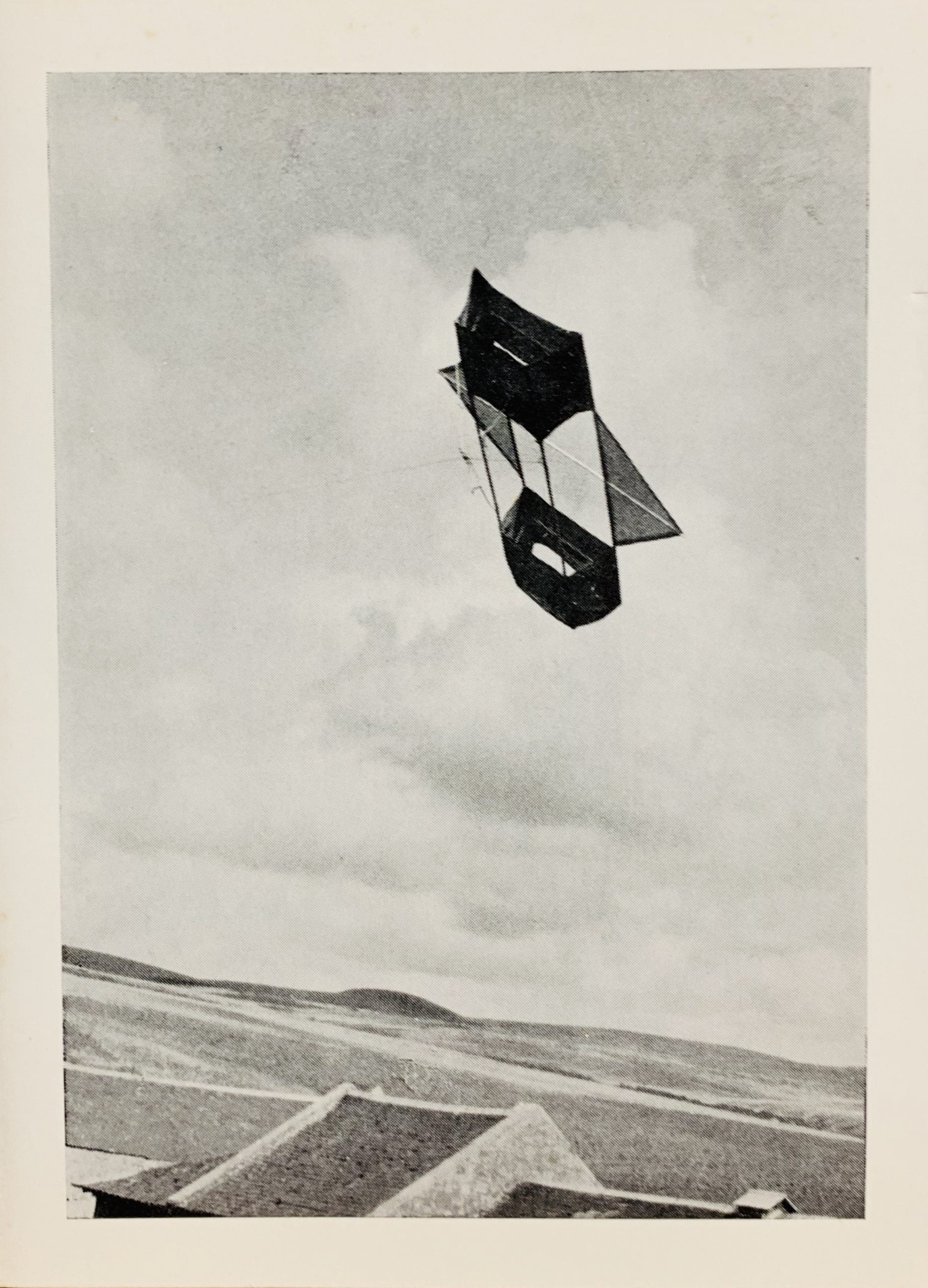
12.5 x 9.1cm, 4pp. Artist's card with a photographic image of a kite on the front. Internally the text reads: "Willing Wings. A Wild Hawthorn kite sets off on a leaflet raid, it's target The Arts Council of Great Britain, or possibly Fulcrum Press. New Year, 1971."
The kite - one of Finlay's handmade toys - is here weaponised. Finlay by 1971 had fallen out with the Arts Council and also the Fulcrum Press (over the production of the fifth edition of The Dancers Inherit the Party" which they had published claiming it was the first edition. This is the first card published by Finlay with an intent of attacking his enemies.

...

Dunsyre: Wild Hawthorn Press, 1971
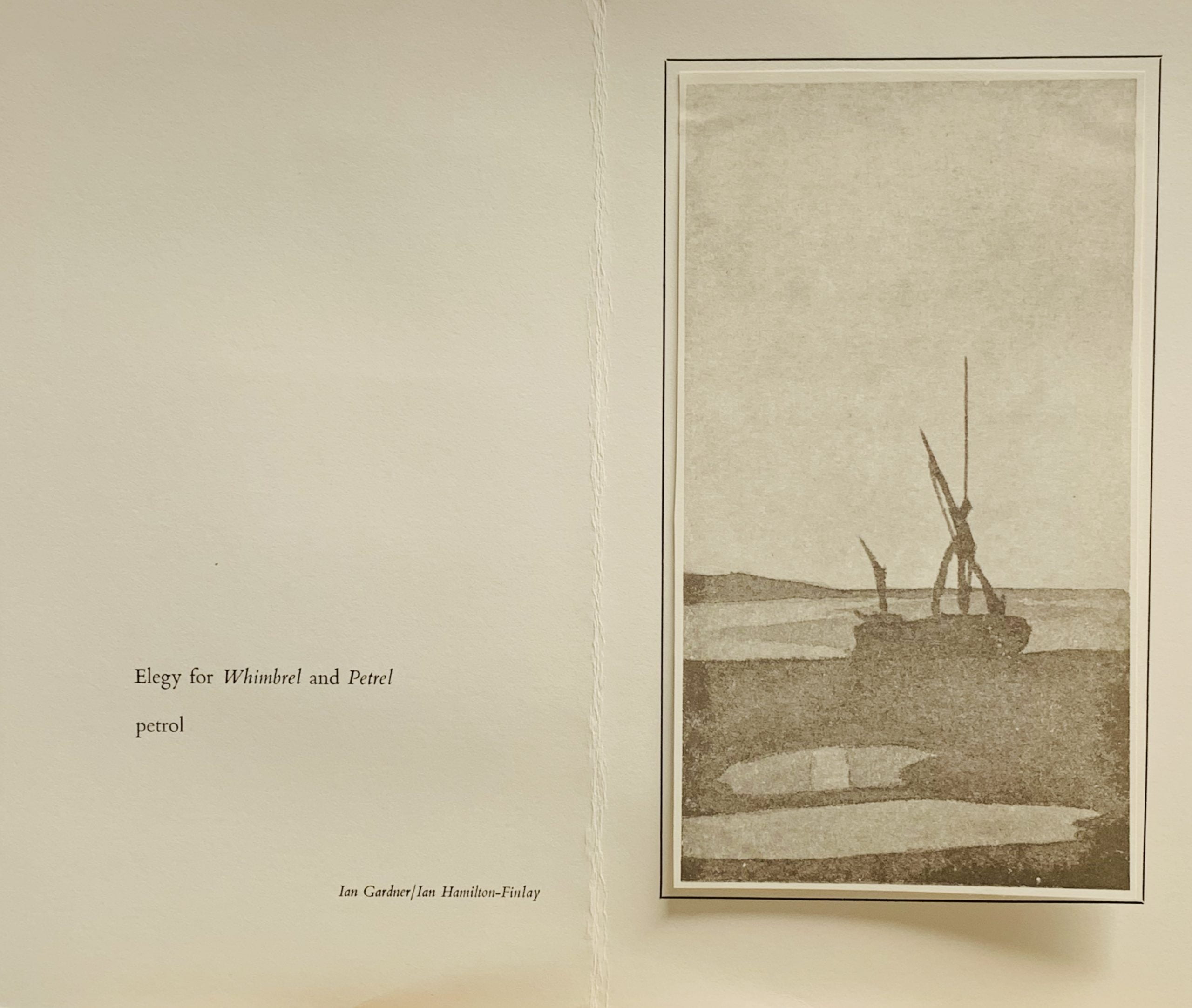
21 x 12.5cm, 4pp. Artist's card with a reproduced painting by Ian Gardner tipped on the card and opposite a text: "Elegy for Whimbrel and Petrel/petrol". A whimbrel is a wading bird and petrel is another sea bird that spends much of its time on the wing rather than on the sand hence between the two animals both sand and sky birds are represented. The elegy - the poem - is a sad consideration of the effects of pollution on seaside bird life. Opposite the boat in the painting is beached and has its sails ripped - hence it appears petrol fuelled boats are replacing the more traditional vessels much to Finlay's dismay. VG+.

...

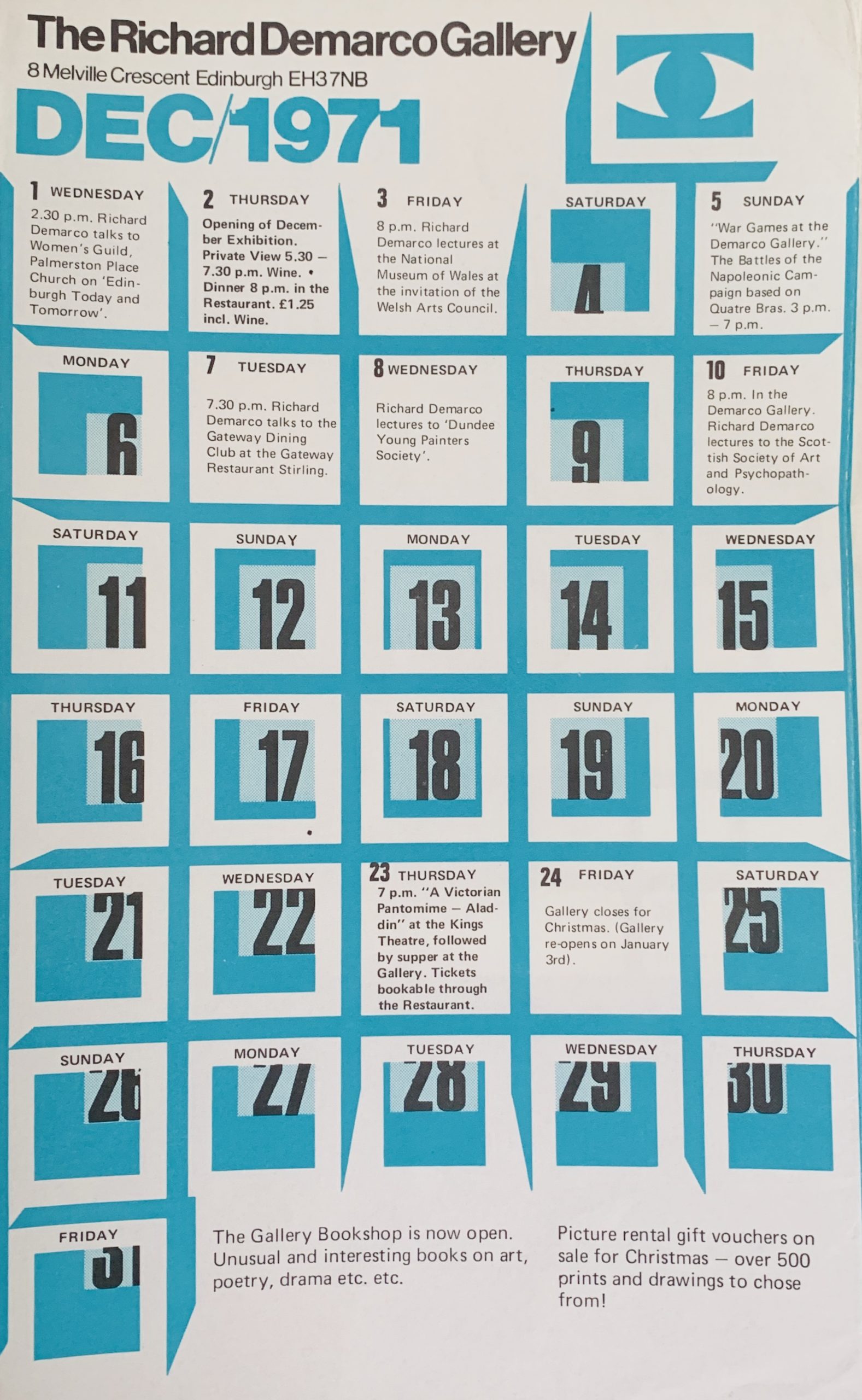
Edinburgh: Richard Demarco Gallery, 1971
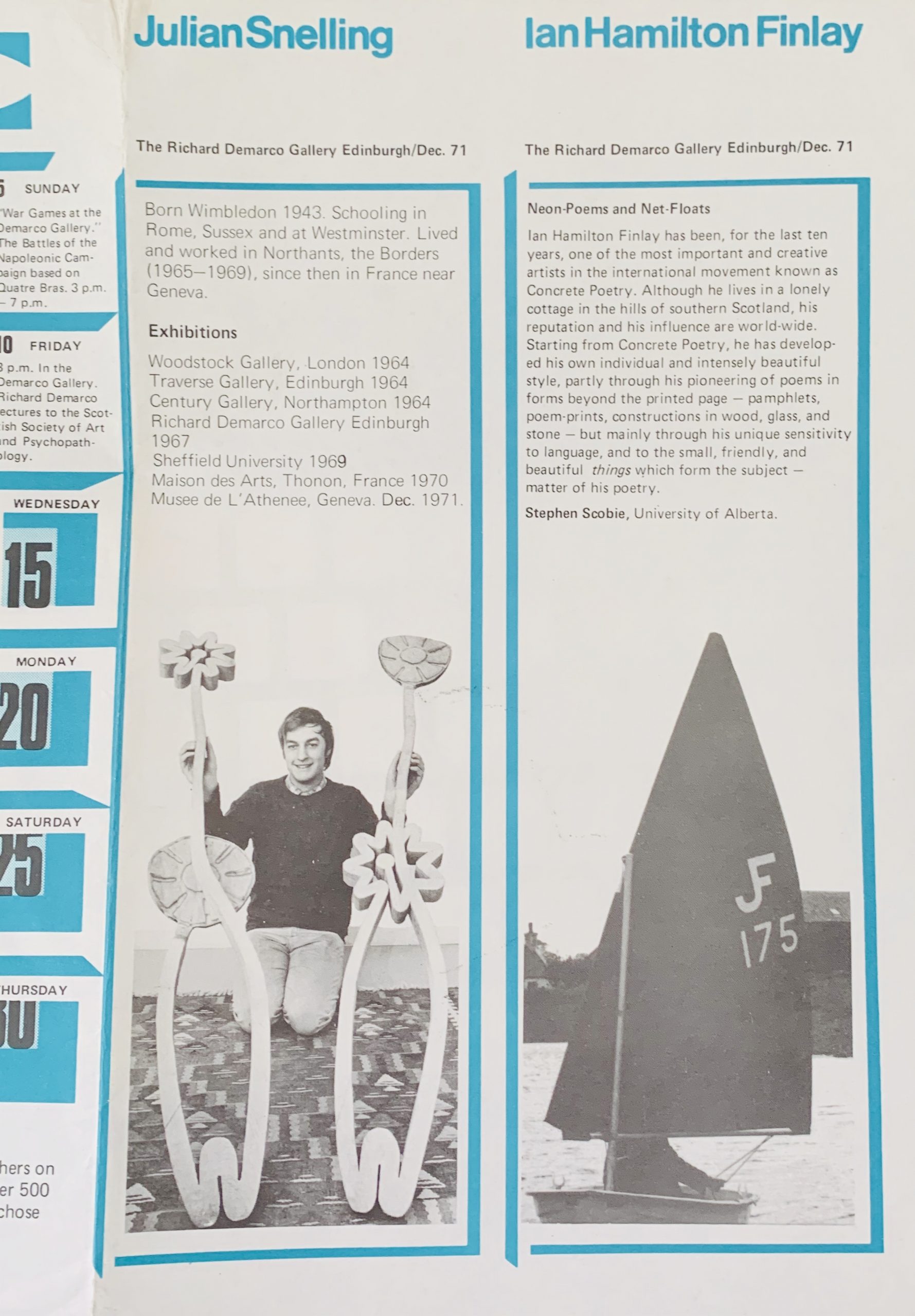
25 x 15cm, 6pp (single sheet printed one side only in turquoise and black). Demarco's monthly programme of events which lists an Ian Hamilton Finlay exhibition of Neon Poems and Net-Floats: the publication doubled as an exhibition catalogue. One b/w image of Finlay (obscured by sails) boating on Lock Echan. VG+ Scarce.

...

Shopping cart0
There are no products in the cart!
Continue shopping