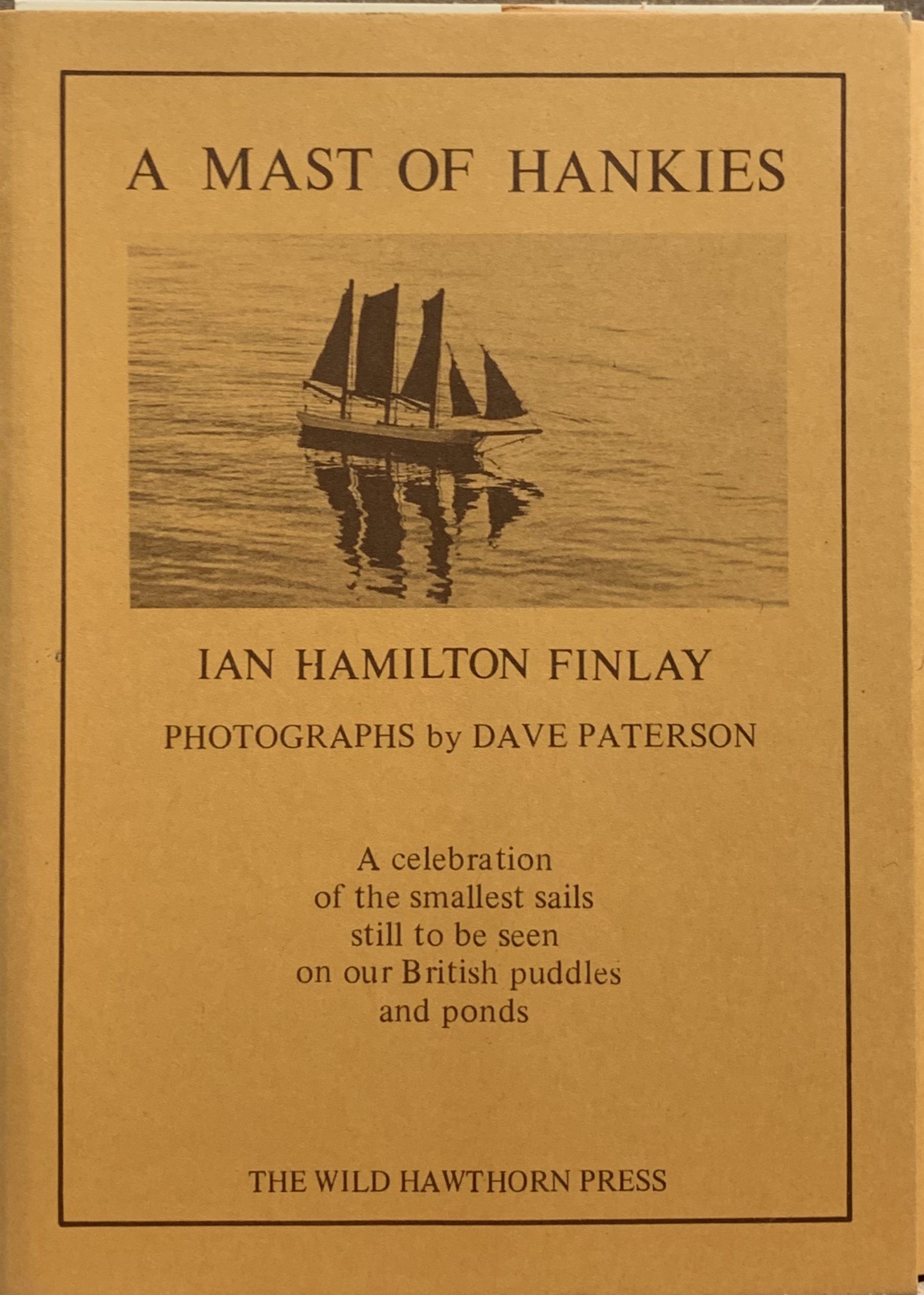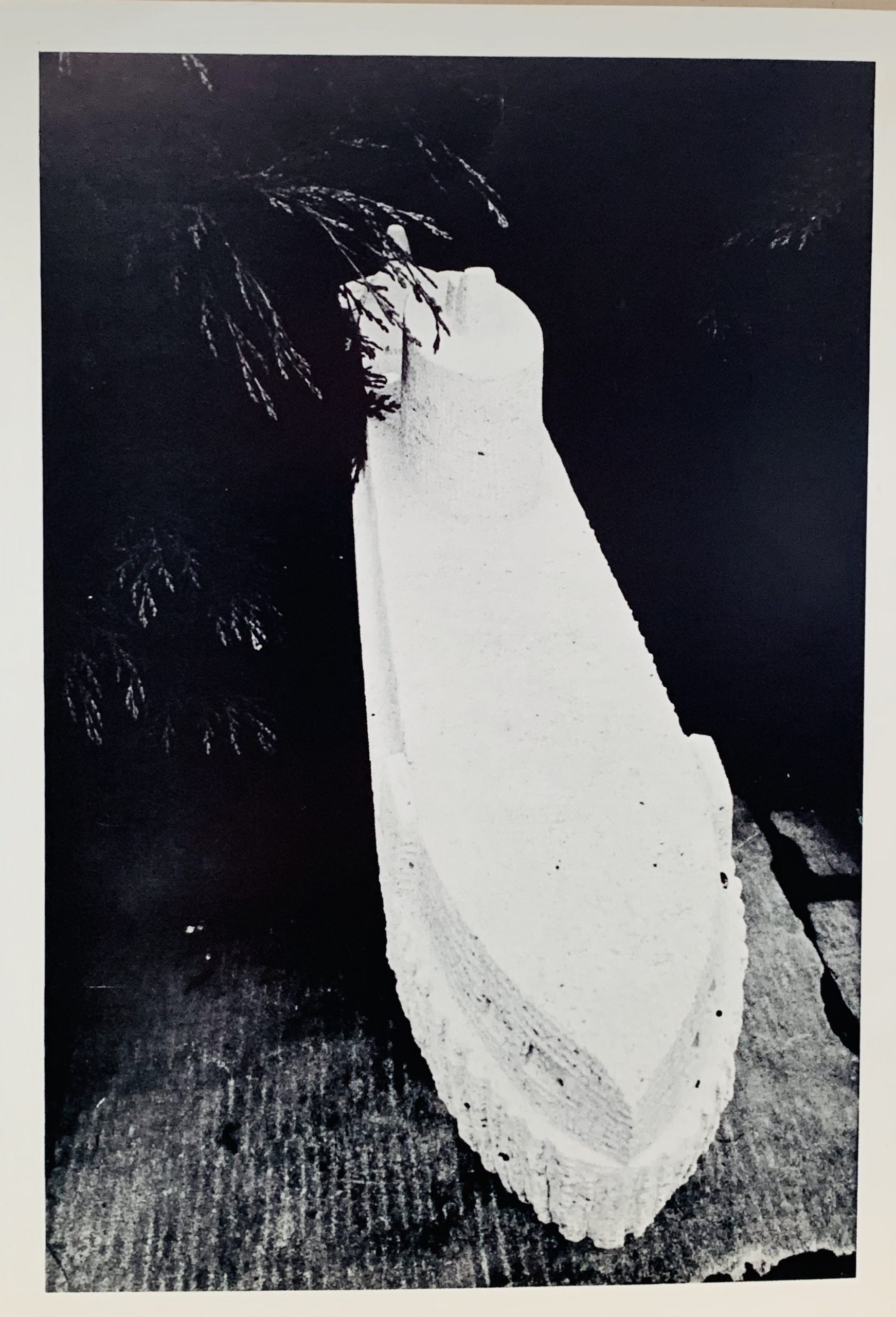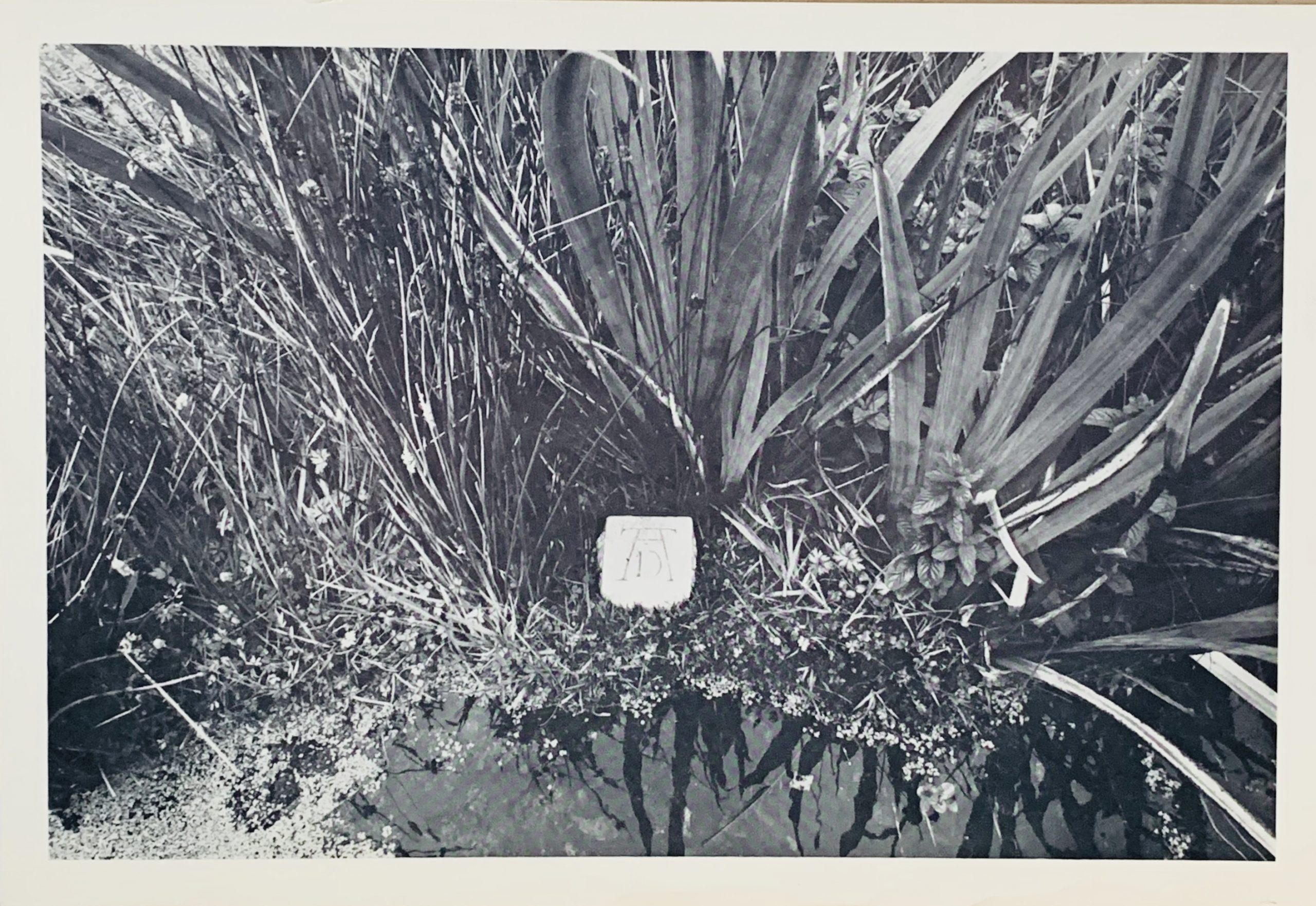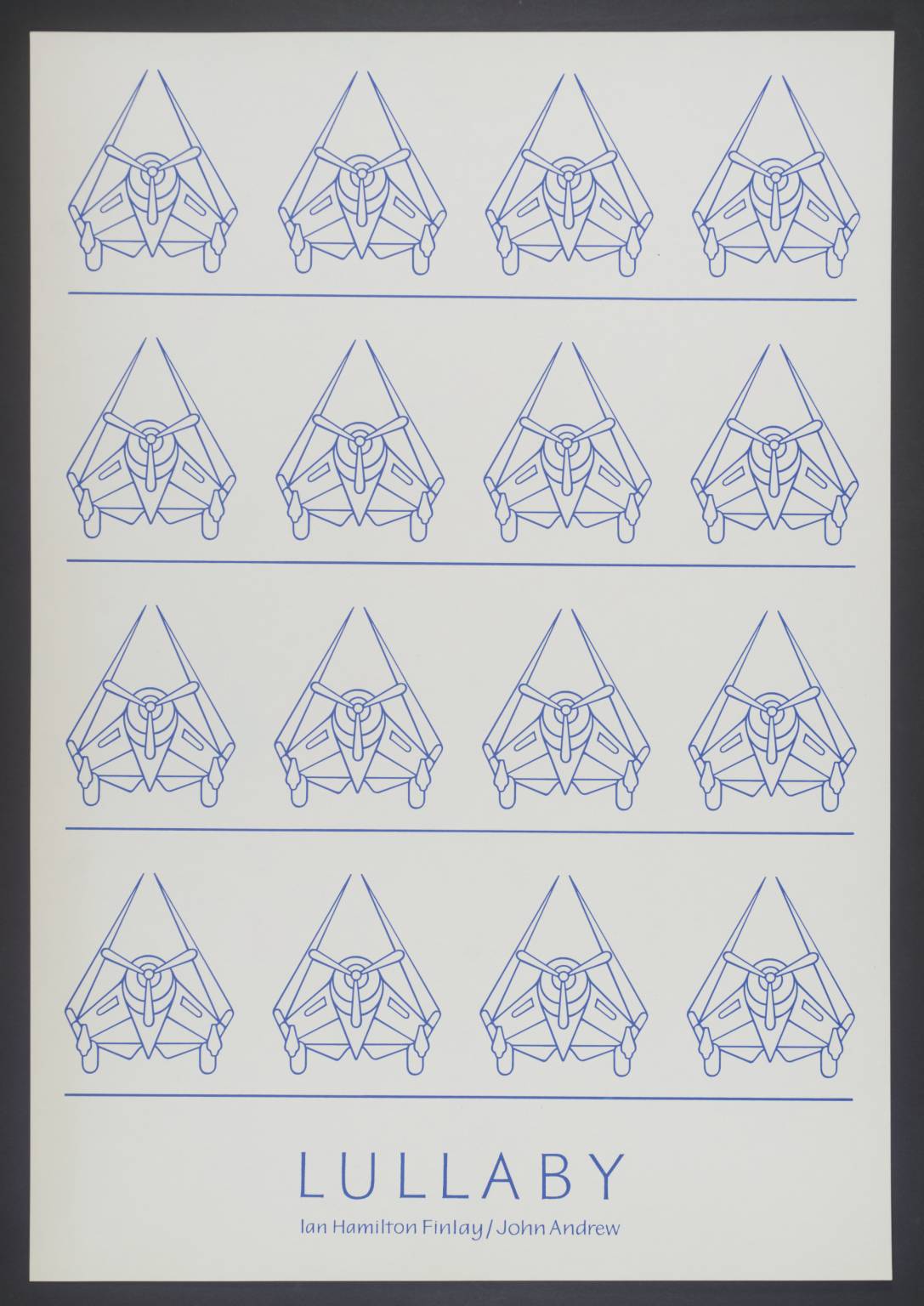
Dunsyre: Wild Hawthorn Press, 1975.
10.5 x 15cm, 2pp. The last of a series of "National Flags" created by Finlay - here the red flag (of war) has three tanks (rampant?) on it. In myth Viking warriors either go to Valhalla (a vast feasting hall overseen by Odin) upon death, or the fields of Fólkvangr hence this fictitious nation is warlike and requires such an angry flag. VG+.

...

Little Sparta: Wild Hawthorn Press, 1975
49.7 x 36cm, olive green and black on white screenprint. The line drawing by Ron Costley is a copy of the outline of the original Bernini sculpture of the gods.
There is a text beneath the image: ‘APOLLO AND DAPHNE/ after Bernini/BIBLIOGRAPHY - Ovid, “Metamorphoses”; Rudolf Wittkower, “The Sculptures of Gian Lorenzo Bernini”; Historical Research Unit, Vol. 6, “Uniforms of the SS”’.
The classical story of the pair is one of desire - Apollo being consumed by lust for Daphne (thanks to Eros messing with his motivation) and Daphne desiring to remain chaste (Again this is down to Eros). When Apollo did manage to catch Daphne (presumably with rape his intent) Daphne's father Peneus turned her into an laurel tree - hence saving her virginity.
The Tate Gallery website claims Finlay explained that "the gods and nature ‘were behaving not unlike the Waffen SS’ (who were the first to use a smock with a leaf camouflage pattern, hence its identification with them). This image, in which Daphne is wearing a camouflage smock which replaces ‘nature’, was used as the poster for the exhibition ‘Ian Hamilton Finlay: Collaborations’ at Kettle's Yard, Cambridge, 1977."
One of 300 such prints issued by the press as a limited printed edition. Fine.

...

Dunsyre: Wild Hawthorn Press, 1975
9.9 x 22.5cm, 4pp Folding card printed only on the inside. Left and right respectively are found:

TEA-KETTLE-DRUM and WATER - LILY - CUP

in a slightly archaic font. The colours of the words alternative black and russet red.
The two groups of three words are able to be combined in any three ways - on the left it can be Tea kettle, Tea drum (a place to store tea) and Kettle drum (a type of drum) on the right Water lily, Water cup and Lily cup (a part of the flower). Additionally the complex words Tea kettle drum and Water Lily cup are in themselves things and have a visual resemblance to each other.
Finally it may be that the mention of the drum recalls the French Revolutionary Army and Bara, the martyred drum boy. The French crown was long associated by the fleur-de-li, a lily. And of course the head of the king (lily cup) was removed when he was legally murdered by the new Republic.
Simple and complex like the best of Finlay and ultimately a "text visual" as opposed to a "visual poem".

...

Zagreb: GalerieSuvremene Umjetnosti, 1975 21 x 20cm, 18pp plus white card covers. Artist's book issued during a show in Croatia where the "4 Saynetes Comiques Interpretees par Christian Boltansi" are reproduced in b/w and a short forward in Croatian. VG+. Very hard to find. ...

Dunsyre: Wild Hawthorn Press, 1975
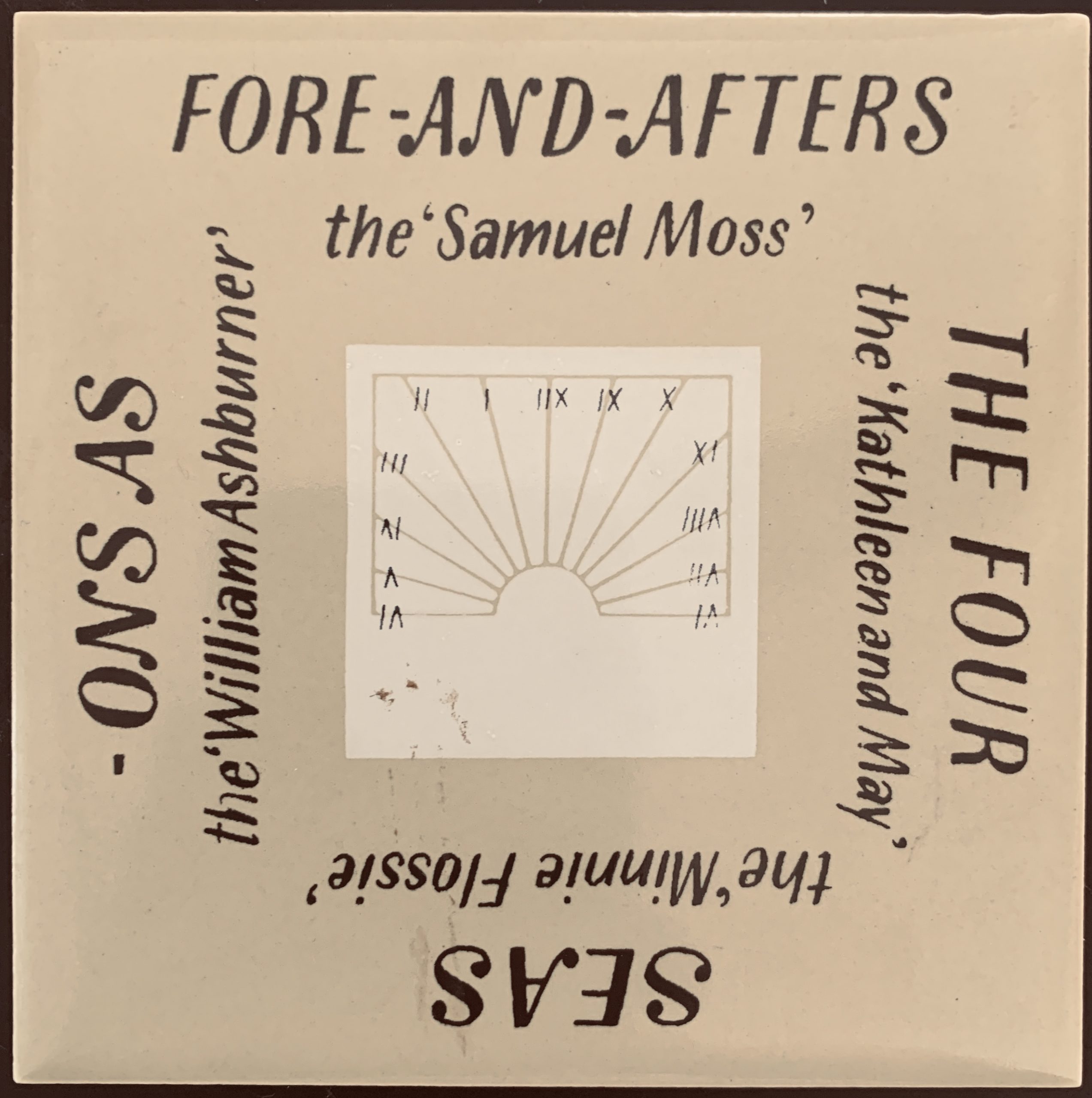
26 x 17cm, 16pp. Original card covers and printed dust jacket. Artist's book comprising 9 b/w drawings by Ron Costley - some are military vehicles or ships with classical allusions by Finlay added (many of which become sculptures and prints). Two show sundials (including Venus of the Hours which is a visual pun on female sexuality) which is another Finlay interest. Finlay often saw parallels between classical stories and modern war machines. Here, for instance, Earth/Air/Fire/Water/Time is a drawing of an aircraft carrier (which Finlay believed was symbolic of the four classical elements) moving across a sylised map which resembles a sun dial - thus bringing in the 5th aspect of reality - Time. One of 350 copies printed - this is an unsigned or numbered copy. Near fine.

...

Little Sparta: Wild Hawthorn Press, 19975
3 x4.5cm, copper and brass plated aluminium medallion with chain. With a design by Ron Costley (which originally was created for the exhibition Heroic Emblems) of a tank above which the title text - a reference to Zeus and his lightning bolts is set. The original quote comes from Heraclitus: "the Thunderbolt that steers the course of all things".
All of the Heroic Emblems showed modern machines (mostly of war) in reference to Classical myths. Originally boxed with leaflet but this example does not have those elements. Edition size not known but very hard to find.

...

Brussels: Musee d'ixèllés, 1975
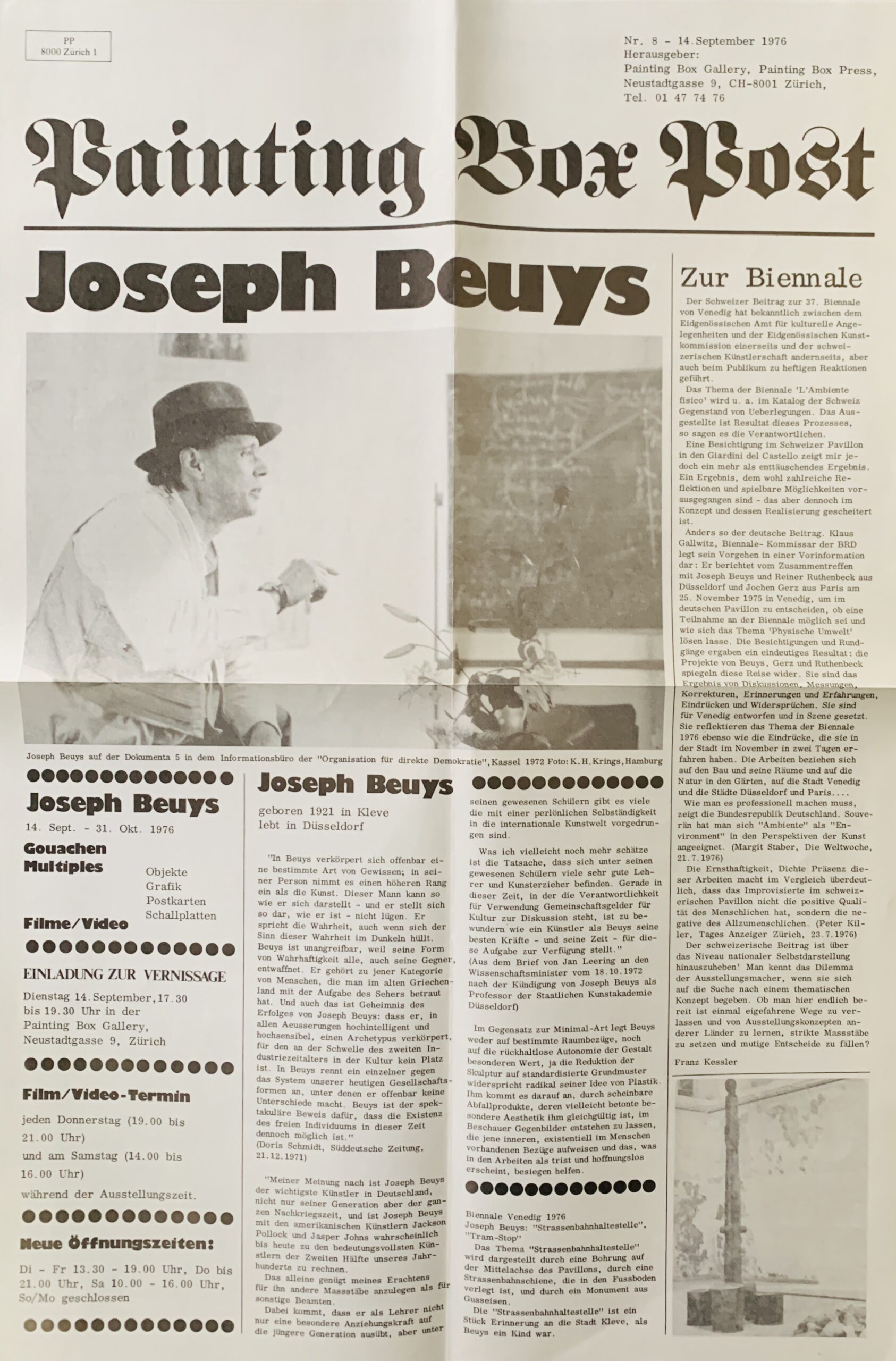
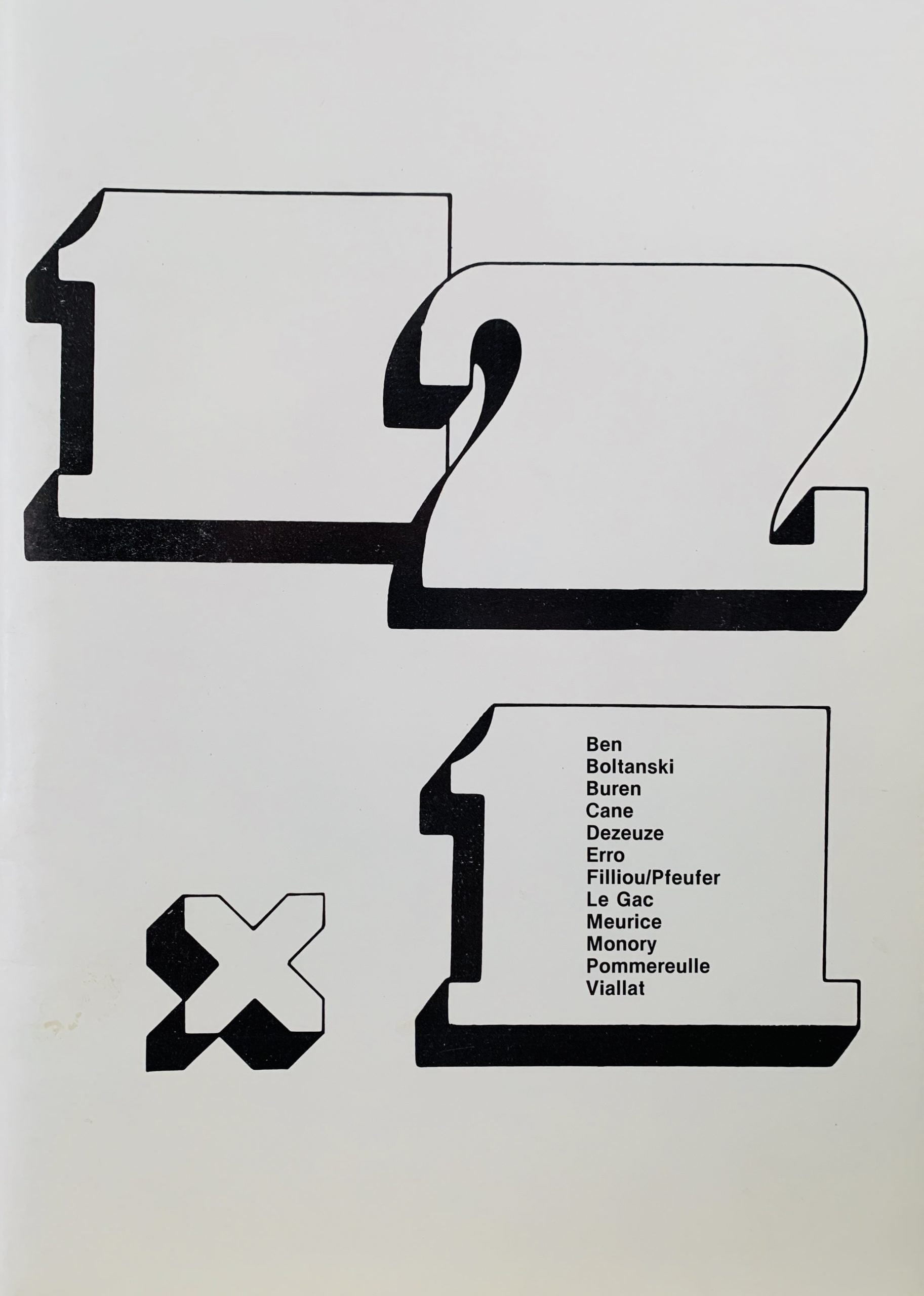
10 x 21cm, 1pp typographic announcement card for a major group exhibition which had contributions by all major European artists including Andre, Artswager, Ben, Beuys, Boltanski, Buren, Byars, Christo, Filliou, Huebler, On Kawara, Kienholtz, Ono, Panamarenko, Spoerri, Tuttle and Weiner amongst others. Harald Szeemann curated the show. This card has been signed by Beuys top right in red ink and stamped with the Haupfstrom impression in blue. VG+.

...

Bruxelles: Pour Magazine, 1975 21 x 30cm, 2pp announcement leaflet for an edition of 28 works in a box issued in support of POUR - a radical political publication which Beuys often raised money for it by various events and editions. This leaflet was unfolded and signed by three of the artists - Beuys (who also has added a Fluxus West rubber stamp impression in blue), Panamarenko and Klaus Staeck. Two of the works found in the box are shown in b/w - Beuys photographs and Christo's wrapped edition of POUR as well as an image of the outside of the box. Really a paper edition as well as announcement this is not found in Schellmann Beuys Multiples although other editions related to POUR are to be found as Nrs 143 and 144....

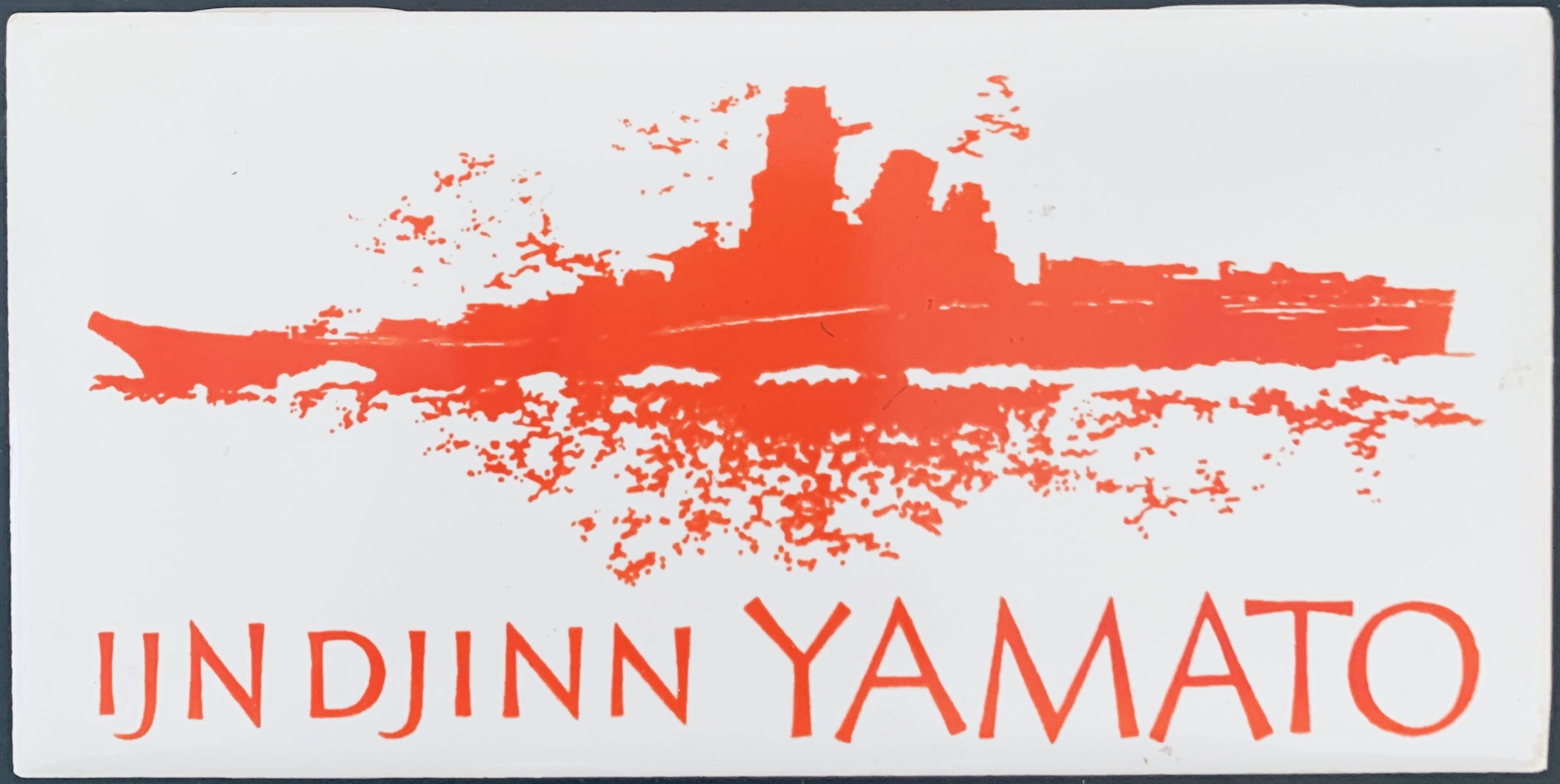
Dunsyre: Little Sparta, 1987 15.3 x 15.3cm, hand-painted yellow on white ceramic tile displaying the title Concrete poem. One of a group of three such tiles each with the name of a boat alongside its official registration number (Buckie in the North East of Scotland). Often shown as part of a triptych consisting of Zephyr, Shepherd Lad and Amaryllis. This is a unique trial proof of the design where Finlay has the colours in red and yellow - he eventually rejected this combination in favour of a single colour for both words. VG+. ...

Little Sparta: Wild Hawthorn Press, n.d. (1975)
15.3 x 15.3cm., blue and green handpainted on white ceramic tile with the the name of a boat SHEPHERD LAD and its registered harbour - Inverness - and number. Often shown as part of a triptych consisting of Zephyr, Shepherd Lad and Amaryllis. One of only 100 made. VG+....

Shopping cart0
There are no products in the cart!
Continue shopping