Paris: Approchest, n.d. (1963)
20.5 x 13cm, 130pp plus original wrappers. A single number of a poetry journal edited by Julian Blaine and Jean-Francois Bory. The editors were aware of the growing changes in experimental poetry and here one finds Pierre Garnier, Jeff Nuttall, John Furnival, de Campos, de Vree, Blaine and Bory alongside Finlay's BROKEN HEART which can be found in Rapel.
The spine and wrappers here are attached but with tears - a bit fragile but a rare early Finlay international contribution and a sign of his growing reputation amongst his peers. Else VG.

...

Dunsyre: Wild Hawthorn Press, 1963
30 x 21cm, Soft cover. First edition. Cream card folder, front panel and flap at rear printed in black, containing only 11 loose sheets printed on one side only: dedication printed in black, 'a peach an apple' printed in blue, a valentine in green, the practice in black, formal poem in three colours, carousel in two colours. Wrappers and contents in fine condition with the exception of a slight tear on the back right fold. Exceptionally rare very early Finlay visual poetry publication.
This was the first wholly conceived "concrete" poetry book by Finlay and contains some of his best known works (which were later reprinted in anthologies and other Finlay publications as well as in different mediums such as unique glass works.

...

Dunsyre: Wild Hawthorn Press, 1963
26.2 x 21.5cm, 1pp blue, green and yellow silkscreen on white card. A concrete poem by Finlay which was created for the Rappel artist's book however a small number of additional sheets in a different size were released - of which this is one. The words 'deer' and 'tree' are placed in different combinations to create small word pictures with the final image the words are conjoined to make "treed" with ree in green. Very scarce. In VG+ condition....

Edinburgh: Wild Hawthorn Press, 1963
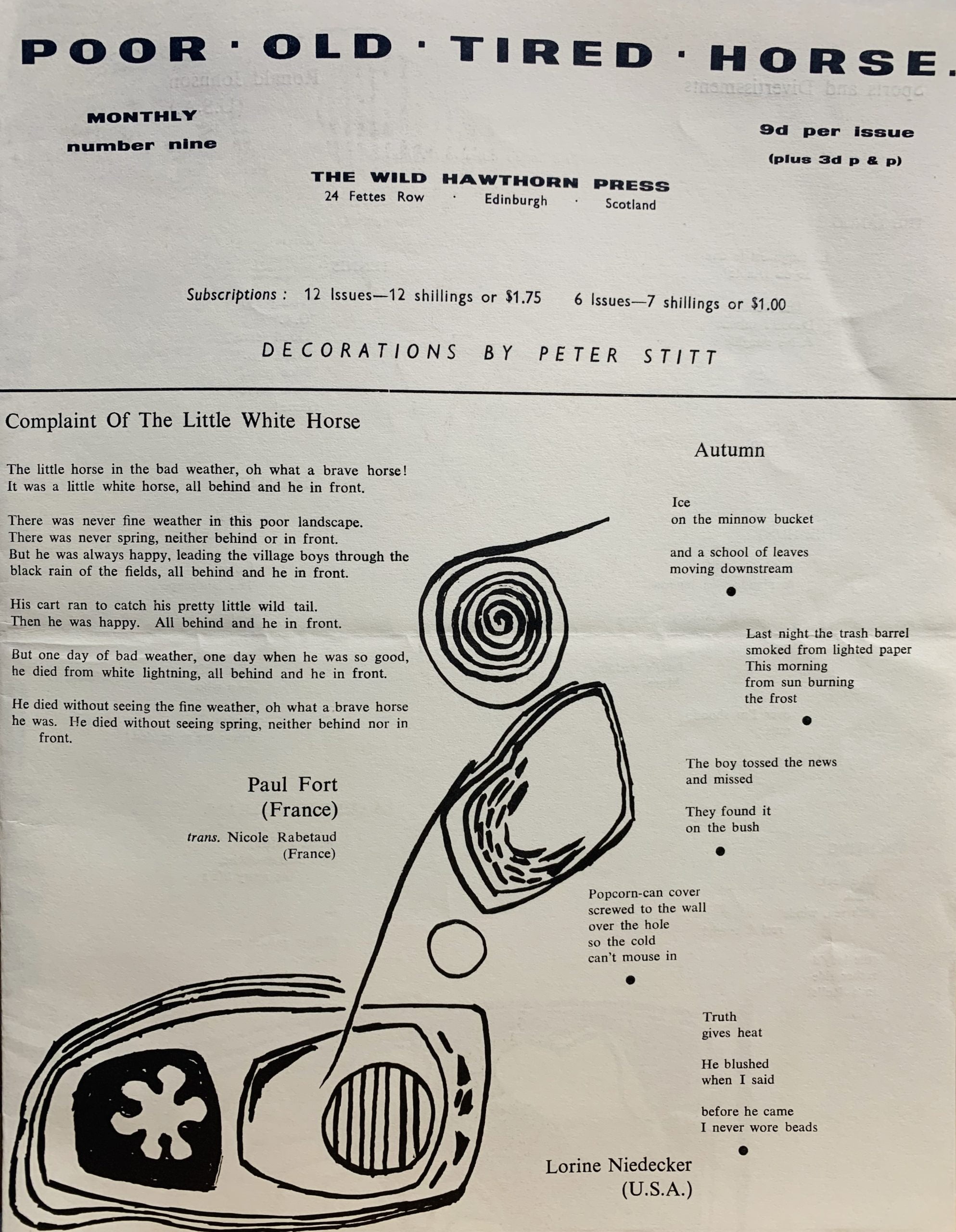
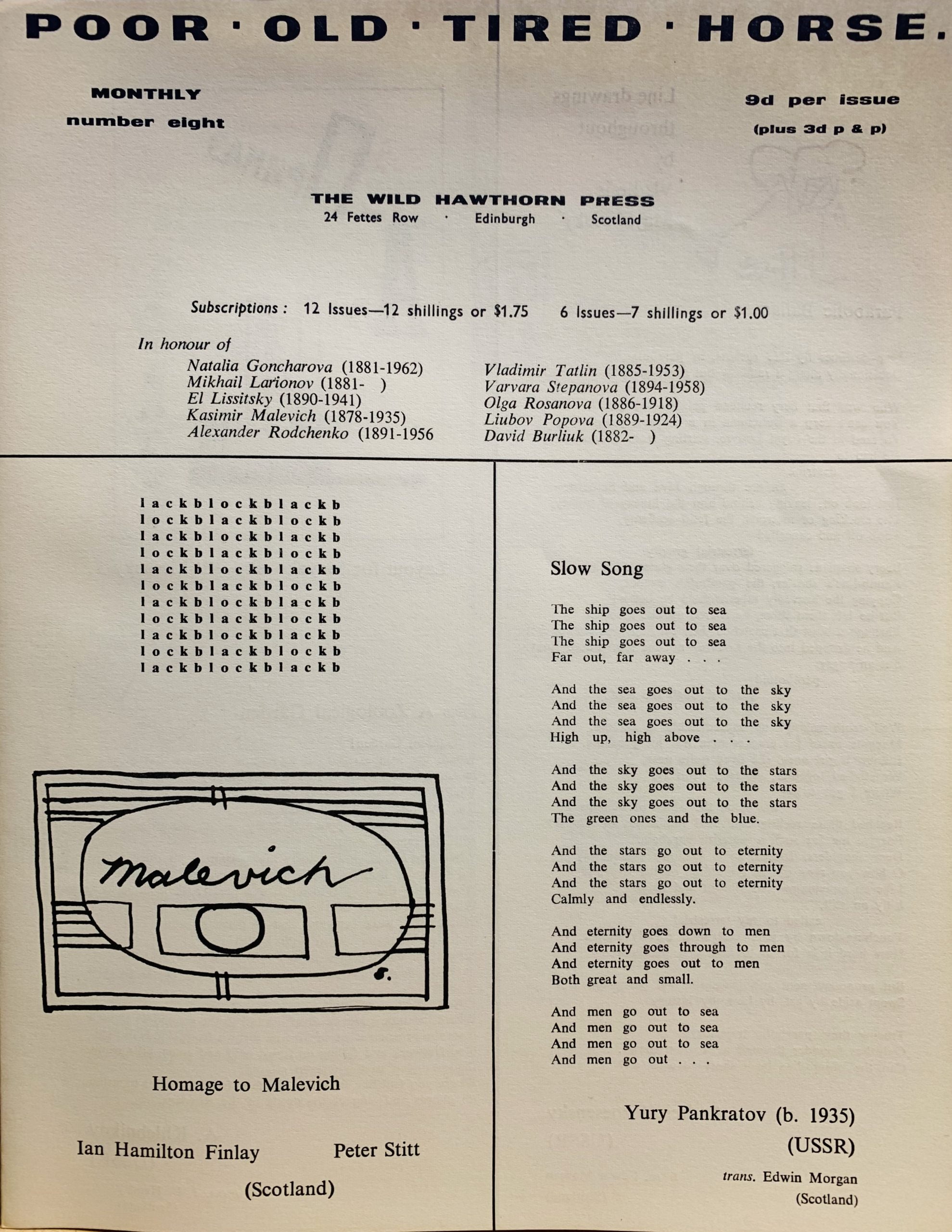
21 x 30cm. single folded sheet printed with texts by six contributors. Unique number of this precursor to Finlay's revue Poor Old Tired Horse. Issued in broadside format, Fish Sheet One is composed of quasi-concrete poetic experiments by Pete Brown, Spike Hawkins, J.F. Hendry, Anselm Hollo, Edwin Morgan and Finlay. Folded as issued. A very good+ example of this early and quite elusive production of the press. Ref.: Murray 1.3.

...

N.p. (Near Edinburgh): n.p. (John Calder), 1963
26.5 x 10cm, 14pp (one page is half size). Mimeographed with similar card cover. The extremely rare first exhibition catalogue that was Finlay's first show alongside the Cobra artist William Gear and Alexander Trocchi and others. Each artist has a page dedicated to them and Hamilton-Finlay's (sic) test is somewhat amusing - including a reworking of his "Notice - please do not feed the boats." and notes Finlay as the inventor of the "Wold (sic) Hawthorne Airship (banned)."
According to wikipedia: " Ledlanet Nights in Kinrosshire, Scotland, was an arts festival that operated from 1962 for around ten years (...

Edinburgh; Wild Hawthorne Press, 1963
20 x 28.5cm, green and mustard printed on light brown card. Very rare folding card (three creases to make an irregular standing rectangle) the very first card sculpture by Finlay.
This example also has the original printed mailing envelope and the instruction leaflet showing how to fold the work.
The evolution of the word PEAR to APPEAR is reversed in the DISAPPEAR to PEAR section of the card. Finlay liked the progression of words and images - the similarity of each step to the previous one added layers of meaning. A fruit - a pear - both becomes visible and invisible in turn. Formed (grown) and consumed even. A very rare item especially with the envelope and the leaflet.

...

N.p.: s.p. (Finlay), 1963
15.5 x 10cm, 4pp (asymmetric fold). Black on yellow card. One of Finlay’s most early of concrete works, this Xmas card has the two texts printed in such a manner that the overlapping front of the card reads LAPPY ISTHMUS FISHES but when opened HAPPY CHRISTMAS WISHES.
The text references the format of newspaper headlines (which Finlay used in several early postcard and bookworks) and suggests the unlikely idea of circulating fish found near a long strip of land which when opened reveals the season's greetings. This card is not found in any catalogue raisonne and is very rare. This example has a handwritten and signed greeting from Finlay.
15.5 x 10cm, 4pp (asymmetric fold). Black on yellow card. One of Finlay’s most early of concrete works, this Xmas card has the two texts printed in such a manner that the overlapping front of the card reads LAPPY ISTHMUS FISHES but when opened HAPPY CHRISTMAS WISHES.

The text references the format of newspaper headlines (which Finlay used in several early postcard and bookworks) and suggests the unlikely idea of circulating fish found near a long strip of land which when opened reveals the season's greetings. This card is not found in any catalogue raisonne and is very rare. This example has a handwritten and signed greeting from Finlay....

N.p. (Gloucester?): n.p., n.d. (c. 1962)
33 x 20cm, b/w offset lithograph. A single sheet with Finlay's ‘Semi-idiotic poem’' printed near the bottom Such "coded" works were invented by Décio Pignatari and Luiz Pinto and categorised as being part of a semiotic or code-poem genre. This poem was printed in Poor. Old. Tired. Horse. Nr 13 but also as part of a John Furnival published portfolio of Finlay's works. This appears to be an early and unused proof copy of the work and any further background is not clear. This example has a significant paper lack bottom right only just missing the image. Any information on this image would be welcome.

...

N.p:. s.p. (Finlay), Christmas 1962
20.3 x 17.4cm, original typescript on typing paper - with an original poem entitled "Look, see" - the first work by Finlay that may well be identified as a visual or concrete poem that we know of. The text- :: "A star ah afar a ww ww wan wan" is similar to other more traditional works by Finlay of the time which used modern day Scots vernacular but the placing of the words one above each other connected by vertical lines (which would have taken some care in construction) give an additional meaning to the text - indicating the act of looking up at a star. The context of being a Xmas gift to Victor Vasarely (the letter is signed to him) gives this work a slight religious overtone.
The letter is hand typed but there was probably more than one made as the "Happy Christmas to" and "from" parts are typed and the name later hand written in by Finlay suggesting others to other friends were made but we have never seen another example of this work. This has been glued at some point in an album (there are paper lacks in the corners of the page where it has been removed and it is somewhat browned but this is an important and quite possibly unique document.

...

Edinburgh: Allan Donaldson, 1962
21 x 14cm, 16pp plus card covers. This was Hugh MacDiarmid's "reply to charges made by Ian Hamilton Finlay and others".
A public dispute had taken place after MacDiarmid said that some poets were not worthy to be included in an anthology of new poems dedicated to Burns - this must have stung Finlay and his circle and a war of words took place following a personal meeting with Jessie McGuffie who MacDiarmid claims told him his work was boring and out of touch with contemporary life.
Because Jessie McGuffie was involved centrally with the Wild Flounder Press (the forerunner in name to the Wild Hawthorn Press) and Poor, Old, Tired Horse (sic) the dispute widened to include Finlay. MacDiarmid claims they accused him of failing to help younger Scottish writers and using his prominence in the field of Scottish letters to exclude others.
The book makes MacDiarmid's case against this (as one might expect) and then attacks Finlay directly - given MacDiarmid was Finlay's best man at his wedding then this is somewhat remarkable. MacDiarmid says that Finlay's published works (at this point mostly Glasgow Beasts a more traditional form of poetry) is 'all "old hat"'. The two poets have by now clearly fallen out badly.
This is one of 50 signed and numbered copies denoted as a "special edition". In a text at the front of the book inside the covers is found:
"HUGH MACDIARMID is undoubtedly great. And alike all great men before him, he has had the unpleasant experience of meeting the unreasonable and artless criticisms of the nonentities who surround art."
JOINT WITH
A letter dated 31 - 7 - 62 from a rare bookseller to one of his clients enclosing the book and inviting his client to a party for the publication of MacDiarmid's A Festschrift.
Both are VG+ and this is a major rarity with insight into the reaction of a literary bun-fight between poets.

...

Kyoto: Cid Corman, 1962
21 x 15cm, 64pp plus typographic wrappers. This single number from the second series of Cid Corman's important little magazine, features 21 pages of poems by Finlay with additional material from Robert Creeley, Thomas McNicholas, Lorine Niedecker, Louise Zukofsky, Michael McClure, and others. Finlay's letter to Corman is reproduced as a de facto foreword. twenty poems mostly traditional but one "The Pond of OO Farm (Rousay)" could be regarded as one of the artist's very earliest concrete poems and as a result makes this an important book. Most have annotations in print by Finlay.
This is a very scarce publication - only 300 copies were published. Slight sunning along spine else VG+.

...

Edinburgh: New Saltire, 1962 21.5 x 14cm, 88pp plus wrappers. A single number of this literary journal which has contributions by Iain Chrichton Smith, Alex Neish and Joan Ure but importantly a very early Ian Hamilton Finlay essay in the form of a review of The Scots Literary Tradition by John Speirs. Finlay is very critical of the book claiming that the author denies the role of Scotland in the wider world and denies any "Scottish Literature" in contemporary writing. Finlay is perhaps not at his best here but it gives a flavour of how antagonistic he could be to peers. VG+. ...

Shopping cart0
There are no products in the cart!
Continue shopping