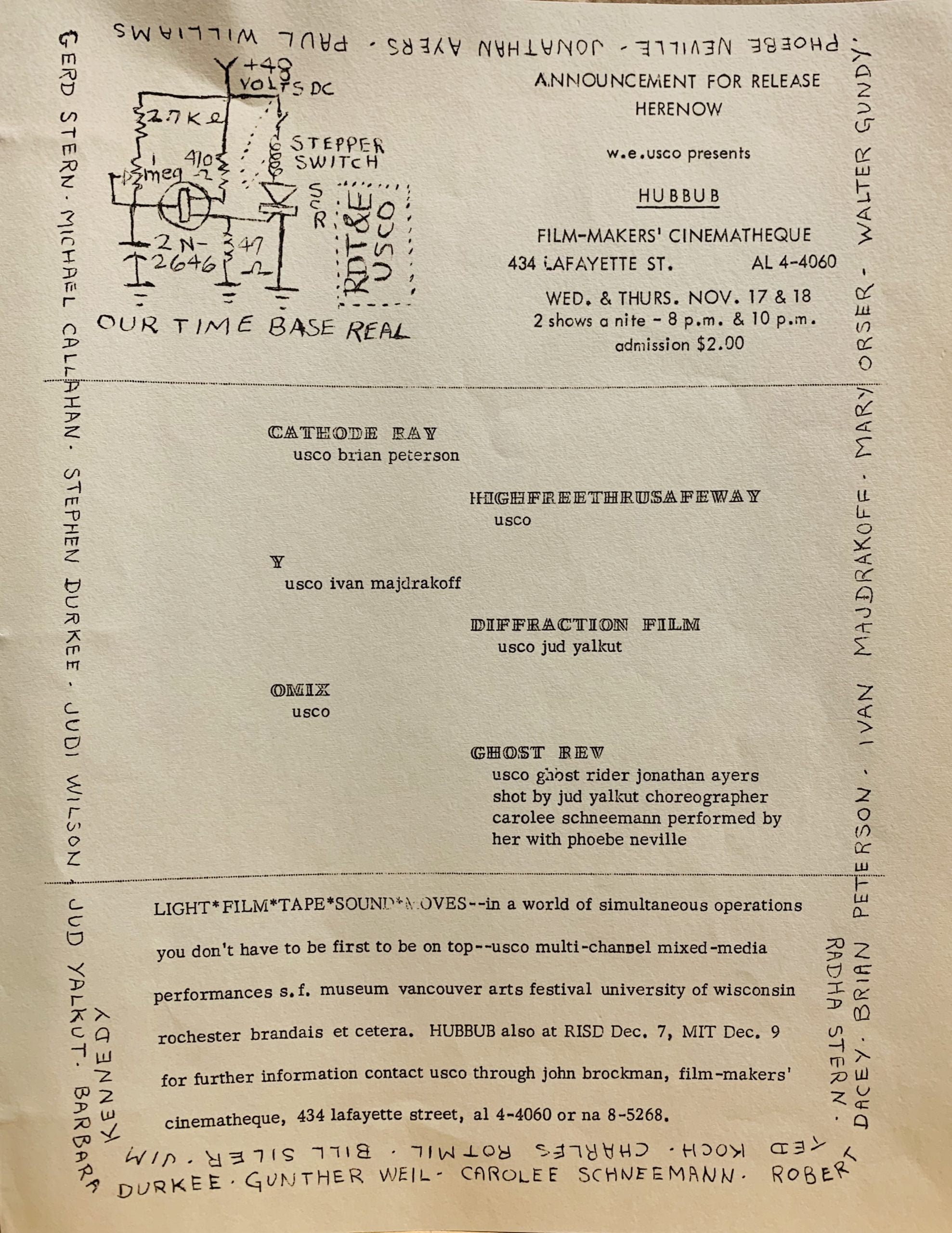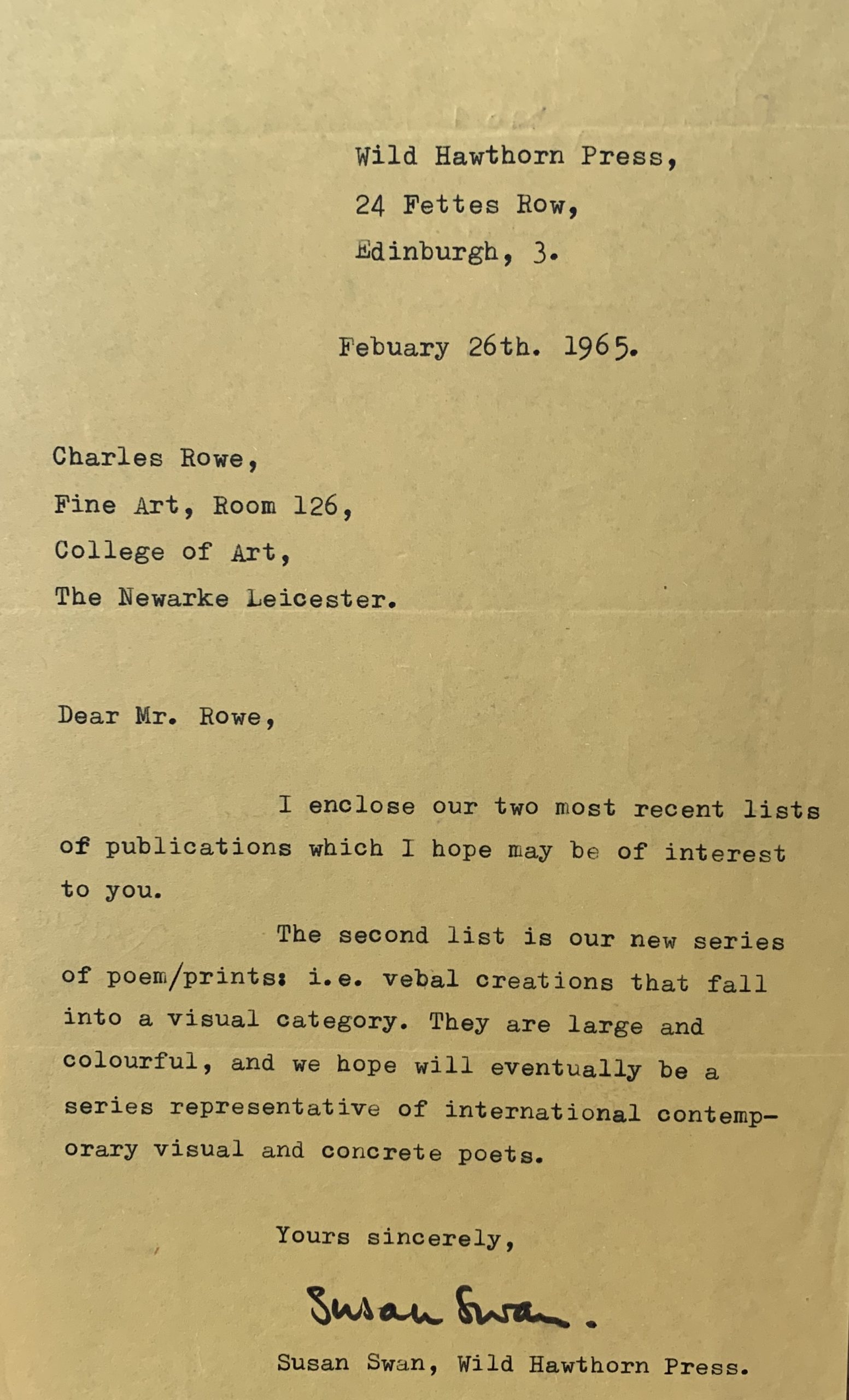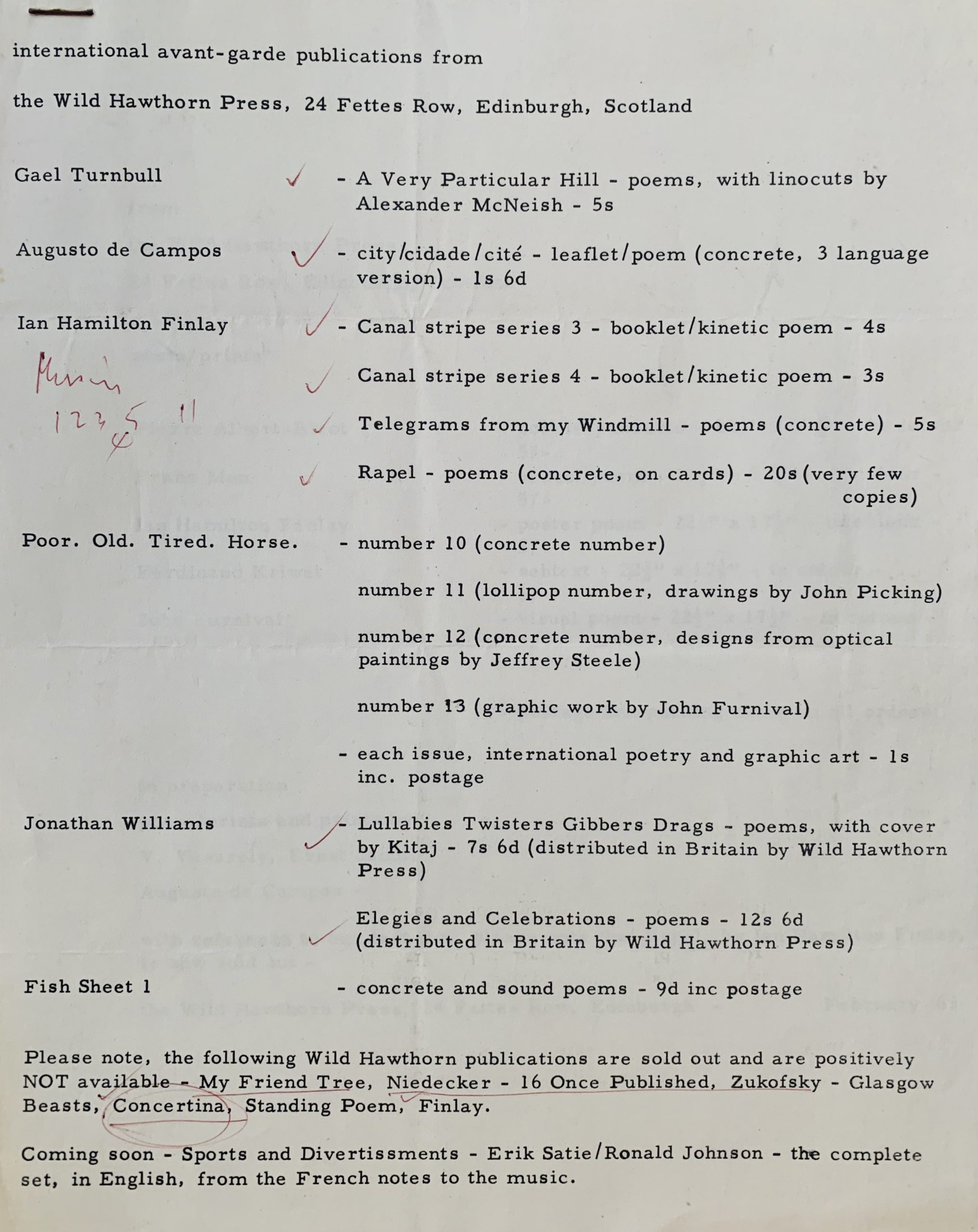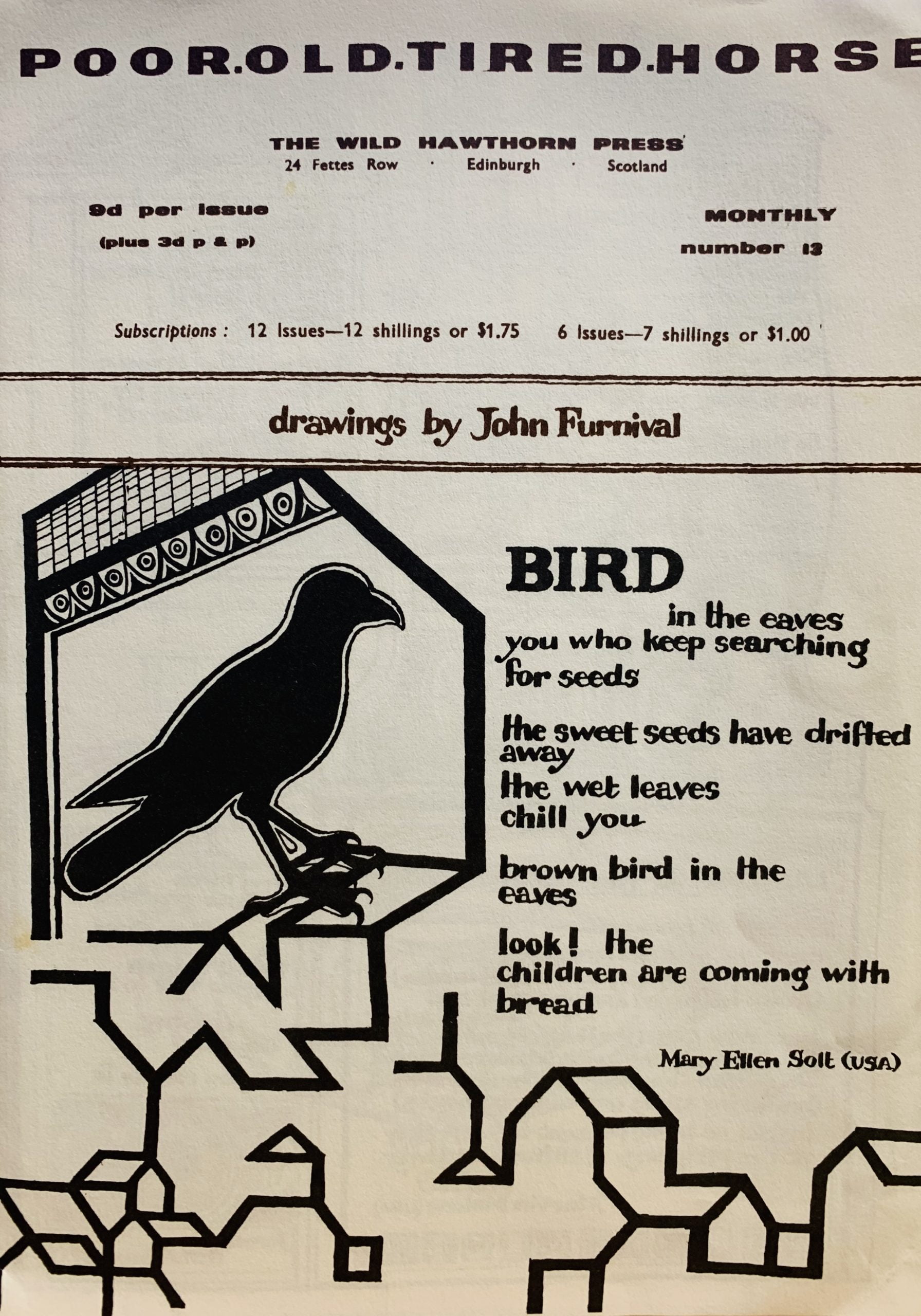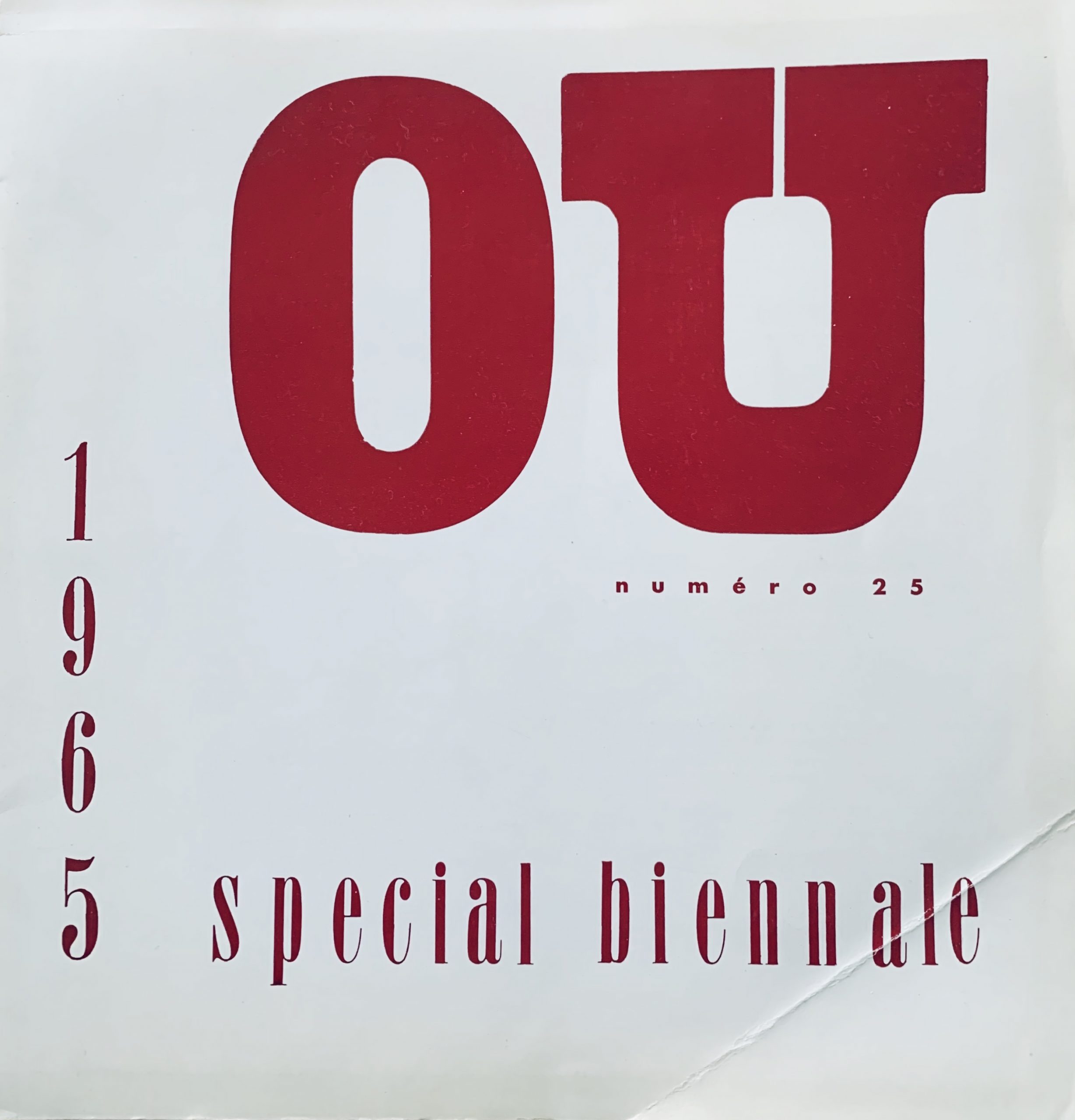
Garnerville: USCO, n.d. (c. 1964) 22 x 26cm, blue/w publicity leaflet with a full sheet image of a guru that Yalkut followed and the title text around him the co-operative art group USCO - USCO founded by Gerd Stern, Michael Callahan, and Steve Durkee in New York. USCO, an acronym for Us Company or the Company of Us. A very scarce item....

Dunsyre: Wild Hawthorn Press, 1964
55 x 43cm, blue and light blue on white silkscreen. This visual poem by Furnival is an image of the Great Bear (Ursa Major) made up of the words BEAR, OURS, NU. Much like in the night sky the shape points to the POLE Star but here it is designated POLAR - hence creating a polar bear.
This was the tenth ever print created by the Wild Hawthorn Press and is very rare.
There are pin pricks in the corners of the print where it has been placed on a wall (possibly during poetry readings and then recovered as Finlay often did in the early years. Murray 1.10.
BR>...

Dunsyre: Wild Hawthorn Press, 1964
55 x 43cm, red and black silkscreen. Concrete poem typical of Kriwet's style of overlapping text to make larger patterned images. One of 300 such prints made. This was the ninth publication of the press (if one does not take in account the early POTHs). VG condition. Murray has this as 1.9.

...

Dunsyre: Wild Hawthorn Press, 1964
43 x 55cm, green and blue silkscreen. Concrete poem published by Finlay's Press from the turn of the century experimental poet. Paradis is a sign post of sorts placing an idyllic, mythical place 1.5 km between "here" and "there". This was the eighth publication of the press. Albert-Birot died only 3 years after this publication. VG condition.

...

London: The Builder, n.d. (1964)
17.5 x 21cm, 52pp. Oversize printed orange wrappers. A single number of this remarkably on point small journal which has here essays on dsh, John Furnival, Henri Chopin, David Hockney (all with illustrations) and Ian Hamilton Finlay who has contributed two works in b/w and there is an uncredited portrait drawing of the poet. One article of note is dsh's translation of Garnier's 'Spacialist Manifesto' which Chopin responds to.
Sadly the inner text block has come away from the wrappers but this is a rare and very early item.

...

Dunsyre: Wild Hawthorn Press, 1964
58 x 43cm, orange and blue silkscreen. Concrete poem - one of the earliest publications of the press. The print is a number of letters N, O and T placed in such a way that different combinations create small words. NON, NOT, TOT - which have negative overtones in English and German. The larger shape of all the letters looks like an X - another negation.
Bayer was an Austrian writer and poet who was a member of the Wiener Gruppe. Franz Mon was also an experimental poet and like Bayer was also influenced by Dada.
Very good condition - this was the seventh publication (ignoring the POTHs) released by Finlay's press. VG condition.

...

N.p.: n.p., n.d. (1964?) Two stapled sheets - one 20.5 x 20.5cm, the other 25 x 20.5cm both black on yellow. An untitled broadside. The first has a work by dsh - Sonic Water - and the other works by ee cummings, Edwin Morgan, dsh, Ernst Jandl, Eugen Gomringer and Summer Vocabulary lesson by Finlay. The latter is a very early experimental poem:

1. Is the tea infished?
2. It is infished.
3. Suffishiently?
4. Suffishiently.
___________________
1. is it pouring? 2. It is pouring.
3. the rain is pouring.
4. May I pour?

The poem in two parts firstly discusses the tea pot and whether it was full but with a punny reference to fish, the second compares the pouring of the tea to rain.

...

Edinburgh: Wild Hawthorn Press, 1964
12 x 18.7cm, 36pp. Original wrappers and cream dustjacket with a design based on an old fashioned post office telegram. An artist's book of concrete poems (printed red on white) which are facsimile of typewriter designs by Finlay. One is reminded of Guillaume Apollinaire's calligrammes where Finlay has used the shape of the typed words to give additional meaning.

...

Dunsyre: Wild Hawthorn Press, 1964
58 x 46cm, two colour silkscreen on thin paper. The word FLEECE is surrounded by words made up of the last four letters of the word but transposed into new combinations (ECCE/CEEC/ECEC/CECE) much like a covering (a fleece). The colour patterns also create a cross in the middle of the paper - hence along with ECCE (trans. BEHOLD), and the metaphor of sheep which is often used by christians this gives this work a strong religious flavour. The design was by Alister Cant on Bann's instruction. Very good condition. Murray has this as 1.6.

...

Edinburgh: Wild Hawthorn Press, 1964
17.5 x 28cm, 16pp. Original wrappers and yellow typographic dustjacket. The second of a number of artist's books using the "Canal Stripe" title - the text internally is printed near the bottom of each page. The text reads "little fields/long horizons" and "little fields long for horizons" and "horizons long for little fields". The movement of the word order changes the meaning of each phrase in turn - the first is a statement of a landscape, the second suggests that there is an emotional desire by the little fields to have horizons (presumably they are too small to be able to create a horizon) and finally the joke "horizons long (all horizons are long after all) for small fields" indicates the geographical relationship between these elements of the world. This is again a favourite Finlay method - word order altering the world view around the viewer. This was the first time this was published in a printed item.

...

Shopping cart0
There are no products in the cart!
Continue shopping